By Chioma Obinna
As the world marks this year’s World Health Day, the Lagos State government on Tuesday rallied policymakers, scientists, and development partners around a central question: Can science-driven policies fix Nigeria’s fragile health system?
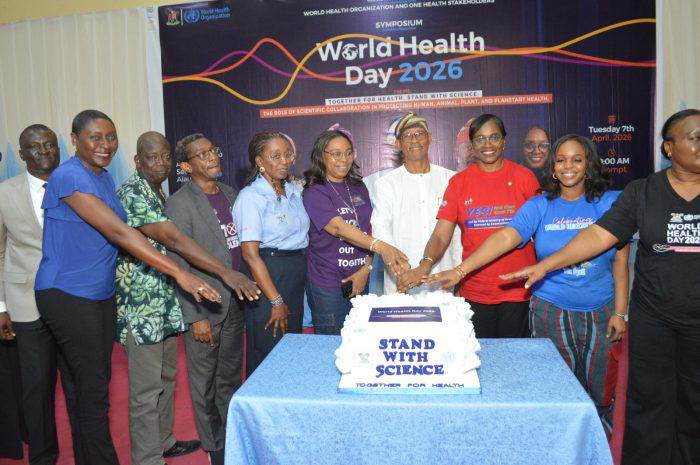
At a high-level World Health Day 2026 symposium held at Adeyemi Bero Auditorium, Alausa-Ikeja, the answer from stakeholders was a resounding yes but only if data, collaboration, and sustained investment replace guesswork, fragmentation, and weak policy execution.
Speaking at the event themed “Together for Health. Stand with Science,” the State Commissioner for Health, Prof. Akin Abayomi, said Lagos is deliberately abandoning assumption-based healthcare for an evidence-driven model powered by research, surveillance, and real-time data.
According to him, the state is building “a proactive, predictive and resilient system” capable of responding to emerging threats.
“We are intentionally shifting towards evidence-driven governance where policies are informed by science, data, and innovation,” Abayomi said.
He pointed to malaria management as a clear example of how science is reshaping outcomes, revealing that widespread misdiagnosis had long distorted treatment across the system.
“Malaria positivity in public facilities has dropped from about 60 percent to five percent. This clearly shows that most fevers are not malaria,” he said, noting that rapid diagnostic testing is now redefining treatment protocols and reducing unnecessary medication.
The development underscores a deeper systemic issue in Nigeria’s healthcare space, the cost of treating assumptions rather than confirmed diagnoses.
Beyond diagnostics, Abayomi disclosed that Lagos is scaling up digital health platforms, upgrading data systems, and investing in research capacity to strengthen decision-making and patient care.
He added that the state is committing nearly 15 percent of its budget to health in line with the Abuja Declaration, while expanding infrastructure, including specialist hospitals, modern primary healthcare centres and climate-smart facilities.
Among key projects are the Massey Children’s Hospital, a new General Hospital in Ojo, and a 1,000-bed Mental Health Institute, investments aimed at reducing medical tourism and improving local capacity.
In her opening remarks, the Special Adviser to the Governor on Health, Dr. Kemi Ogunyemi, stressed that Nigeria’s health challenges are interconnected and cannot be addressed in silos.
“Malaria, HIV, and malnutrition require coordinated responses and stronger policy advocacy,” she said, highlighting mandatory health insurance, improved emergency systems, and digital health investments as critical reforms.
Ogunyemi said the push for compulsory health insurance is central to achieving universal health coverage and reducing out-of-pocket spending, a major barrier to access for millions of Nigerians.
Also reinforcing the need for collaboration, Permanent Secretary, Ministry of Health, Dayo Lajide, said the symposium was designed around the One Health concept, which recognises the link between human, animal, and environmental health.
“We have brought stakeholders together to strengthen our collective response to emerging health challenges,” she said.
Also, the Permanent Secretary, Ministry of Environment and Water Resources, Dr. Omobolaji Gaji, cautioned against sectoral isolation.
“Working in silos is inefficient and unsustainable. Environmental issues like pollution and poor waste management significantly contribute to disease burden,” she said.
From the global health community, the State Coordinator of the World Health Organisation, Dr. Chinyere Okafor, called for increased domestic investment in research and stronger international collaboration to support African-led science.
Similarly, the President of the Healthcare Federation of Nigeria, Njide Ndili, warned that poor integration of private sector data continues to weaken health planning.
“A large volume of valuable data remains underutilised. Without proper integration, One Health will remain theoretical,” she said.
On disease surveillance, Director of Epidemiology, Biosecurity and Global Health, Dr. Ismail Abdus-Salam, said Lagos has strengthened its monitoring systems through digital platforms such as SORMAS, while investing in climate-resilient infrastructure to prepare for future outbreaks.
Representative of the Ministry of Agriculture, the Director of Veterinary Services, Dr. Rasheed Macaulay, also highlighted the gains of inter-agency collaboration, citing the successful containment of an anthrax outbreak in the state.
Participants agreed that combating misinformation, integrating data across sectors, and sustaining investment in research are critical to building a resilient system.
Stakeholders reaffirmed commitment to placing science at the centre of policymaking, a move seen as essential to reversing poor health indices and restoring public confidence in the system.
Disclaimer
Comments expressed here do not reflect the opinions of Vanguard newspapers or any employee thereof.