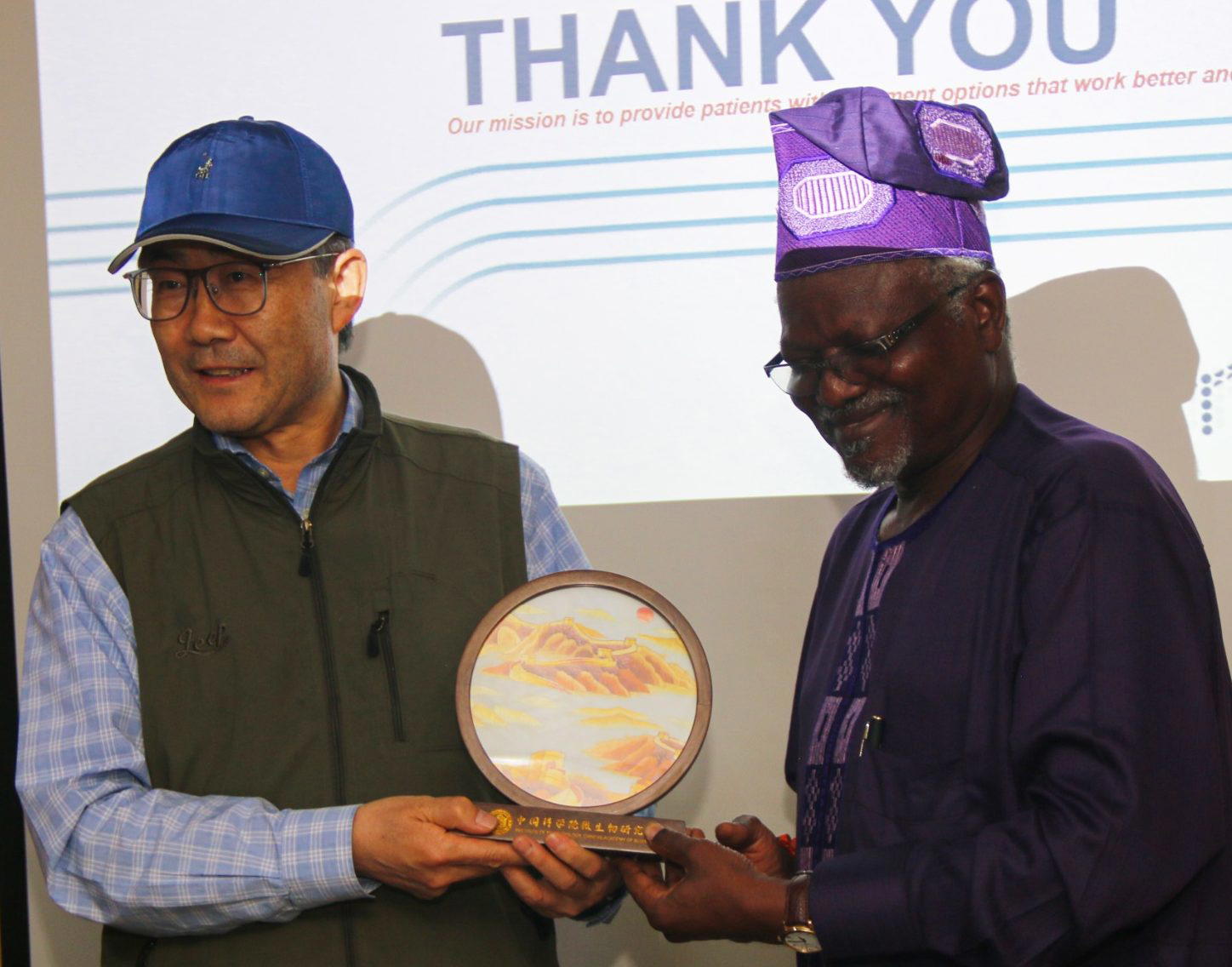
Former DG, China Centre for Disease Control and Prevention Prof George Gap (left) presenting a souvenir to Prof. Oladapo Obafunwa DG NIMR, during the visit of some top Chinese scientists to the institute recently.
By Chioma Obinna
Nigeria’s quest for stronger disease control and vaccine independence received a major boost as a high-powered Chinese scientific delegation led by renowned virologist and former Director-General of China CDC, Prof. George Gao, visited the Nigerian Institute of Medical Research, NIMR, in Lagos.
The visit, which brought together leading experts from the Chinese Academy of Sciences, China CDC, Peking University and Shanghai Junshi Biosciences, signals a renewed push to deepen collaboration in infectious disease research, vaccine development and capacity building.
Addressing NIMR scientists, Gao said the engagement was part of ongoing efforts to strengthen scientific partnerships with Africa, particularly in tackling shared public health threats.
“We are here looking for future collaborations in Nigeria. I have worked extensively in Africa and understand the public health landscape. There is a strong basis for partnership,” he said.
Gao, who played a key role in virus discovery and vaccine development during the COVID-19 pandemic, stressed that emerging and re-emerging infectious diseases demand stronger cross-border scientific cooperation.
The meeting featured technical sessions, including cutting-edge research presentations on next-generation vaccines, with a major focus on Mpox.
A presentation by Prof. Han Wang of Peking University revealed ongoing efforts to develop safer, more effective and affordable vaccines tailored to high-burden regions such as Africa.
She warned that existing vaccine options remain largely inaccessible due to safety concerns, limited effectiveness and high costs, noting that some doses currently exceed $60.
“Africa is where vaccines are most needed, yet affordability remains a major barrier,” she said.
Wang disclosed that her team is working on a next-generation vaccine using a novel chimeric immunogen approach aimed at boosting immune response while reducing production complexity and cost.
Preliminary findings, she said, show significantly stronger immune responses compared to traditional vaccines, alongside improved safety and potential for wider accessibility.
For Nigeria, the engagement opens doors to collaboration in vaccine development, genomic sequencing, clinical trials, technology transfer, training, and rapid response to emerging diseases.
Welcoming the delegation, Director-General of NIMR, Prof. John Oladapo Obafunwa, said the institute is ready to leverage global partnerships to strengthen Nigeria’s research capacity and transition from basic research to full-scale production.
“We have facilities we can start with, but we are still in the process of developing full vaccine production capacity. With the right collaboration, we can move from potential to impact,” he said.
Obafunwa stressed the need for partnerships that prioritise Nigeria’s local health challenges rather than externally driven research priorities.
“Some donor-driven research does not always reflect our peculiar needs. We want collaborations that focus more on diseases prevalent in our environment,” he noted.
He also highlighted NIMR’s growing capacity in molecular biology and genomics but lamented Nigeria’s continued dependence on foreign laboratories for advanced procedures such as whole human genome sequencing.
“It is time we begin to look inward rather than depending on other countries,” he said, calling for technology transfer and hands-on training for Nigerian scientists.
Despite recent progress, the NIMR boss pointed to persistent infrastructure and funding gaps, including the absence of a centralised, fully equipped research complex, which has led to fragmented operations across departments.
The visit marks a significant step in strengthening Nigeria–China cooperation in medical research, with both sides expressing optimism that the discussions will translate into concrete, high-impact projects capable of improving disease control and public health outcomes in Nigeria.
Disclaimer
Comments expressed here do not reflect the opinions of Vanguard newspapers or any employee thereof.