By Babatunde Jimoh
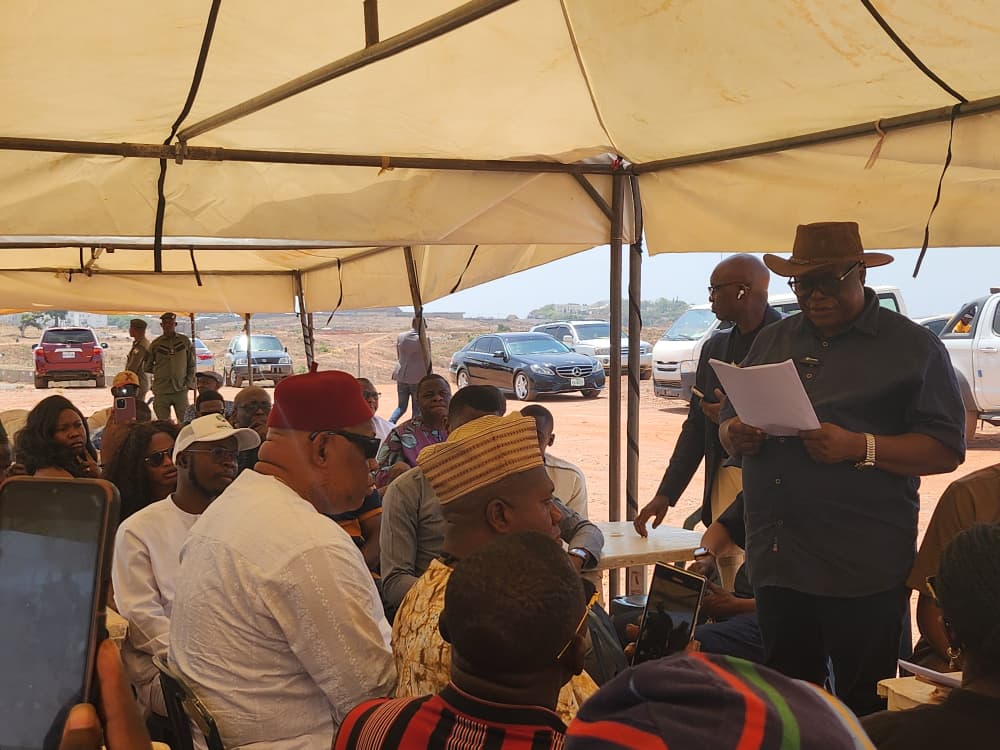
What was meant to be a day of celebration at Praco Estate, Kugbo, on the outskirts of Abuja, carried far more weight than the ceremonial distribution of allocation letters.
For the 89 allottees who received their documents on Wednesday, the moment symbolised hope. But for Praco’s Chief Executive, Chief Success Obioma Akagburonye, it marked the culmination of a bruising 20-year struggle defined by legal battles, reputational scars, and a relentless fight for legitimacy.
Addressing stakeholders, Akagburonye framed the event not just as a handover, but as a milestone in a long and turbulent journey.
“Today is set aside to recognise you, update you and give you guidelines that shall lead you to possess your portion in this estate,” he said.
Yet beneath the formalities lay a complex history of a property that has endured repeated reductions in size, regulatory uncertainty, and prolonged disputes that once cast doubt on its very existence.
A Battle That Spanned Two Decades
Akagburonye recounted a struggle he described as both legal and personal, involving years of courtroom battles, allegations, and pressure.
“The battle to recover this place lasted more than 20 years. I suffered humiliations, blackmails and losses,” he said.
He pointed to his discharge and acquittal on May 5, 2022, referencing a court judgment which, according to him, found no victim of fraud linked to his real estate activities.
Maintaining his innocence, he argued that no individual had come forward to claim they were defrauded, insisting that the accusations that trailed him over the years were unfounded.
Shrinking Land, Expanding Expectations
Central to the controversy is the drastic reduction in the estate’s size.
Originally granted in 1992 as Plot 2 measuring 388 hectares, the land was later reduced to 131 hectares after partial restoration in July 2023. It was subsequently withdrawn again in March 2024, before being reallocated in October 2025 — this time at just 53 hectares.
The implication is stark: early investors who bought into a much larger vision must now adjust to a significantly smaller reality.
Akagburonye admitted that final plot allocations remain uncertain, pending approval of the site plan by the Federal Capital Territory’s Urban and Regional Planning authorities.
Despite this, he noted that some investors have demonstrated notable flexibility. He cited the example of a subscriber who initially paid for 20 hectares but relinquished half to accommodate others.
Navigating a Complex System
With allocation letters now issued, Akagburonye shifted focus to what lies ahead — a process he warned would require discipline, structure, and engagement with government authorities.
He urged allottees to organise themselves, create a formal platform, and appoint knowledgeable representatives to interface with the Federal Capital Development Authority (FCDA).
“Every other thing regarding the size of the land, when to start work, payable dues and fees, you have to ask FCDA from today,” he said.
He cautioned against misinformation and speculation, advising stakeholders to rely only on verified facts.
A Personal Line Drawn
Beyond the administrative directives, the Praco boss struck a personal note, reflecting on the toll of the long-running dispute.
“I have paid my dues. I have decided to make all the sacrifices to maintain my relationship with God and humanity,” he said.
He also issued a firm warning against further intimidation over land matters, signalling a readiness to move forward without revisiting past conflicts.
For dissatisfied allottees, he offered a clear option: return the allocation letter for a refund, subject to resale of the land.
Looking Ahead
In a bid to manage expectations and prevent disputes, Akagburonye announced the establishment of a Praco Desk to handle complaints and enquiries.
The initiative is expected to serve as a liaison between investors and authorities, potentially easing tensions in what is often a volatile real estate environment in the Federal Capital Territory.
More Than Just Land
Ultimately, the event underscored more than the allocation of plots. It told the story of endurance — of a developer seeking redemption, of investors clinging to hope, and of a property that has survived years of uncertainty.
As the letters exchanged hands, one reality became clear: while the ceremony marked the end of a chapter, the real test — development, compliance, and delivery — has only just begun.
In Abuja’s complex land ecosystem, victory is rarely a single moment. It is a process shaped by persistence, compromise, and the willingness to begin again.
Disclaimer
Comments expressed here do not reflect the opinions of Vanguard newspapers or any employee thereof.