By Chioma Obinna
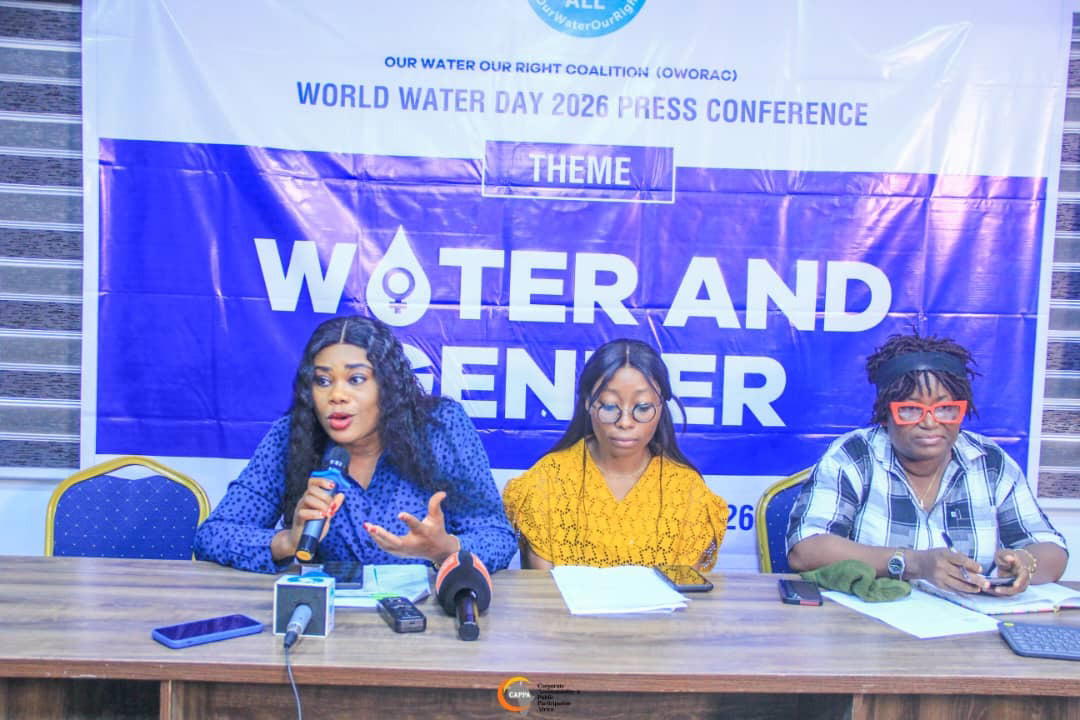
On this year’s World Water Day, a coalition of African civil society groups on Tuesday warned that water privatisation is deepening inequality and placing an overwhelming burden on women and girls.
The Our Water, Our Right Africa Coalition, OWORAC, who spoke at a press conference in Lagos said governments across the continent must reject private control of water systems, arguing that profit-driven models are incompatible with basic human rights and gender justice.
“This year’s theme, ‘Water and Gender,’ underscores the critical importance of addressing inequality,” the coalition stated, noting that billions of people worldwide still lack access to safe water.
Speaking on behalf of the group, Fatou Diouf said: “As the world comes together to mark World Water Day, we must remain clear-eyed about two of the pillars underpinning the global water crisis: gender inequality and corporate greed.”
She added, “Across Africa, women and girls pay the highest price when governments relinquish public water systems to private interests.”
According to the coalition, the burden is staggering.
They lamented that women and girls in sub-Saharan Africa collectively spend 200 million hours every day collecting water, time lost to education, work, and safety.
Cecilia Sharp highlighted the human cost behind the numbers, saying, “Every step a girl takes to collect water is a step away from learning, playing, and safety.”
OWORAC warned that privatisation turns water into a commodity, driving up costs, reducing accountability, and worsening inequality. “Privateers’ loyalty is to their profits,” Diouf said, arguing that such systems “deepen existing injustices.”
The coalition also raised alarm over developments in Zimbabwe, where the government is reportedly considering scrapping the Zimbabwe Gender Commission while simultaneously exploring water privatisation schemes.
“This would represent a troubling step backward,” they added, noting the commission’s role in amplifying women’s concerns and advocating for access to essential services.
OWORAC further criticised the inclusion of AquaFed, which represents global water corporations in World Water Day structures, calling it “shameful” and accusing international institutions of embracing water profiteers instead of holding them accountable.
The coalition urged African governments to invest in publicly financed and democratically governed water systems, end secretive contracts, and ensure meaningful public participation in water governance.
“Ensuring that women do not continue to bear the brunt of water crises is paramount,” the group said, insisting that communities, civil society, and workers must have a central role in decisions affecting access to water.
The position was endorsed by organisations across the continent including the Senegalese Water Justice Network, Corporate Accountability and Public Participation Africa, and Voices for Water, among others.
Disclaimer
Comments expressed here do not reflect the opinions of Vanguard newspapers or any employee thereof.