By Gabriel Ewepu
ABUJA – A nonprofit organization, Hope Behind Bars Africa, HBBA, along with the Federal Ministry of Interior, and Nigeria Correctional Service, Wednesday, sought solutions to address food inadequacy and recidivism in correctional facilities.
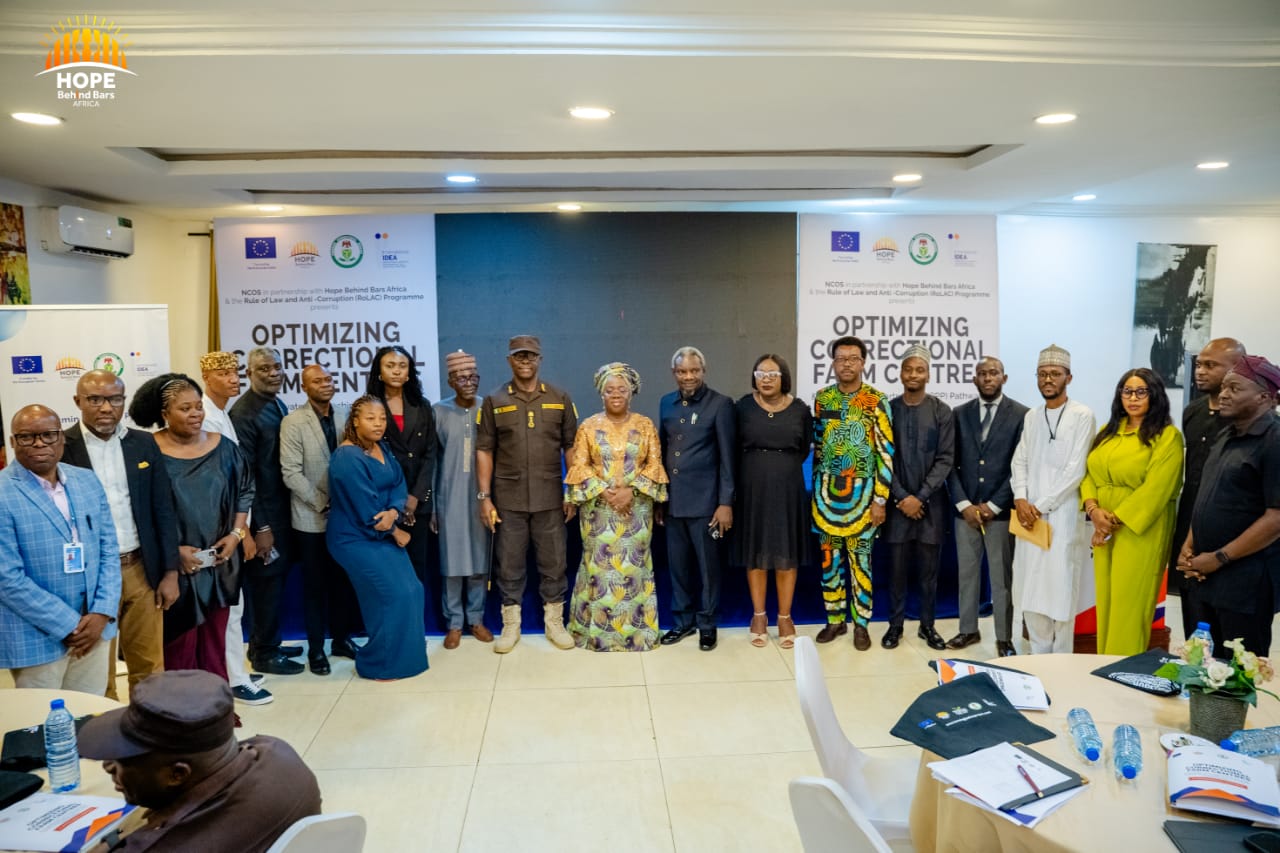
In her remarks, the Executive Director, Hope Behind Bars Africa, Funke Adeoye, at an engagement tagged ‘Stakeholders’ Roundtable on Strengthening Public–Private Partnerships (PPP) in the Nigerian Correctional System’ held in Abuja, said government, development partners and Nigerians are to work together to ensure enough food is made available through farming and engaging inmates at correctional facilities in order to have enough to feed them and also boost food security.
Through HBBA’s Farming Justice Project, HBBA has been working with the support of European Union and International IDEA to reposition correctional farm centres as structured, rehabilitation-focused agricultural hubs that contribute to food security within and outside prison while strengthening correctional productivity and reintegration outcomes.
Over the past year, HBBA conducted baseline assessments and implemented practical agricultural interventions across four custodial centres in Abuja, Lagos, and Edo States. These engagements revealed both promising outcomes and systemic gaps that require coordinated, multi-stakeholder action.
The engagement served as as a platform to share key findings from its assessments, then presented a draft training manual for rehabilitation-centred agricultural programming, and examine practical strategies to strengthen farm productivity, governance, accountability, and sustainability, which also explored responsible PPP entry points across the agricultural value chain.
Meanwhile, according to Adeoye said that some participants have successfully transitioned into ventures such as fish farming after release, demonstrating the long-term impact of such interventions.
She said: “Why does this stakeholder dialogue matter? It matters because it directly addresses two critical and interconnected issues — food insecurity within custodial centres and recidivism.”
She also pointed out with deep concern about what she referred to as poor nutrition and limited access to structured activities, saying these could frustrate inmates, and could make them fall back to criminal activities after release.
She (Adeoye) expressed optimism that when agricultural initiatives and interventions are well articulated and implemented at the correctional centres use the PPP approach this will lead to deep transformation of the character and lifestyle of inmates even after being released.
She also maintained that investing in food production and vocational training not only addresses hunger but also creates pathways for reintegration.
In a speech delivered by the Minister of Interior, Olubunmi Tunji-Ojo, represented by Permanent Secretary, Dr. Magdalene Ajani, said that food insecurity and recidivism are closely linked, which demand public private sector synergy to and improve food systems through structured agricultural programmes.
The Minister also expressed believe that when the issues are addressed collaboratively it will positively impact inmates’ welfare, drastically reduce tension within the correctional facilities, and provide opportunities for skill development.
The minister added that the Federal Government is prioritizing partnerships to unlock the full potential of correctional farm centres.
He emphasized that correctional facilities should go beyond confinement and evolve into centres for rehabilitation and economic productivity.
Similarly, Controller-General of the Nigerian Correctional Service, Sylvester Nwakuche, underscored the importance of engaging inmates in productive activities to reduce reoffending.
Nwakuche further stated that the Service currently operates 18 farm centres alongside various agricultural and industrial projects nationwide, producing crops including rice, maize, cassava, and soybeans.
According to him, these initiatives are designed not only to feed inmates but also to provide practical skills for successful reintegration into society.
He added that expanding such programmes through private sector collaboration would improve efficiency, introduce modern farming techniques, and align training with current market demands.
Disclaimer
Comments expressed here do not reflect the opinions of Vanguard newspapers or any employee thereof.