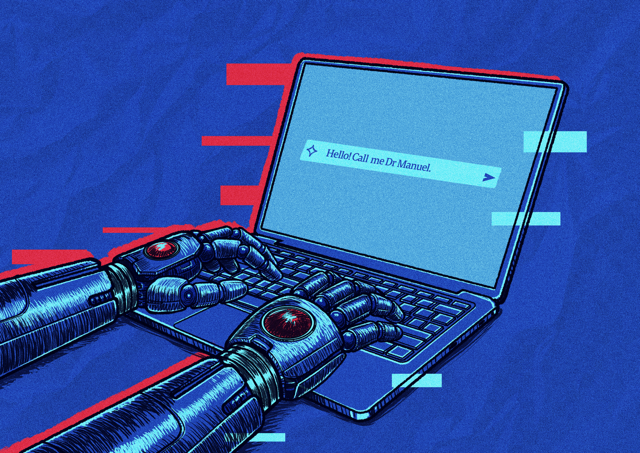
An investigation has revealed that OpenAI’s ChatGPT was used to generate Russia-aligned propaganda, with a made-up ‘Dr Manuel Godsin’ persona used as a byline. This was then published as serious analysis by one of South Africa’s largest media conglomerates, before being syndicated into other African outlets and legitimate news sites like MSN.
Russian propagandists have been caught using OpenAI’s ChatGPT and fake media personalities to covertly inject manipulated content into major high-circulation mainstream media across Africa, and the world.
The campaign, first uncovered by OpenAI and verified by Code for Africa’s (CfA) forensic analysts this week, copies similar ‘information laundering’ and ‘paid punditry’ techniques pioneered by Chinese state agencies in the early 2020s.
The Russian campaign used AI tools to create output for a fake geopolitical academic and commentator, ‘Dr Manuel Godsin’, who published a string of polemics praising Russia, and criticising Ukraine, the United States and the United Kingdom, while also commenting on local political issues in South Africa and Kenya. The content was amplified by a network of faux news pages posing as local, grassroots news sources on Facebook, described by Meta as ‘a network originating in Russia that targeted audiences in Sub-Saharan Africa.’ Meta took down 37 Facebook accounts and 29 pages for Coordinated Inauthentic Behavior.
The content was also amplified by fake think tank websites, with some of the articles republished on global platforms, such as the Microsoft owned global news portal MSN, as supposed credible expert analysis.
OpenAI exposed the campaign in its February 2026 report, ‘Disrupting malicious uses of our models’. A ‘Covert IO: Operation ‘No Bell’ case-study in the report details the behaviour of a ChatGPT account, since banned by OpenAI, whose main activity was generating social media posts and long-form commentary articles about geopolitics in Africa using the Godsin persona. The persona itself is a textbook example of what the information integrity community calls a “paper person” operation — a synthetic identity given enough surface-level credibility (fake credentials, fake institution, fake books) to pass editorial gatekeeping in under-resourced newsrooms. To generate the articles, the user entered a series of prompts, which are short instructions that guide an AI generator about the story’s elements, such as the setting, messaging, and tone. In this case, the user mainly prompted in English, but sometimes prompted with Russian-language instructions that OpenAI says ‘the user attributed to their manager’.
The user also attempted to hide the fact that the text was AI-generated. OpenAI’s investigation found that the account operator tried to conceal AI authorship, including by instructing the model not to use em dashes and by experimenting with multiple large language models. An em dash (—) appears unusually often in text produced by AI tools, because they are trained on large corpora where this punctuation is common in edited or literary writing. Frequent em-dash usage is treated as a marker and warning of AI-generated text.
Bad actors often use multiple large language models to produce disinformation because different models have different strengths, guardrails, and writing styles. By switching between models, they can bypass safety restrictions, refine or rewrite content, and generate variations that appear less repetitive or machine-generated.
CfA’s investigation built on the brief OpenAI case-study, confirming that ‘Dr Manuel Godsin’ is a fictitious identity – a sockpuppet created to launder Russian narratives into the mainstream media ecosystem by posing as an independent commentator. Reverse-image checks linked the profile photos used for Godsin to Mikhail Malyarov Yurievich, an apparent real individual in St Petersburg with a legal background, whose known qualifications do not match the academic credentials claimed in Godsin’s bylines.
On his author bios, including those on Independent Media’s IOL news site, Godsin is described as holding a PhD from the University of Bergen and a master’s degree in International Crisis Management from the University of Oslo. OpenAI and CfA found no trace of him in the University of Bergen’s library or the Norwegian National Research Information repository. The University of Oslo confirmed that the university ‘does not offer any study programmes in “International Crisis Management”. Nor can we find any student, current or previous, with the name Godsin.’
Further online research identified web articles that purported to show Godsin’s photo; the same picture featured on the profile of a St Petersburg law student on a Russian legal networking site, apparently posted online in the 2010s. Godwin is also described as a researcher at the “International Centre for Political and Strategic Studies” (ICPSS), and author of several books that CfA could not trace in any catalogues or databases. While there does appear to be a Sudanese organisation calling itself the ICPSS, with a website and a small Facebook presence, many of its social media contact details are defunct. A mail to the supplied Gmail address was returned as ‘address not found’, the site’s contact form doesn’t work, and the ICPSS’s LinkedIn page, X, Instagram and YouTube accounts are dormant. Messages on Facebook went unanswered. Although its website says that ICPSS was founded in 2022, the domain was only registered in 2025.
Open AI’s ‘Covert IO: Operation “No Bell”’ report said that ‘other than finding Godsin’s byline on 53 articles online, we were unable to identify credible evidence of his existence’. CfA has been able to confirm 42 of these, with the articles published 77 times across at least 27 separate websites in eight African countries. Thirteen of these 27 websites have previously been flagged in FIMI-related investigations, nine of which are actively pro-Russian. All 13 have been used to launder state-sponsored narratives. Of the 77 republications, 45 appear on digital platforms associated with South Africa’s third largest media conglomerate, Independent Media. Another op-ed was republished by CapitalFM, in Kenya, which previously published opinion pieces by a pro-China false persona, Yi Fan, unmasked in September 2023.
Amongst the 27 websites which published Godsin’s articles are Nigeria’s Vanguard media group and the Angolan crime-journalism platform Na Mira do Crime. These media outlets have also previously published articles attributed to another fictitious author, João Fabunmi, that featured in an earlier CfA investigation. After CfA reached out to Vanguard, Fabunmi’s 13 November 2025 article was taken down alongside Godsin’s articles.
The use of fake identities on Independent Media platforms to disseminate disinformation and propaganda is also not new. A CfA report published on 21 September 2022, ‘Newsroom uses fake journalist to spread disinfo’ (and featured in a Daily Maverick investigative article) revealed that fake journalist ‘Jamie Roz’ was used by Independent Media to write articles that formed ‘part of a wider coordinated attempt to deflect public attention from the banking travails of IM’s parent company Sekunjalo Group, whose accounts have been closed by a number of South African banks, as well as investigations into Chinese government influence in the South African political and media ecosystems’. CfA found that articles by the Roz sockpuppet were published 75 times across group titles – 69 on IOL – showing the distributive potential of disinformation. Godsin is in this tradition.
Edmund Phiri is another apparently fake writer whose columns appear in Independent Media titles. He has written in strong defence of Independent Media and its chair, Iqbal Survé, as well as penning attacks on rival outlets and journalists. An investigation by News24 and the Digital Forensic Research Lab into Edmund Phiri suggested that ‘he is a mere persona controlled by a hidden hand and an analysis of his subject matter and social media activity signals that he works at the behest of Survé.’ Phiri drew wider attention after a column under his byline compared News24 journalist Karyn Maughan to Nazi propagandist Leni Riefenstahl, leading to a Press Council ruling ordering Independent Media to apologise and remove the piece.
The Godsin operation appears interwoven with a broader Kremlin-aligned propaganda machine targeting Africa. A central node in that ecosystem is African Initiative, a Moscow-based state-funded agency launched in 2023 that presents itself as an ‘information bridge’ between Russia and Africa and that operates in Arabic, English, French and Russian, with offices in Burkina Faso, Mali and Niger. Reporting by CfA and the Africa Defense Forum, amongst others, has linked African Initiative to attempts to disguise and spread disinformation, including about vaccines and democratic processes, in support of military regimes and Moscow’s strategic interests.
Timeline analysis by CfA indicates that several Godsin articles closely followed African Initiative pieces on similar themes. On 16 March 2025, African Initiative reported on a purported 72‑hour ultimatum for South Africa’s ambassador to leave the United States. Two days later, African Times published a Godsin article framing the ambassador’s alleged expulsion as a sign that South Africa was reshaping its international posture and no longer concerned with Washington’s views. In September 2024, African Initiative accused US-linked private military company Bancroft of destabilising the Central African Republic; within days, IOL and the Sunday Independent ran a Godsin analysis echoing those claims.
Similar patterns emerged around a story alleging Moldovan and Ukrainian support for Sahel separatists, and claims that Wagner-linked forces freed child slaves in the Central African Republic. In each case, narratives seeded on channels associated with Russian military or media structures – including the Telegram channel of Wagner in CAR, the Officer’s Union for International Security (COSI) – were rapidly repackaged under local or pseudonymous bylines in African outlets, including the BRICS-aligned African Times, CAR’s pro-Russian Ndjoni Sango, and IOL, often with imagery originating from those same Telegram sources.
Besides media identified as pro-Russian, like African Initiative, African Times and Ndjoni Sango, or as a key “information bridge” for Russian state narratives, like Independent Media, Godsin-bylined propaganda was also laundered into news organisations that audiences would view as politically neutral. These are organisations with codes of ethics pledging nonpartisanship, such as The South African, and those with restrictions on publishing of ‘hoaxes, false information, propaganda, and deliberate misinformation’, like Microsoft’s portal MSN. The Godsin article on The South African is tagged as partner content, but published under the byline of the site’s campaign manager, effectively obscuring its true source.
Through its partner programme, MSN has published at least 9 different Godsin articles, all from Independent Media (two have subsequently been removed). For example, ‘Why the US is quietly delivering humanitarian aid to Orania?’ claims that, despite cutting aid to South Africa, the US was secretly providing aid to Orania, an Afrikaner-only town in the country’s Northern Cape province.
‘In Orania… residents reported receiving a donation of Starlink satellite terminals from a powerful donor. Social media posts show Starlink kits in the trunk of a car in boxes branded with the seal of the Office of the First Lady of the United States… South Africa’s growing strategic weight as a BRICS member, its independent foreign policy, and its contested domestic debates make it a tempting stage for outside influence. The question for South Africans is not whether foreign powers have interests here, that is obvious, but whether recent events form a pattern that points to deliberate pressure on our internal balance.’
The original story appeared on 25 September 2025 in both the print and online editions of Sunday Independent and Sunday Tribune newspapers, and on the IOL website, all owned by Independent Media. They were however compelled to publish a full retraction of the article on 03 October 2025. The retraction read, ‘The Sunday Independent hereby fully and unreservedly retract (sic) the article …. As part of this retraction, we have removed the article from all our platforms, including online editions and social media.’ Only the Sunday Independent was named in the retraction.
Despite the retraction, the story had already entered wider circulation. The African Diaspora News Channel, a YouTube network with nearly two million subscribers, posted a video under the title “The United States Secretly Provides Humanitarian Aid to Orania Despite South Africa Being Cut Off,” which in turn was amplified on Nairaland, a Nigerian forum with 3,3 million members. This is an example of what CfA describes as “information laundering,” in which a narrative originating from state-aligned or opaque sources passes through layers of media and influencers until it appears as credible independent reporting. The deliberate planting of false stories in mainstream media outlets, at the top of the media hierarchy, confers archival authority even if those stories are later debunked or removed.
Another Godsin story carried by MSN is “How Crisis Action shaped anti-BRICS protests in South Africa”, which is also on Strategic Culture Foundation, a website the US State Department has identified as a Russian government-linked disinformation outlet, sanctioned by the US Treasury in 2020. The ‘How Crisis Action shaped anti-BRICS protests in South Africa’ article (originally published 18 September 2025 on IOL) was republished verbatim on on Strategic Culture on 2 October 2025, the day before Sunday Independent editor Sizwe Dlamini issued his retraction of a different Godsin article. The text is identical, including the phrase “the installation of a foreign-aligned convening node inside South Africa’s civic sphere”.
The Strategic Culture Foundation example confirms the classic IO laundering loop: generate content → place in legitimate African media → republish on Russian-aligned platforms to amplify credibility. The Strategic Culture republication is the smoking gun for external IO amplification. The site exists specifically to give Russian-aligned narratives a veneer of ‘independent analysis’ and is widely blocked or flagged by Western cyber agencies.
The Godsin case illustrates how, when basic safeguards are absent or ignored, African news organisations can act as vectors for foreign information manipulation and influence (FIMI). Are the news organisations willing participants in the spread of disinformation, victims of FIMI, or useful idiots?
Commenting on the report, Sbu Ngalwa, secretary-general of The African Editors Forum (TAEF), said “The reality is that AI lowers the barrier of entry for disinformation, which is why the human element of journalism remains a necessary safeguard. Despite the digital disruption that has resulted in smaller, hollowed-out and high-pressure newsrooms, the need for fact-checking cannot be gainsaid. TAEF believes that rigorous standards and transparency are the only ways to ensure African media remains a source of truth rather than a vector for foreign interference.”
AI-assisted influence operations need not be technically advanced to succeed, if newsrooms allow editorial standards to lapse. Newsrooms that published ‘Dr Manuel Godsin’ did more than simply fail to spot a sockpuppet; they lowered the guardrails that are supposed to protect their audiences from orchestrated foreign information operations. By ignoring basic verification standards, these outlets effectively acted as unwitting amplifiers for a coordinated pro‑Russia influence campaign across Africa.
Read the full CfA investigative report, including the full list of media that were duped into publishing the Godsin content here.
The Sunday Independent was contacted for comment but had not responded at the time of publication.
However, The South African issued a statement after the article was published, saying: “This has now been removed from our site. Going forward, we will also ensure much tighter control over paid content attempting to infiltrate our site.”
Written by Chris Roper. Digital investigative analysis for this article was provided by Code for Africa’s Eliud Akwei, Sandra Roberts and Amanda Strydom, with editing by Justin Arenstein.
Disclaimer
Comments expressed here do not reflect the opinions of Vanguard newspapers or any employee thereof.