… media urged to hold government accountable
By Esther Onyegbula
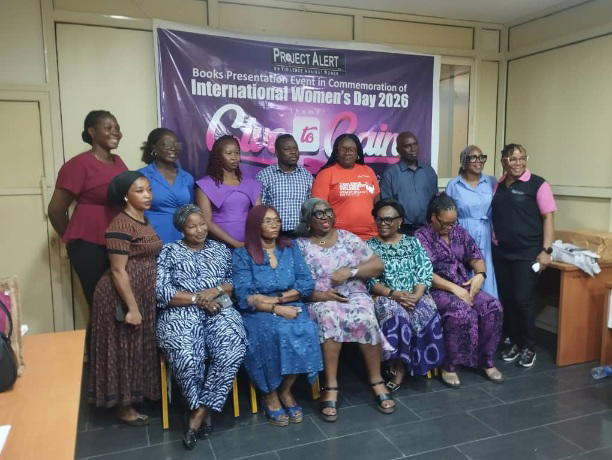
Determined to deepen the fight against sexual and gender-based violence in Nigeria, non-governmental organisation, Project Alert on Violence Against Women, in commemoration of International Women’s Day 2026, has unveiled four major books aimed at strengthening prevention, advocacy, and institutional response to abuse across the country.
The publications, presented at an event attended by civil society actors, media practitioners and stakeholders, include How-To-Guide: Sexual Violence Prevention and Response Programming in Schools, No Safe Haven: Attacks on Women and Girls in Nigeria 2024, Beacon of Hope Volume 2, and Project Alert Strategic Plan 2025–2029.
Speakers at the event stressed that beyond documenting abuse, the publications are designed to provide practical tools, data and strategic direction for preventing violence, supporting survivors and mobilising collective action.
Executive Director of Project Alert, Josephine Effah-Chukwuma, said the organisation’s work is anchored on the principle that meaningful change requires individuals and institutions to contribute what they have toward advancing human rights.
According to her, giving is not limited to financial resources but includes knowledge, empathy, solidarity and advocacy.
“If you don’t give, you can’t gain. You must give to gain rights, you must give to gain justice, you must give to gain action,” she said.
“When we hear the word give, the first thing that comes to mind is money. But it’s not all about money. You can give knowledge, empathy, solidarity, charity and sympathy, anything you have that can help build a just society.”
Effah-Chukwuma noted that before individuals can contribute meaningfully to human rights advocacy, they must first possess the right values and attitude.
“You cannot preach human rights if you don’t believe in human rights. You cannot give what you don’t have. So we must cultivate the right attitude, values and morals before we can truly contribute,” she added.
She explained that the organisation’s latest publications represent its commitment to sharing knowledge and strengthening public awareness about gender-based violence.
“Today we are giving what we have, knowledge. These publications are tools to guide action, shape policies and open doors to justice for survivors.”
Chairman of the Board of Trustees of Project Alert, Professor Ngozi Osarenren, said the books serve as documentation of the organisation’s decades of advocacy and its impact in tackling violence against women and girls.
“What we have done today by presenting this series of books is to bring to public awareness the work we have been doing and the impact it has had,” she said.
Professor Osarenren noted that one of the publications, Beacon of Hope Volume 2, is a compilation of documented cases and survivor stories, updating an earlier volume published in 2008.
She explained that financial constraints had delayed the production of the new volume but expressed gratitude that the publication had finally been completed.
Another key publication, she said, focuses on practical guidelines for preventing sexual abuse in schools and communities.
“The critical one is the guideline for preventing sexual abuse in schools and communities. We would be happy if it trickles down to primary and secondary schools,” she said.
She urged ministries of education, women affairs and social welfare to help distribute the publication widely.
“It is not enough to say this child has been abused or this person is a survivor. We must also know how to prevent these situations from happening in the first place,” Osarenren added.
She stressed that tackling gender-based violence requires collective responsibility.
“It is not only NGOs or civil society organisations. It is everybody’s problem. We all have to work together because we want a society with children, women and young people we will all be proud of.”
One of the key publications, How-To-Guide: Sexual Violence Prevention and Response Programming in Schools, emerged from a four-year intervention project implemented in schools in Cross River and Akwa Ibom states.
The project, supported by the African Women Development Fund, began in 2022 with a baseline study across ten schools, five in each state, including both secondary and tertiary institutions.
The research exposed patterns of abuse, gaps in reporting, and a widespread culture of silence surrounding sexual violence in schools.
Following the findings, Project Alert conducted advocacy with education authorities and traditional leaders, organised sensitisation programmes for students and established student-led anti-sexual violence clubs in 14 institutions.
The publication provides a structured roadmap for preventing and responding to sexual violence in schools, including policy development, confidential reporting systems, capacity building for educators and partnerships with education authorities.
According to the organisation, the guide emphasises that awareness campaigns alone are insufficient without clear reporting structures and enforcement mechanisms.
‘No Safe Haven’ highlights scale of violence
Another publication, No Safe Haven: Attacks on Women and Girls in Nigeria 2024, documents cases of violence against women recorded throughout 2024.
The report, which draws on media reports and cases reported directly to the organisation, recorded 82 incidents between January and December 2024.
Project Alert said the figure represents only a fraction of actual cases across the country, noting that many incidents remain unreported.
The publication categorises various forms of violence, including domestic abuse, rape, incest, femicide and harmful traditional practices.
It also examines broader structural factors, such as social norms, weak accountability systems and gaps in enforcement, that allow violence to persist.
According to the organisation, while Nigeria has made progress through legislation, improved law-enforcement response and the establishment of sexual assault referral centres, significant challenges remain, particularly in funding and accountability.
Founder of the Mirabel Centre, Itoro Eze-Anaba, who spoke at the event, called on journalists to move beyond event-based reporting and play a more active role in demanding accountability from government institutions.
She noted that survivors seeking support at the centre range widely in age.
“The youngest survivor we have treated is three months old and the oldest is 82 years old, and it involves both men and women,” she said.
Eze-Anaba urged the media to follow up on stories and press government authorities to take concrete action against gender-based violence.
“We want the media to move from reporting events to reporting with responsibility and accountability,” she said.
“After the headlines fade, what happens next? The media must continue to ask government what has been done and keep the pressure on.”
She added that sustained advocacy by organisations like Project Alert has helped expose previously hidden issues such as incest in Nigeria.
“It is because of the work Project Alert has done over the years that many of these issues have come to light. Documentation like this is very important,” she said.
Presenting the synopsis of the publications, programme officer Tope Adibeli said the plan sets a clear direction for future interventions.
“Through the strategic action plan, Project Alert seeks not only to respond to violence but also to prevent it, challenge the systems that enable it and promote a society where the rights and dignity of women and girls are fully realised,” she said.
Stakeholders at the event emphasised that tackling gender-based violence requires sustained collaboration among government institutions, civil society organisations, educators, communities and the media.
They noted that the newly launched publications represent a significant step in strengthening evidence-based advocacy and equipping stakeholders with tools to address one of Nigeria’s most persistent human rights challenges.
Disclaimer
Comments expressed here do not reflect the opinions of Vanguard newspapers or any employee thereof.