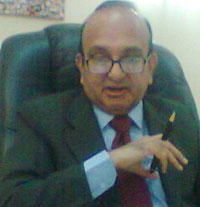
MAHESH SACHDEV.
BY VICTORIA OJEME
The Indian High Commissioner to Nigeria, Mahesh Sachdev, says diplomatic ties between his country and the host country are strong but believes things can be better.
What is the state of relations between India and Nigeria?
India was the first to have diplomatic ties with Nigeria, that was two years before Nigeria got her independence.
We opened a High Commission in Nigeria in 1958 and the goal of the government of India was to give its official support to Nigeria for the independence. The ties have been exceptionally close; never have India and Nigeria defaulted on any issue and people to people contact has remained great.
We have been engaged with Nigeria for decades at people to people level, business to business level and government to government level. Today, we count Nigeria as one of the top 15 trading partners of India. For instance, India’s trade, last year, was higher than India’s trade with the United Kingdom meaning that we traded more with Nigeria than with the United Kingdom.
What is the volume of trade between India and Nigeria?
The vibrancy is easy to quantify when it comes to trade according to the Indian data. Bilateral trade with Nigeria in 2011 was $16. 376 billion; what India exported from Nigeria was worth over $13billion and our own export to Nigeria was only $2.648million. In other words, the total trade was $16. 376million; we had $11billion trade deficit with Nigeria. So, India was contributing to the tune of $11 billion to the Nigerian economy. That figure makes Nigeria our second largest trading partner.
Commodity wise, majority of trade export to India is crude oil but our export is slightly more diversified; we are talking about transport equipment such as cars, buses, trucks, machineries and instruments which Nigeria needs for its economy. Pharmaceuticals and fine chemicals, rice and electronics are five top major components of Indian export to Nigeria.
I also have figures from Nigeria’s National Bureau of Statistics for the last quarter of 2011 which show that India was the 3rd largest recipient of Nigerian export, 3rd largest source of import into Nigeria and overall 3rd largest trading partner. The trade between both countries is doing very well despite the challenges and I believe there are opportunities for the trade to grow further. For example, India needs $9billion palm oil every year, and we did not know of palm oil until the white man came to West Africa especially the Niger Delta.
Now we don’t get any palm oil from Nigeria. Isn’t that a potential area for the two countries to collaborate so that palm oil can be revived on large scale in Nigeria and exported to India?
There are other areas as well where we can collaborate. India needs a lot of cashew nut; some of it comes from Nigeria but cocoa, shea butter are also needed in the country as well and Nigeria is welcome to take even more prominent place in the Indian market.

MAHESH SACHDEV.
What are the major challenges impacting on the India, Nigeria relations?
The trade relationship is doing well, it is not stagnant or receding; so I will not like to accept the word challenges, but why we are not able to leverage the opportunities. If that is the question, I could answer it by suggesting that we need a better frame work, awareness of each other’s capability, more openness and transparency, equivalent of standards so that some products, once tested in India, can enter Nigeria; they don’t have to be tested again in Nigeria.
For instance, Nigeria and India can put together a preferential trading document so that Nigeria’s export can go to a large india market of 1.1 to 2billion people and India’s export can go to the Nigerian market without hindrance, without standard customs, without all those checks. If we are able to have no customs duties, no standard related checks, Indian companies will come to Nigeria and invest in palm oil and plantation so that they have supply security and they know that they can take the palm oil to India without hinderance. I think if we can put it in place together that will be wonderful.
At another level, trade is encouraged if we have direct shipping, direct banking and direct connectivity between India and Nigeria. For instance, if you ordered for something, the payment has to be made in two to three countries because there is no Nigerian bank in India and no Indian bank in Nigeria.
The goods arrive but not in a container that is shipped from Mumbai and Lagos, it first goes to maybe Singapore, Dubai, South Africa, then it is transshipped and that raises cost. With $16.4 billion trade, it should be possible to have direct services for shipping. So these are the factors that impede the growth of trade, if these factors are ameliorated, a trade, which is already doing so well, will do even better.
India has acquired a reputation as a major medical tourism destination. How did India achieve this feat?
I think we are privileged to be trusted by the Nigerian health sector. Our medicines are the best selling in Nigeria today; more than a third of Nigerian medicines are of Indian origin or made in Nigeria from India. About three years ago, the medical tourism sector picked up between Nigeria and India.
It was not done through active promotion but through word of mouth from Nigerians patients who returned from India after treatment. Initially, the number was small, but, after three years, the number rose and today constitutes the biggest component which has been given by the Indian High Commission Lagos and Abuja to Nigerians.
We are sensitive to Nigerian patients and we do our best to give fast and careful service. We are not allowed to impede a critical ill patient from going to Indian hospitals. I believe Nigerians find Indian health care providers, preferable and it has indeed become a byline for preference because the cost and quality of Indian health care providers are quite good.
Secondly, I believe Nigerian patients see Indian health care providers as treating them with greater dignity. The patient and the health care provider are taken into consideration and told what exactly is wrong with the patient and what are the various options available and then the patient, with his health care provider, decides what option is best for him or her,and this is quite unique.
The Nigerian patient is treated as an automobile; you know, an automobile doesn’t have to be consulted on whether there are parts that need to be changed or to be repaired. In India, the Nigerian patients are treated with dignity.
I would also like you to know why tourism to India might have mature. This is not an ideal situation because, it is inhuman for a seriously ill patient to be forced to travel 7,000 kilometers to receive treatment in a strange country, undergo two or three flight connections, negotiate with taxi drivers at the airport, cope with bureaucracy and so on and so forth.
I prefer we come to table and provide Nigerian patients care in their own country, care that is of international standard. I am happy to note that an Indian hospital is operating in Abuja and nearly 50 Indian health care providers and doctors are rendering tertiary service to patients in their own country.
What is the volume of India investments in the Nigerian health sector?
I won’t be able to give you specific figures but allow me to say there are about thirty Indian companies engaged in providing pharmaceuticals to Nigeria. There is Primus Hospital here in Abuja and Kilis Hospital in collaboration with the Indian government. With seventy-year history in optomology in India, we have also conducted more than 80,000 cataract operations in Nigeria on demand.
Primus Hospital is one of India major health establishments in Nigeria and it is currently under investigation by the authorities over alleged unethical practices. Is the Indian government seeking diplomatic ways of resolving the issue?
When you start something, you are bound to come across some instances of misunderstanding with the regulatory authority. I don’t believe this difference should overshadow the positive gesture that the Indian health care providers have to offer. I believe the misunderstanding is being sorted out without diplomatic involvement.
India is fast earning a reputation as a country plagued by official corruption. How is this issue being tackled?
I would like to contest this question that we are fast emerging as a corrupt country; I think it is a subject of assessment. Allow me to say the corrupt and protection interest index put India at 95 rank out of 178 countries and the rank of Nigeria in that list is 143.
Does it look as if we have anything to be proud of in that particular ranking? I don’t is think so.
However corruption remains a problem that the Indian state is determined to deal with, what will help India in fighting corruption , its open and diverse society with more than 7,000 newspapers, 14,000 T.V channels. Indian is an open and vigilant society.
Disclaimer
Comments expressed here do not reflect the opinions of Vanguard newspapers or any employee thereof.