…on free clean cookstoves, mass tree planting
By Nnamdi Ojiego
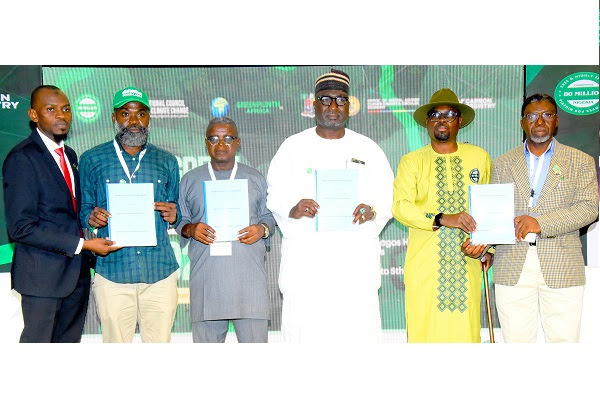
Nigeria’s effort to move from climate policy commitments to practical action gathered momentum this week as Greenplinth Africa Limited entered into a major decarbonisation partnership with the governments of Benue and Niger States.
The agreement, signed during a three-day green conference in Lagos, is expected to support the deployment of tens of millions of clean cookstoves and the planting of millions of economic trees across participating states. The initiative is designed to cut carbon emissions, reduce deforestation, improve household health, and create new economic opportunities in rural communities.
The gathering, organised by Greenplinth Africa in collaboration with the National Council on Climate Change and the Office of the Vice President with the theme, “Decarbonising Africa: From Policy Commitment to Scalable Implementation,” brought together senior government officials, regulators, investors, and development partners to examine how Africa can move from climate pledges to projects that deliver measurable results.
At the centre of the discussions was the signing of a Memorandum of Agreement, MoA, between Greenplinth Africa and the two state governments, an arrangement stakeholders described as a turning point in translating Nigeria’s climate commitments into large-scale implementation.
The agreement forms part of a broader clean energy and environmental restoration programme that seeks to distribute highly efficient improved cookstoves to millions of households, particularly women and low-income families who depend on firewood for daily cooking.
Under the project framework, beneficiaries will receive improved cookstoves and cooking pots at no cost. The intervention is expected to drastically reduce reliance on firewood, one of the major drivers of deforestation and indoor air pollution across many rural communities.
Beyond the household benefits, the programme also incorporates a large-scale afforestation component. The partners plan to plant and nurture millions of economic trees across the three senatorial districts of each participating state. The initiative is designed not only to restore degraded forests but also to generate economic value through agricultural and forestry products.
Environmental experts at the conference described the partnership as a practical example of how state governments can work with the private sector to accelerate climate action.
Participants also explored strategies for closing the financing and technology gaps that continue to slow climate projects across the continent. They stressed that Africa’s path to a low-carbon future would depend largely on practical investments that deliver both environmental and economic benefits.
Speaking on the significance of the agreement, the Director-General of the National Council on Climate Change, Dr. Omotenioye Majekodunmi, described Africa as standing “at a pivotal moment in the history of global development,” noting that while the continent is rich in resources, innovation and human potential, millions of people still lack reliable access to modern energy.
She stressed that Nigeria’s transition strategy is built around a pragmatic energy mix, where natural gas plays a crucial role alongside renewable energy and emerging low-carbon technologies.
Majekodunmi disclosed that Nigeria had recently introduced a national framework to decarbonise the upstream, midstream and downstream segments of the oil and gas sector in collaboration with the Minister of Petroleum Resources for Gas.
According to her, the framework focuses on methane monitoring, emissions reduction, capacity building and climate-aligned financing, while leveraging technology to ensure measurable climate action.
President of Greenplinth Africa, Dr. Olawale Akinwunmi, said the initiative is expected to generate tens of thousands of jobs in both states.
“The MoA is for the deployment of two million stoves to women and households at no cost to the beneficiaries. Additionally, we aim to plant 100 million economic trees in Benue and Niger States respectively. We will also ensure that women in the states have employment opportunities. We will be employing 13,000 people at a minimum wage of N185,000 per month,” Akinwunmi said.
Also, the Deputy Managing Director and Chief Finance Officer of Greenplinth Africa, Babatunde Aina, disclosed that each clean stove beneficiary would also receive a monthly payment of N10,000 and free health insurance under the National Health Insurance Scheme.
“Each individual receiving a clean cookstove in Benue and Niger States will get one stove, two stainless steel pots, and 40 kilograms of farm-waste briquettes,” Aina stated.
Officials from Benue State described the agreement as a pathway to both environmental recovery and economic development.
Managing Director and Chief Executive Officer of the Benue State Agricultural Development Company, Donald Akule, said the partnership position the state to benefit economically from emerging climate finance opportunities while creating jobs for the people
““For Benue State, the agreement means we are becoming part of the green economy,” he said. “When we talk about greening the environment, we are also looking at the entire agricultural value chain. This includes managing emissions, restoring soil fertility, and converting waste into reusable energy products that can support sustainable farming.”
Representatives of Niger State also endorsed the initiative, describing it as an opportunity to strengthen the state’s climate resilience while improving livelihoods in rural areas.
Officials said the combination of clean cooking solutions, afforestation, and local economic incentives would address several pressing challenges at once, including energy poverty, land degradation, and unemployment.
Disclaimer
Comments expressed here do not reflect the opinions of Vanguard newspapers or any employee thereof.