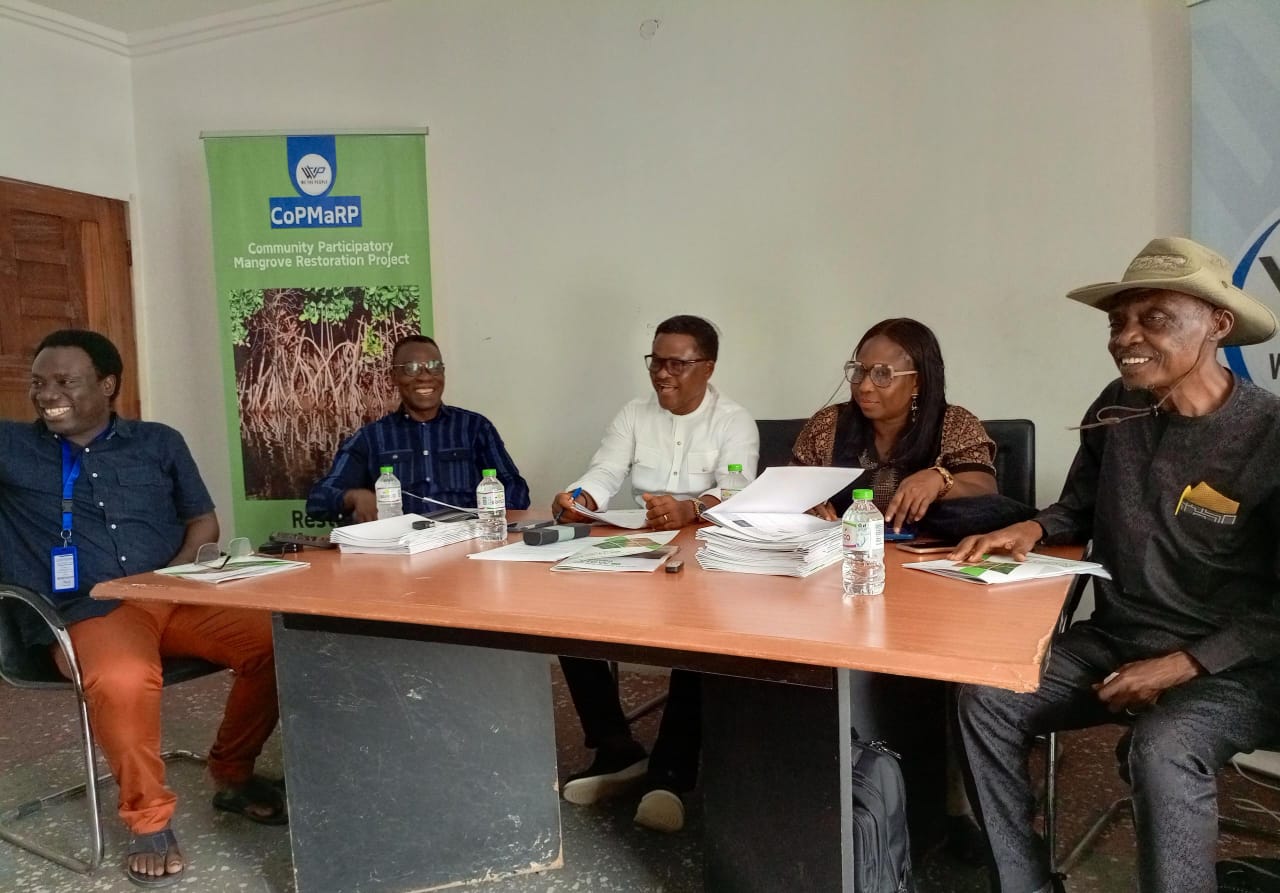
Environmental Experts addressing Journalists on Wednesday in Calabar
By Ike Uchechukwu, CALABAR
Civil Society Organisations (CSOs), relevant stakeholders in the environmental sector have described the Cross River State 2010 forestry law as obsolete and can no longer deal with current realities like illegal logging , depletion of climate assets amongst others.
Briefing newsmen on Wednesday in Calabar a network of CSOs led by , The Executive Director of “We The People” Comrade, Ken Henshaw emphasized the importance of updating the State forestry law, noting that there was need for a comprehensive modernisation of the law as will further strengthen Forest conservation and management which is essential for global economic opportunities.
Henshaw explained that the existing law allows for loopholes and penalties that could act as incentives for crimes to blossom adding that the law does not expressly prioritize the people ( communities) , academia and other important stakeholders.
He explained that if a truck is seized during the commission of a forest crime, the penalty is almost next to nothing, giving room for perpetrators to pay a paltry fine and continue their illicit activities stressing that a reviewed law will keep more trees standing which is invariably more beneficial to the country.
His words:” “Illegal logging and wildlife trafficking continue to undermine conversation efforts. Weak penalties and enforcement gaps have allowed these activities to persist.
“The current law allows for penalties that could act as incentives for forest crimes to continue. For instance, if a truck is seized during the commission of a forest crime, the penalty is a meagre N200,000, a sum most illegal loggers will gladly pay and continue their crime”, he added.
In an effort to strengthen sanctions and block some loopholes he recommended stronger and more strigent sanctions in line with the degree of the crimes, improved monitoring systems, and better coordination among enforcement agencies.
Henshaw, noted that Cross River holds great potential for ecotourism that biodiversity and landscapes can generate revenue, create jobs, and incentivize conservation adding that there was more money in keeping the tree standing
He bemoaned the declining forest cover, insecurity linked to illegal activities, and lack of purpose and frameworks which has undermined the state forest potentials, stressing that the new forestry law should embed ecotourism principles within forest governance, provide legal backing for conservation-based enterprises, and encourage public-private partnerships.
“By protecting forest, we are also protecting economic opportunities for present and future generations. We recommend community participation in forest governance, recognition of traditional knowledge systems and community-based monitoring mechanisms”, he explained.
On his part, renowned Environmental Expert, Odigha Odigha, pointed out that Cross River has lost over 60 percent of its original forest cover and was only bearing the name of biodiversity hot spot on paper.
Odigha stressed that if urgent reforms are not carried out , there are risks of losing Nigeria’s most valuable ecological assets.
“Cross River is home to Nigeria’s largest and most biodiverse tropical rainforest ecosystem. Cross River has lost over 60 percent of its original forest cover. Large areas that were once dense rainforest have become degraded lands and grasslands.
“If urgent reforms are not undertaken, we risk losing one of Nigeria’s most valuable ecological assets permanently “, he lamented.
Disclaimer
Comments expressed here do not reflect the opinions of Vanguard newspapers or any employee thereof.