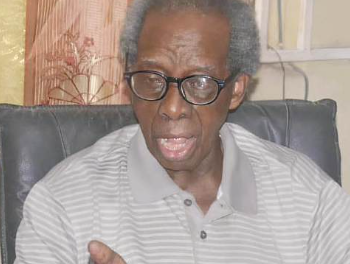
Pa Ogundana
By Nnamdi Ojiego
72 years after Ekiti Parapo College Ido-Ekiti welcomed its first set of students in 1954, one of the young boys who helped define the school’s earliest culture is still alive to tell the story.
Sitting in his FESTAC home in Lagos, 88-year-old Pa Francis Ogundana speaks with calm clarity about a period when education in Ekiti was scarce, discipline was strict, and opportunity was treated as a collective responsibility.
Pa Ogundana was among the first 36 students admitted into the college and later became its pioneer Senior Prefect, a position he held for five years.
As the institution marked its 72nd anniversary this year, his memories offer a rare window into the struggles and determination that shaped one of Ekiti State’s historic schools.
“In those days there were very few secondary schools,” he recalls. “Christ’s School was there, then Ekiti Parapo College came as the second one. The college was pioneered by Ade Akomolafe, who left Igbobi College to become the founder and Principal of Ekiti Parapo College. It came at the right time people were eager to educate their children. So the establishment of the college was a big thing. We were happy to be foundation students.”
The early years were far from comfortable. The school began at a community centre before moving to its permanent site, which at the time was located in what many students considered an isolated area.
“We started at the community centre before moving to the permanent site”, he states.
“Even when we moved, the place was in a deserted area. Some students were frightened about living in such an isolated place. One student even said snakes were chasing him in his dreams”, he say, smiling faintly.
“That shows how uneasy we felt. The Principal, Ade Akomolafe, worked very hard to make sure we settled properly.”
Beyond classroom learning, students were exposed to intense physical work. Farming was part of daily life. Under the supervision of agriculture teacher, Mr Ade Ajayi, students worked on both school and personal farms, often waking early and spending weekends clearing land or tending crops.
“It was rigorous, and demanding. But it built discipline”, Pa Ogundana recalls.
“We woke up very early, especially on weekends, to work on the farm. “The Principal himself was very hardworking and determined to build a strong foundation. When we took our first examination, I think only two students failed. That showed the seriousness of the school.”
Rise
That discipline would soon shape his own path in unexpected ways. His rise to become the first Senior Prefect came after an incident involving students who planned to steal groundnuts from the school farm.
He refused to join them. When the others were caught, his reputation for discipline earned him the leadership role.
He narrates: “There was a classmate who was close to the Principal, and was to be named Prefect.
“Later, some students planned to go and eat groundnuts from the school farm. I refused to join them. “Unfortunately for them, they were caught. That was how I became the Head Prefect, and I held the position for five years.”
On major test encountered as Senior Prefect, Pa Ogundana explains: “It was not easy. In fact, it was a big restriction. The major test was discipline. When others were playing pranks or eat on the school farm or go to the store where groundnuts were kept, you had to stay away because you wanted to preserve the dignity of the office.”
According to him, when eventually some of the students were caught, “they said maybe I was using some spiritual protection or something.
“But it was simply discipline. And, as I told you, it was because of that discipline that I became the Senior Prefect for five years.
“And I think I was the only one who had that opportunity. I thank God I was able to do that.”
Historic turn
His academic journey later took another historic turn. After leaving Ekiti Parapo College, he gained admission into the University of Lagos in 1962, becoming part of its pioneer law set at a time when many young Nigerians preferred teaching career.
“At that time, becoming a lawyer was not common,” he says.
“Everybody wanted to be a teacher but in my own case, I was lucky I didn’t go to any HSC because I was able to make some papers, which gave me admission to University of Lagos and I was a pioneer law student”.
At the University of Lagos, exposure to top legal minds, including Professor S.C.B. Gower, helped shape his professional outlook.
After qualifying as a lawyer, he joined the Nigerian Bank for Commerce and Industry, where he served as legal adviser for many years before retiring into private practice.
Yet while he speaks proudly of his educational journey, his reflections on present day Nigeria carry a tone of concern.
According to him, the discipline that defined his generation has weakened across schools and public institutions.
“In those days, it was difficult to misbehave,” he says proudly.
“Today, you hear of parents buying exam papers for their children. That was unheard of during our time.”
His concern extends beyond education.
He believes leadership failures and corruption have weakened public trust and moral standards across the country.
“What is going on in government is frightening,” he says quietly.
“Many people go there for personal gain.”
Hope
Despite this, he insists there is still hope for Nigeria, though he warns that prolonged hardship and public anger could trigger serious unrest if not addressed.
“If things continue this way, people may rise in protest,” he warns. “Things cannot continue like this forever.”
His connection to Ekiti Parapo College remains strong.
Recently, he donated N500, 000 to the school but insisted the money be used strictly for development, not celebrations.
“If you pass through an institution, you should not abandon it,” he emphasises.
“Old students and parents must show interest.”
At home, Pa Ogundana, who still drives himself, credits his longevity and strength to his wife of 56 years, Mrs Oluremi Ogundana, a pharmacist who carefully monitors his diet and health.
“She is the one performing the magic,” he says, laughing softly. “My wife is the secret. She is a pharmacist and watches what I eat. “We do quarrel occasionally. So if the restriction is getting too much, I find a way to quarrel with her. But she takes good care of me. So I thank her. She is wonderful.”
As Ekiti Parapo College marked another milestone year, voices like Pa Ogundana’s serve as living bridges between the past and present.
His story is not just about one school or one generation.
It is about the values of duty, sacrifice, and discipline that once defined many Nigerian institutions.
For him, the lesson is simple: Strong schools build strong citizens. And without discipline, even the strongest foundations can weaken over time.
Disclaimer
Comments expressed here do not reflect the opinions of Vanguard newspapers or any employee thereof.