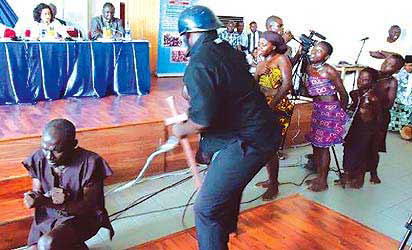
Depictions of the trans-Atlantic slave trade at Esuk Mba in Akpabuyo near Calabar, CRS
By McPhilips Nwachukwu
NIGERIAN poet, Odia Ofeimun, in the second stanza of one of his poems titled Lagoon captures the enduring memory vault of the sea when he writes:
The lagoon speaks
Like fetus remembering future
Listening from the depths of formless song
For the Words that break
Against the voyages of discovery
In the discovery of voyages.

Depictions of the trans-Atlantic slave trade at Esuk Mba in Akpabuyo near Calabar, CRS
However, one may not easily come to terms with the truth encapsulated in this beautiful stanza that conveys the image of the lagoon as the “collective unconscious” from which all human and environmental memories are buried except one is confronted with the coming and going of sea tide. It is this kind of reality that one experiences as one takes time off to see and inhale from timeless experience at the Marina Resort home of Museum of Slave History in the paradise city of Calabar.
Nestling at the bank of the Atlantic ocean through her route through thousands of slaves were shipped away to work in the new world of America and the Caribbean, the eternal wave of the sea that splashes at sea banks continues to come memory of time past: to the visitor, the sea reminds of the howling cries and drowning noises of the unfortunate slaves. It reincarnates the years of barbarism. As one walks into the reception hall of the Museum, the first thing that opens one’s floodgate of memory is the unsettling lyrics of Elton John’s Abide with Me:
Abide with me, fast falls, the even tide
The darkness deepens, Lord with me, Abide
When other helpers fail, and comfort flee
Help of the helpless, oh, abide with me…
As this painful song reels out from the background of large screen mounted on the wall for the screening of images from the obnoxious human trade, one is taken on a journey that traverses through time, pain and suffering. One source had it that John’s song, Abide with Me, was shaped by the type of songs sang by slaves while on board being shipped away to America. This claim may be credible when viewed from the fact that the popular hymn toes the pattern of songs sang in American plantations by the over laboured slaves; songs that became popular as Negro spirituals.
Like Ofemun’s poetic claim in his lagoon, the Calabar Sea makes the visitor to begin afresh like a fetus to remember of the day of copulation, pregnancy and birth. He begins to remember even as distorted images, the years of teething and growing up and in fact, the story of the enslaved which can be rightly be described as a story that begins from the middle, and a story that eventually may end up being told without beginning or end. At the museum this story starts with a visit to a section with an artistic recreation of large ship used by the slave merchants to ship the captured slaves to the new world where they were sold off. In the ship, sculptural human figure impressions done by an artist are tightly packed like sardines with their heads arranged with some tucked into the boot of the ship while other heads are turned to face the sea even as they are tied to iron bars with their mouths gagged. Atop the ship are neatly stacked kegs of palm oil and different varieties of spices. According to the museum’s tour guide, Fidelis Uzor, who conducted us round the museum, “the slaves were packed in such a manner that made it impossible for them to converse or talk to one another. Also the palm oil and spices were sold when they got to America to make up for the cost some slaves who died in the course of the journey to the new world.”
The ship, he further explains “was big enough to carry between 150 and 200 slaves at a time on each trip.” The infamous human trade, which prevailed from the 15th century and lasted to early part of the 19th century according to a source: From the Atlantic Slave trade census. P.Curtin, resulted in the enslavement of 776,400 people from the Bight of Biafra, which constituted 30.1 per cent of the entire, 2, 579, 500 volume of English slave trade in Africa between 1690 to 1807. According to our guide, about 40 per cent of the entire number of slaves shipped away from the coast of Calabar to the new world were taken from Calabar and its environs and hence, the location of the museum in the city. What further makes the experience of slavery more real and sorrowful at this museum is the audio animation provided by the management of the museum. As one watches with wonder and admiration the artistic recreation of this sorrowful candour, he is also immediately drawn into the cathartic field following the animation of characters which brings to reality the pains of anguish, wickedness, torture, abandonment and hate oozing out of the slave drivers.
Beside the slaves captured around Calabar and its environs, other slavers, according to our sources, were captured by the raiders from the hinterland and from there marched through strenuous bush paths down to the coast where they were shipped away. However, there is a notorious slave route, called the Akpabuyo Slave Route. According to the book, A Guide to the Slave History Museum: “the Akpabuyo’s slave project is drawn from the spectacular blood men slave revolts on the Akpabuyo plantation in the 1840s and 50s. The plantation harboured slaves for sale and produced food that would be used to feed slaves en route to America and those in the American plantation.
“Today, some of the inhabitants of Akpabuyo are the descendants of slaves that were not sold after the abolition of the slave trade and were rather sent to Akpabuyo plantations as labourers. Also, the market that was used for the sale of slaves in Akpabuyo known locally as Esuk Mba market still practices trade by barter.” Another pathetic section of the museum is the room that houses relics of the slave trade. In this section, one is shown the items used by the Portuguese slave dealers in exchange of slaves. The items include manila, cowries, ceramic jars, bells, swords and dane guns. Also shown in this section are shackles used to tie the slaves on their feet and necks. In retrospect, when one considers the import of these items of exchange, especially with regards to those of swords and dane guns, one is left with no conclusion than that the charade called trade was an exercise in power domination.
Images of local kings
A power to perpetuate the trade as well as a power to continue to make the dominant kingdoms and their kings to continue to lord it over the marginal states. Another revelation clearly made on this visit is the fact that the human trade survived and thrived that long because the invading slave merchants had their collaborators from the local communities. At one section of the museum, there are images of some local kings, who are alleged to have collaborated with the Portuguese merchants in prosecuting the inglorious trade. Some of these local facilitators were so rich that some of them bought fabricated houses from England for themselves. However, the most pathetic site of the museum is the section titled, Final Destination. In this section of the museum, the worn out slaves are seen brought out and auctioned off like discarded commodities. What awakens one from a stream of unconsciousness as the slave goes through this emotional journey is the voice of a white auctioneer, who declares amid high throated laughter:
“Here is a fine piece of African working machine. He is strong and can be used for domestic as well as plantation work. Who goes for him? And one would hear some body reply: “I will pay $10.” “$10 dollar going” the auctioneer retorts. Another buyer would price “$11.” One of the public notices for sale of slaves issued on March 15, 1883 at 10 pm at Potters Hart in Charleston, S.C. reads: “A valuable Negro woman, accustomed to all kinds of house work. Is a good plain cook, and excellent dairy maid, washes, irons. She has four children, a girl about 13 years of age and another, seven; a boy about five and an infant 11 months old. Two of the children will be sold with mother, the other separately, it best suits the purchaser.”
The travails of the slave do not end with his being sold off. No, it is rather after being auctioned off that he undergoes more strenuous, serious and humiliating baptism of fire. There are images that show even as they re-enact through animation instances when the slave’s new master brands his back with smoking hot iron to make for easier identification of his slaves. There are also images of hanged slaves, beaten slaves, slaves put to all forms of dehumanizing punishments as well as infants and adults, who work in the tobacco and cotton plantations over the watch of dogs and stern looking task masters.
Soul stirring phase of traumatic journey
The only soul stirring phase of this traumatic journey in time is that section of the museum aptly tagged Reintegration. This section shows how the slaves in their new world tried to adjust. This reflects in their new found dress sense, social communion and religion. Here there are images of new converts, who have adopted the western form of religion as well as efforts by some slaves to retain the traditional African culture. It is soul stirring to see and explain how the museum uses the popular Ekpe dance to explain the birth of such famous Abakua in Cuba.
With the end of slavery and slave trade, the question becomes: how does the world take advantage of the hybidity of civilization that the process of slavery created to advance human civilization. Already in Nigeria, there exists a pan African body called Centre for Black African Arts and Civilisation, CBAAC, which pioneers effort towards the harnessing of developmental and creative potentials of Africans at home and Africans in the Diaspora for the development of blacks all over the world. This is an important task. And it is time world governments took advantage of the reintegration spirit in furthering peace, progress and development.
Disclaimer
Comments expressed here do not reflect the opinions of Vanguard newspapers or any employee thereof.