By Ebunoluwa Sessou
The United States and Nigeria have reaffirmed their commitment to strengthening bilateral commercial relations and expanding opportunities for private sector–driven economic growth under the U.S.-Nigeria Commercial and Investment Partnership (CIP) framework.
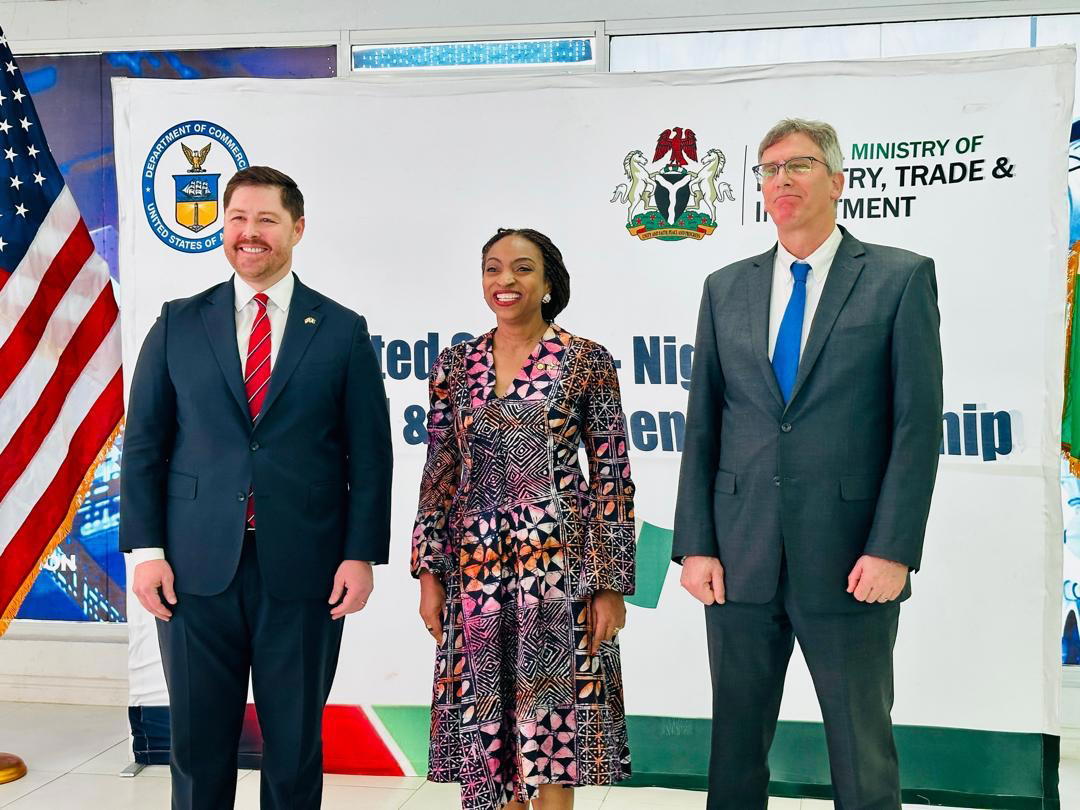
This followed the co-chairing of the U.S.-Nigeria CIP Ministerial held on Thursday in Lagos by the U.S. Deputy Assistant Secretary for the U.S. Commercial Service at the Department of Commerce, Mr. Bradley McKinney, and Nigeria’s Minister of Industry, Trade and Investment, Dr. Jumoke Oduwole.
The meeting marked a continuation of high-level engagements under the CIP, a five-year initiative aimed at deepening two-way trade and investment, improving the business environment, and advancing reforms across key sectors of the economy.
At the ministerial, both governments convened an interagency delegation of trade financing, promotion and project development experts to review priority reforms recommended by the CIP Working Groups on Agriculture, Digital Economy and Infrastructure.
The reforms, developed by U.S. and Nigerian private sector leaders, are expected to deliver long-term improvements to Nigeria’s investment climate and remove barriers to trade and commercial expansion.
McKinney said the ministerial reflects significant progress in strengthening economic cooperation between both countries.
“This meeting underscores the advancements in the vital U.S.-Nigeria commercial and investment partnership,” he said. “Over the past six months, the working groups have developed practical proposals to unlock trade and deepen the bilateral commercial relationship.”
Minister Oduwole applauded the continued strong relationship with the United States, describing the high-level delegation from Washington as evidence of deepening cooperation.
She encouraged U.S. businesses to invest in the partnership’s priority sectors and take advantage of Nigeria’s access to the wider African market.
“A central priority for us is to accelerate non-oil export diversification and ensure more Nigerian businesses can access U.S. markets in a way that is competitive, sustainable and inclusive,” Oduwole said.
She added that since the launch of the CIP Working Groups in June 2025, Nigeria has sustained momentum on business climate reforms, strengthened competitiveness and advanced trade and investment policy alignment.
The ministerial was attended by senior U.S. officials, including U.S. Mission Chargé d’Affaires, Mr. Keith Heffern; Associate Administrator of the Foreign Agricultural Service, Mr. Jason Hafemeister; and Regional Director for sub-Saharan Africa at the U.S. Trade and Development Agency, Ms. Heather Lanigan.
On the Nigerian side, participants included the Permanent Secretary of the Federal Ministry of Industry, Trade and Investment, Ambassador Nura Rimi, and the ministry’s Director of Investment, Mrs. Gertrude Orji.
Under the CIP, both countries are expected to continue consultations on a broad range of trade and investment issues, explore ways to expand trade in goods and services, and encourage increased investment flows to drive growth, prosperity and job creation.
Nigeria is currently the United States’ second-largest trading partner in Africa, with two-way trade in goods and services totaling nearly $13 billion in 2024.
The United States also remains one of Nigeria’s leading foreign investors, with U.S. foreign direct investment reaching $7.9 billion in 2024, representing a 25.2 percent increase from 2023.
Disclaimer
Comments expressed here do not reflect the opinions of Vanguard newspapers or any employee thereof.