By Ndahi Marama, Damaturu
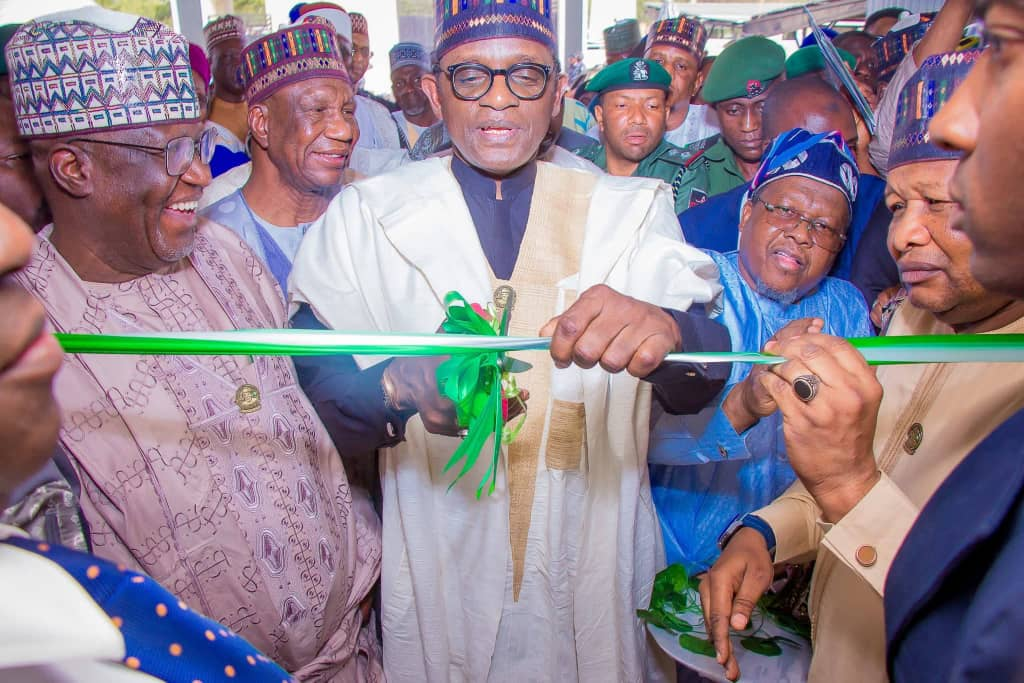
Apparently perturbed by the high increase of kidney disease and other health related ailments, especially among residents of Bade Emirate and communities in the shores of Kumadugu River Basin areas, Governor Mai Mala Buni yesterday unveiled the multi billion naira Biomedical Science Research and Training Centre (BioRTC).
The Centre located at the Yobe State University Teaching Hospital was established to address the long-standing under-representation of African populations in biomedical research, particularly in drug development and disease modelling.
Addressing the gathering, Buni said that the Centre now houses over ₦10 billion worth of advanced research equipment, including technologies unavailable anywhere else in Nigeria.
“This BioRTC is currently leading one of Nigeria’s most comprehensive investigations into chronic kidney disease, focusing on the Bade Emirate. The project, supported by the Yobe State Government, involves a multidisciplinary international team and has already collected over 3,000 biological and environmental samples, with early findings pointing to environmental risk factors requiring urgent policy attention”. He noted.
The permanent facility of the Biomedical Science Research and Training Centre (BioRTC) in Damaturu, Buni added, marked a historic milestone that further positions Yobe State as an emerging hub for advanced biomedical research in Nigeria and across Africa.
Speaking at the ceremony, the Vice-Chancellor of Yobe State University, Professor Mohammed Bashir Tahir noted that the commissioning of the Centre represents far more than the unveiling of physical infrastructure.
According to him, it signifies the consolidation of a bold idea that has already attained credibility, impact, and international relevance.
“BioRTC stands today as one of the most visible and globally connected research initiatives associated with Yobe State University. Its growth affirms that when vision is matched with leadership, partnership, and sustained commitment, excellence is achievable anywhere,” the Vice-Chancellor stated.
He commended Governor Buni for his visionary leadership and unwavering commitment to the advancement of science, research, and higher education in the state. Adding “it as a clear demonstration of leadership that understands development as sustained investment in people, knowledge, and institutions rather than short-term gains”.
He observed that the Governor’s commitment to education and research has extended well beyond BioRTC to the broader development of Yobe State University, yielding measurable academic outcomes.
The VC further revealed that, between 2019 and 2025, the University recorded the graduation of 106 First-Class graduates across disciplines spanning the sciences, humanities, and management studies—an achievement he described as a strategic human capital asset for Yobe State and Nigeria at large.
Prof. Tahir also formally recognised Professor Mahmoud Bukar Maina, Founder and Director of BioRTC, for his scientific leadership, resilience, and dedication to capacity building in Yobe State, describing Professor Maina’s decision to establish a centre of international calibre in Yobe as a strong vote of confidence in both the University and the State.
He reaffirmed Yobe State University’s commitment to sustaining an enabling institutional environment that promotes academic excellence, innovation, and transparent partnerships, while deepening constructive collaboration with BioRTC for the benefit of students, researchers, and the wider society.
Also speaking at the ceremony, the Director of BioRTC and Shettima Ilmube of the Damaturu Emirate, Professor Mahmoud Bukar Maina, described the commissioning as “the opening of a possibility,” signalling Nigeria’s deliberate shift from being a consumer of global knowledge to becoming a producer of world-class science.
Highlighting the Centre’s achievements within just four years, Professor Maina revealed that “BioRTC is currently leading one of Nigeria’s most comprehensive investigations into chronic kidney disease, focusing on the Bade Emirate. The project, supported by the Yobe State Government, involves a multidisciplinary international team and has already collected over 3,000 biological and environmental samples, with early findings pointing to environmental risk factors requiring urgent policy attention”.
He also disclosed that the Centre has developed innovative open-science, battery-powered microscopes for field-based malaria diagnosis, is integrating artificial intelligence into diagnostics, and now hosts Africa’s first open-access induced pluripotent stem cell (iPSC) biobank, a landmark initiative allowing diseases to be studied using African-derived biological systems.
According to him, BioRTC is also leading Nigeria’s most deeply characterised dementia and Alzheimer’s disease research cohort, placing the country firmly on the global map of neuroscience research.
In the area of human capacity development, Professor Maina said BioRTC has trained over 1,000 scientists from Yobe State, Nigeria and across Africa through international summer schools and specialised programmes since 2022, with experts drawn from leading institutions across the world.
Building on this momentum, he announced the establishment of the BioRTC–University of Maiduguri MSc and PhD Neuroscience Programme, the first of its kind in Nigeria and only the second in Africa, designed to train world-class neuroscientists locally.
In another development, the people of Yobe State have lauded the Executive Governor for his generous recognition of three TeenEagle World Champions from the state. The champions—Nafisa Abdullahi, Rukaiya Mohammed Fema, and Hadiza Kashim Kalli—were each awarded ₦10 million, laptops, and full scholarships for higher education, following their outstanding performance at the international TeenEagle competition in London.
Disclaimer
Comments expressed here do not reflect the opinions of Vanguard newspapers or any employee thereof.