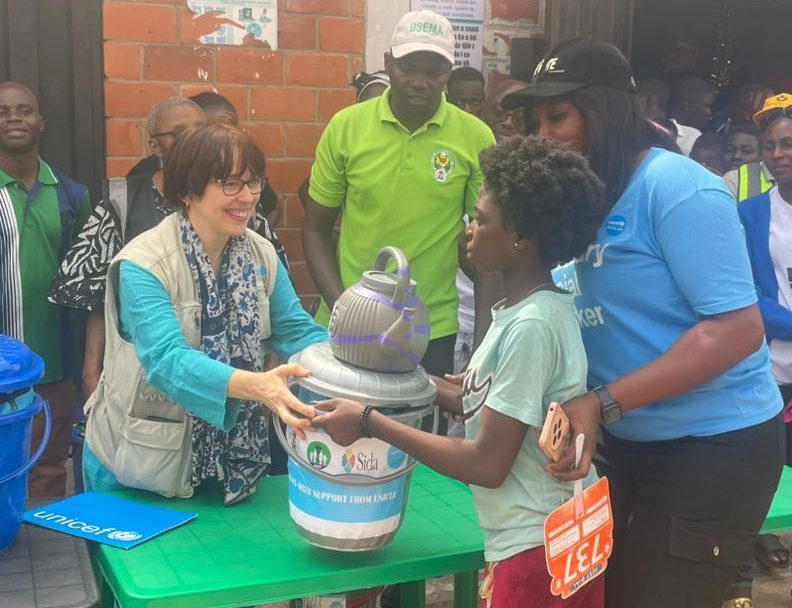
The UNICEF Chief, Field Services doing a presentation at the Makurdi IDP camp
By Peter Duru, Makurdi
The United Nations Children’s Fund (UNICEF) has called on governments, donors and other stakeholders to scale up support for internally displaced women and children in Benue State, following the prolonged humanitarian crisis caused by violent attacks in parts of the state.
Speaking on Wednesday during a visit to the Internally Displaced Persons (IDPs) camp at the Makurdi International Market, established for victims of the Yelewata attack, UNICEF Chief of Field Services, Judith Léveilée, said the situation of displaced families, particularly women and children, remains critical despite a reduction in the intensity of the crisis.
Léveilée, who said she had been monitoring developments in Benue since assuming duty in September 2024, described her first visit to Makurdi as “impressive,” commending the efforts already made to support vulnerable populations in the camp stressing that over 3,000 displaced persons were currently living in the International Market IDP community.
“I must say that I am very impressed with what has been done so far to help the women and children who are living in this community. We are interacting with more than 3,000 people here who have been displaced due to the conflict, though there were more people before,” she said.
She explained that they inspected sanitation facilities, safe spaces for women and girls, and were scheduled to visit the health centre, stressing the importance of preventing disease outbreaks in emergency settings.
“One of the most important things in emergencies is to prevent epidemics. Access to safe water and adequate sanitation is extremely important,” she noted.
The Chief of Field Services who also participated in the distribution of hygiene kits to 100 girls in the camp done in collaboration with the JASPI Health and Gender Development Initiative, emphasized that “distributing hygiene kits not only brings dignity to displaced people but also encourages good hygiene practices.”
She also raised concerns over the lack of educational services in the camp, revealing that discussions had been held with the State Universal Basic Education Board (SUBEB) on the need to restore learning opportunities for displaced children.
“Young people and children want to have education, but at the moment there is none. There was some support before, but due to funding challenges, it could not be sustained,” she said.
Léveilée disclosed that Benue State hosts more than 14 IDP camps with over half a million displaced persons, describing the population as extremely vulnerable and in urgent need of protection, education, healthcare and sanitation services.
While acknowledging the support of donors, the Benue State Government, the State Emergency Management Agency (SEMA) and partner organisations, she lamented a sharp decline in humanitarian funding.
“Our funding has decreased tremendously, but we are doing everything possible to mobilise more attention,” she said, adding that UNICEF plans to deploy a full-time staff member to Benue state to provide technical assistance to government and communities.
On her part, Patricia Suswam, Executive Director of JASPI Health and Gender Development Initiative, said her organisation was distributing hygiene kits to displaced girls to help them manage their personal and menstrual hygiene with dignity.
“These kits are essential for girls to manage their lives. They asked for them, and this is the second time we are providing them, on a yearly basis,” Suswam said.
She explained that the kits include reusable sanitary pads, disposable pads, soap, toothpaste, toothbrushes, cups and other essential items, noting that the number of reusable pads provided could last for over one year.
“From where they are coming from, many of them do not have access to procure these items. The package also supports other family members, making life a bit easier for them instead of resorting to begging,” she added.
One of the beneficiaries, Deborah Orya, expressed gratitude to UNICEF, JASPI and other partners for the support, assuring that the hygiene kits would be used judiciously to improve the wellbeing of her family.
Disclaimer
Comments expressed here do not reflect the opinions of Vanguard newspapers or any employee thereof.