By Emmanuel Elebeke
Laureates of the Nigerian National Order of Merit (NNOM) have called for the institutionalisation of Science, Technology and Innovation (STI) communication as a strategic tool for accelerating Nigeria’s economic growth and achieving sustainable national development.
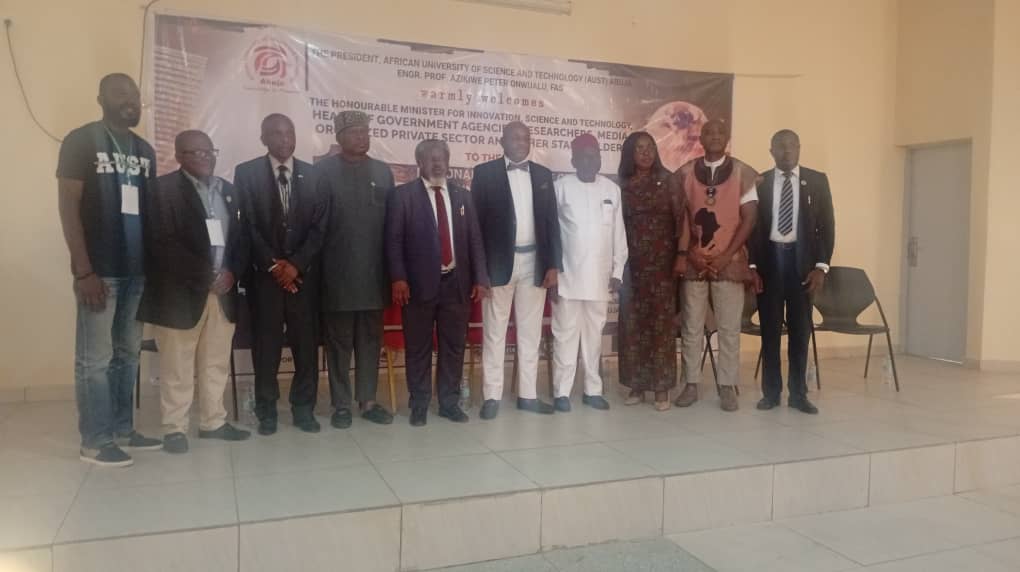
The call was made at a Townhall Forum held on the sidelines of the first National Conference on Science, Technology and Innovation Communication (STICOMMS’26), which took place from January 20 to 22, 2026.
The conference was organised by the African University of Science and Technology (AUST) in collaboration with Oracle Solutions Limited, publishers of the African Science & Technology Digest (AfriscitechDigest), with support from partner organisations.
Speaking at the forum, the Chairman of the NNOM, Prof. Hilary Inyang, underscored the importance of science communication in translating research outputs into governance tools, industrial development and socio-economic growth.
He noted that although Nigeria has produced world-class experts across various scientific disciplines, the country has yet to fully harness science, technology and innovation for national development.
“Since independence, about 70 Nigerians have been awarded the National Order of Merit, but only 39 are still alive today. Their contributions underscore the depth of knowledge available, yet more must be done to translate STI into tangible national benefits,” Prof. Inyang said.
He explained that the Nigerian National Merit Agency (NNMA) convened the forum to deepen discussions on science communication and encourage experts to share insights on converting research and innovation into socio-economic development outcomes.
According to him, while the Federal Government is promoting STI and its applications, deliberate and structured mechanisms are required to achieve measurable impact.
The NNOM Laureates jointly called for the establishment of a Centre for STI Communication, Research Commercialisation and Science Diplomacy to enhance public understanding of science, accelerate industrialisation and promote job and wealth creation.
Also speaking, Prof. Ogunmola Gabriel of the University of Ibadan criticised the fragmented nature of Nigeria’s scientific ecosystem, noting the lack of coordination across sectors.
“We appear to be working in different directions and are not effectively mobilising the national economy. There is a need to coordinate the entire scientific structure,” he said.
Prof. Ogunmola also decried inadequate funding and Nigeria’s reliance on foreign research infrastructure, calling for improved budgetary allocations and stronger integration of the STI ministry into the national economic framework.
On government policy, the Head of the Presidential Task Force on Executive Order No. 5 at the Federal Ministry of Innovation, Science and Technology, Engr. Ibiam, said the effective use of STI remains a key distinction between developed and developing nations.
“Developed countries take ideas from conception to the market. In Nigeria, we must ensure that our human capital is fully utilised and our raw materials are processed locally,” he said.
He explained that Executive Order No. 5 and the “Nigeria First” policy were designed to stimulate demand for locally developed innovations by mandating government patronage of made-in-Nigeria products.
According to him, the policy aims to de-risk innovation, support prototyping and encourage the commercialisation of research outputs.
Addressing environmental and community-level challenges, the Vice-Chancellor of the University of Environmental Studies, Science and Technology, Ogoni, Prof. Chinedu Mmom, lamented poor access to research funding and weak collaboration between academia and communities.
He stressed the need for closer engagement between researchers and local communities to address development challenges, noting that research findings on issues such as pollution, desertification, flooding and resource extraction often fail to reach affected populations.
Speakers also warned that limited dissemination of critical information—particularly in rural areas—has worsened disaster impacts, citing instances where flood predictions by NIMET and international agencies failed to reach vulnerable communities.
Similarly, the Director of Research on Polymers and Advanced Composites at SHEDA, Dr. Edith Ishedi, described the STI ecosystem as fragmented, attributing the challenge to poor communication and siloed operations.
“There is a communication gap. We work in silos, but we must work together,” she said.
Climate change expert, Prof. John Osunwa, called for a policy realignment, noting that Nigeria currently operates multiple overlapping climate change policies. He urged policymakers to prioritise the commercialisation of viable innovations rather than dispersing limited resources across numerous initiatives.
“Economic emancipation comes from moving ideas from conception to products on the table,” he said, citing his experience in developing market-ready products from agro-waste and polymer reinforcement.
Several speakers expressed concern over Nigeria’s low investment in research and development, revealing that the country allocates about 0.15 per cent of its budget to R&D—well below the African Union’s recommended one per cent.
Dr. Henry Emeju and other participants urged the Federal Government to meet the AU benchmark, emphasising that research outcomes should translate into market-ready products and that the STI ministry should retain a high strategic national status.
Addressing the health sector, participants highlighted challenges including underfunding, digital literacy gaps and limited medical infrastructure, noting that Nigeria’s health sector funding remains below global standards.
In his remarks, Prof. Ohuegbulem of an Enugu-based university stressed the importance of motivation, meritocracy and digital skills in driving national development.
“Without addressing digital literacy and recognising merit, progress will remain limited,” he said.
The conference concluded with a consensus that effective STI communication, increased investment in research and development, coordinated policy frameworks and stronger collaboration among academia, industry and government are essential for translating research into sustainable national development under Nigeria’s Renewed Hope Agenda.
Disclaimer
Comments expressed here do not reflect the opinions of Vanguard newspapers or any employee thereof.