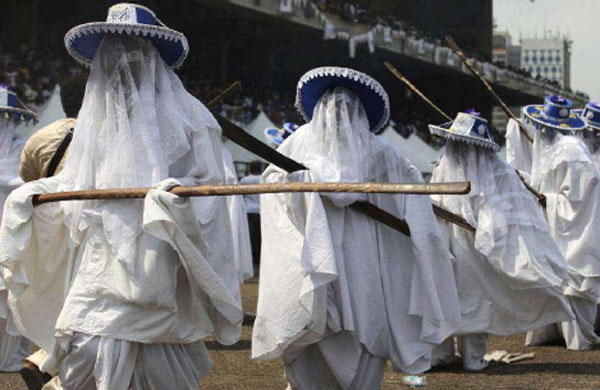
The Eyo Masquerade
By Alade Aromashodu
THE Eyo festival, otherwise known as Ada mu Orisa play, a vibrant Yoruba masquerade unique to Lagos Island (Eko) hinter awwland of Lagos, Nigeria, featuring white-clad Eyo figures representing ancestral spirits that parade with staffs (opambata) to honor deceased Obas (kings) or chiefs, mark new leadership, or for special state occasions, evolving from secret society rites to a major cultural and tourist event showcasing Lagos’ rich heritage, would trooped out of the Island on Saturday, December 27, in commemoration of Sir Michael Otedola, who passed away in 2014 at 87.
This year’s festival would feature 66 groups (Iga) with five groups of the Orisas (deities) as the head of all, The Adimu (Orisa baba Nla Mila); Okanlaba Ekun (Alakete pupa); Eyo Orisa Oniko (Abara yewu, egun Onigemo); Eyo Orisa Ologede (Olugbani), and Eyo Orisa Angere (Agere mo’lokun) respectively. A unique feature of the event is its infrequent staging, the festival does not hold on an annual basis like the popular Lagos carnivals of Olowogbowo, Oko-Faji, Egungun etc. There have been times in the past when for 21 years, the event did not hold.
Also, there had been years when Eyo was staged three, four and five times in a single year: 1903, 1906 and 1909 respectively. However, the five traditional Eyo deity groups: Eyo Orisa Adimu, Eyo Okanlaba, Eyo Orisa Oniko, Eyo Orisa Ologede and Eyo Orisa Angere are the leading groups on Adamu Orisa Play day. At the Awe Oniko (Oniko cult), in Isale Eko, Lagos, Mr Aliu Bajulu, Captain of the Orisa Oniko, has reiterated last week, uniqueness of Eyo Orisa Oniko among other orisa groups.
According to him: “Eyo festival, Adamu Orisa Play, is the traditional play of Lagos staged for the commemoration of final burial obsequies of an Oba or a chief, and sometimes in memory of a deceased person who had contributed to the progress and development of Lagos,” Bajulu said. Bajulu who spoke on behalf of other leaders of Awe Orisa Oniko, stated that registered members of the group are eminent personalities including military personnel, police and paramilitary. He further warned that security operatives would be on ground to maintain law and order on the Adamu Orisa Play day.
Continued, Bajulu noted: “Origin of Eyo masquerade has been a conflicting traditions debate but scholarly analysis points to Iperu-Remo (Ijebuland), Ogun State, Nigeria, as a key site of early practice, from where it spread via cultural exchange to Lagos. One account describes it arriving in Lagos as a wedding gift when an oba (king) married an ijebu princess who embedding it in Isale Eko customs. Another ties it to Ibefun in Ijebu, where the Adamu Orisa deity prompted the masquerade’s creation for protection. “Lagos adoption of Eyo festival became institutionised in Lagos Island around 1854 to honour deceased obas like Akintoye or instal new leaders, representing ancestral spirits in white agbada attire,” Bajulu stated.
Meanwhile, despite ijebu influences, its prominence is distinctly Lagosian organised by indigenous palace (Iga) and forbidden from crossing water overnight. Ibefun stories link Eyo to the Adamu Orisa deity, originating there, the masquerade emerged to protect the deity from hooligans using the iconic staffs (opambata), as a weapon. A childless princess from the town, Olugbani who married Oba Ado of Lagos embedding Eyo practices, brought as part of her entourage.
Tradition recounts Olugbani consulting Ifa diviners in Ibefun, where the oracle prescribed sacrifices leading to the Adamu Orisa cult’s development, this included creating the Eyo masquerade with opambata staffs for deity protection, later introduced to Lagos for her husband’s burial rites. Eyo Okanlaba (Alakete pupa), on its own, functions as the ‘Police’ of the Orisa Adimu administration. ‘Laba ensures and maintains maximum discipline among the Eyo groups.
They must ensure that Eyo groups keep to the rules and regulations of Adamu Orisa Play. They take directives from Awe-Adimu (adimu cult) and maintain regular contact with Awe Adimu throughout the preparation period and Adamu Orisa Play day. Other major function of Eyo Laba is to construct “AGODO” (an enclosure constructed with mats) on the eve of Adamu Orisa Play day, along Enu-Owa Street (now Iga Iduganran Street) to house the drummers on the instruction of the elders of Awe Adimu. They are among the Eyo groups to lead opa processions for the announcement of Adamu Orisa Play day.
Disclaimer
Comments expressed here do not reflect the opinions of Vanguard newspapers or any employee thereof.