By Jude Njoku & Kingsley Adegboye
Nigeria’s inflation rate according to statistics released by the Central Bank of Nigeria, CBN, rose to 12.9 percent in April 2012. As the inflation marches forward every year, the fear is that people’s buying power will diminish if their investments do not appreciate as quickly as the cost of what they buy.
There is also the fear that the Naira and major world currencies could become worthless someday apparently due to hyperinflation. In a related development, Nigerians who invested in the stock market during the bullish era, are today counting their loses while those who fixed their money with banks or invested in bonds, have also witnessed a depreciation in the value of such funds.
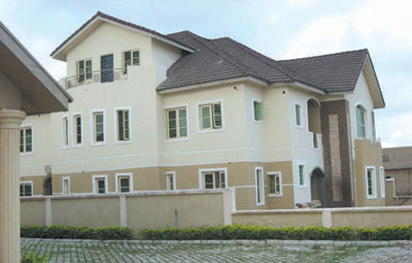
Against this backdrop, many Nigerians who had before now, shied away from investing in real estate, have suddenly discovered that it is the best form of investment because it serves as a hedge against inflation. The shift is seen by real estate professionals as a welcome development because real assets like property hold their value better than paper assets which have their value easily eroded by inflation.
Like gold, real estate tends to retain its intrinsic value even during periods of inflation. But unlike gold, it is possible to earn a regular income on real estate. Depending upon various economic factors, a property owner can increase rent in times of high inflation.
A Lagos-based Estate Surveyor and Valuer, Mr. Kunle Awolaja noted that even if the real estate sector experiences a crash as is presently the case in the United States and Europe, the properties will still be there and will later appreciate. Awolaja who is the General Secretary of the Nigerian Institution of Estate Surveyors and Valuers, NIESV, however warned those intending to invest in real estate not to buy blindly. 
According to him, they should take into consideration, the physical and land use administration/ planning of the area they intend to invest in. “If you don’t do this, you may buy land in a place that has been zoned for a dump site; what that means is that your property may not appreciate. Look at what is happening along the Mowe -Ibafon axis, (Lagos -Ibadan expressway) people didn’t wait for the planning of the area before buying land because they have this notion that land will appreciate, no matter where it is. This is creating a lot of problems and the area is being turned into slums from the onset,” he said.
A former Managing Director, Lagos State Development and Property Corporation LSDPC, Mr John Bede Anthony, an Architect, corroborated this view. He described real estate as the best form of investment because of the possibility of capital appreciation. “If one decides to put for instance, N1 million in the bank today, after one year, the money becomes less than the N1 million; it is only land and houses that appreciate. ‘The best form of of investment all over the world today is property investment’’, the former LSDPC boss said. He urged investors to make their decisions based on their own income, existing financial health and risk appetite.
Mr John Bede who is now a developer said property investment is different from other forms of investments because real estate is a multi-dimensional asset while other forms of investments are limited to one dimension with intrinsic differences.
‘’For example, your stock investments are one dimensional. You buy low and hope to sell high. Maybe it pays you a small dividend once in a while. You pay taxes on them, then sell them and get hit with the capital gains tax. But over the years, real estate has proven itself time and again to be the premium asset if you want to create life-changing wealth. The multi-dimensional nature has a lot to do with that.
‘’With real estate it is all about buying low and selling high. Other dimensions include mortgage and cash flow in the rental market. Your mortgage is a major asset in real estate business. The mortgage you hold can never be duplicated due to the ravaging effects of inflation. In case of cash flow in the rental market, rents from your property investment can be increased each and every year to keep pace with inflation. But no one can stop you from increasing rents at a reasonable rate in comparison to the inflation rate. This is important for any investor focused on long term positive cash flow properties,” he said.
Continuing, the former LSDPC boss said: ‘’Rent increases are treated the same as the salary you earn from your job. Employers increase your salary at a nominal rate, based on inflation. This is because your salary should increase based on the rate of inflation in the country you live in. Cash flow pays your expenses, most notably your mortgage, the biggest expense you will have over the life of the mortgage. Once the mortgage is paid off, your cash flow increases exponentially.
Cash will increase based on the rate of inflation , giving you more purchasing power. ‘Most importantly, cash flow puts money in your pocket at the end of the month, each and every month, for the entire time you hold that property investment.
In addition, if investors focus on investing in properties that have six or more units, the banks will solely look at the positive cash flow property and provide financing based on the properties ability to support themselves without the need of the investor’s personal financial status.
That is to say, as long as the property has enough positive cash flow to sustain itself, banks would not require personal financial information from clients, such as your income, net worth and any other financial information deemed necessary for applying for a mortgage. ‘’One cannot deny that your expense will go up, also based on the rate of inflation. It is natural that inflation exists, just as it is natural that expense for products and services go up over time, and so too does your rents.
Disclaimer
Comments expressed here do not reflect the opinions of Vanguard newspapers or any employee thereof.