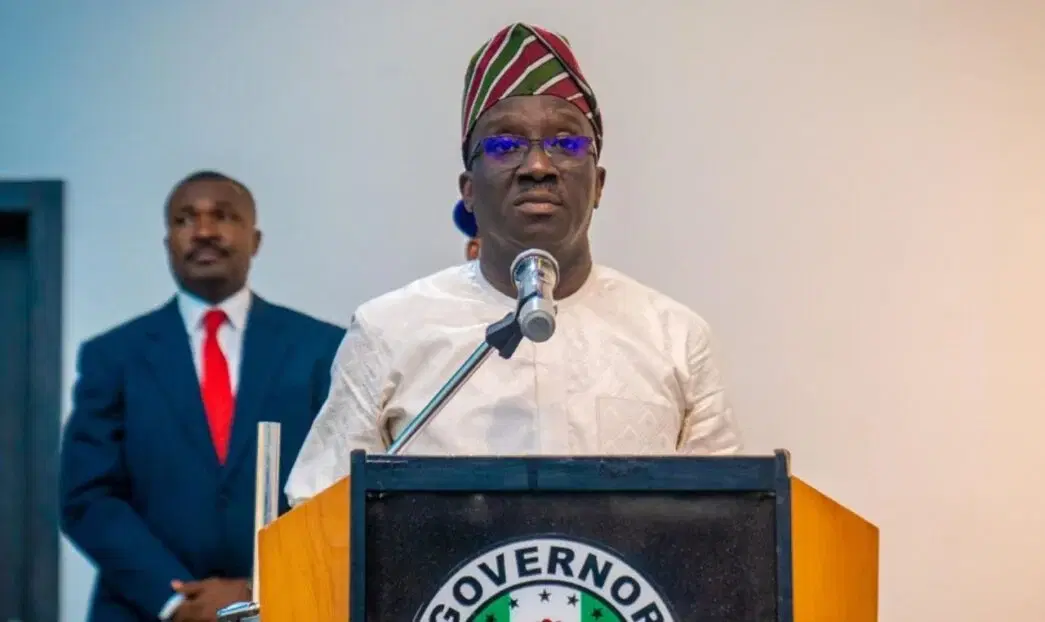
Governor Monday Okpebholo of Edo State
The Benin Unity League has lauded Edo State Governor, Senator Monday Okpebholo, following the state’s emergence as one of Nigeria’s strongest-performing states in budget implementation for the 2025 fiscal year, describing the development as a clear signal of fiscal discipline, credible planning, and effective governance.
Data compiled by Agora Policy, based on states’ budget implementation reports, shows that Edo State achieved an 81.2 percent budget execution rate between the first and third quarters of 2025, placing it among the top performers nationwide.
The figure positions Edo narrowly behind Lagos State, which recorded 81.5 percent, and ahead of several states with significantly larger revenue bases.
In a statement, Tuesday, by National President, Dr. Osarumwense Osayawemwem, the performance was particularly noteworthy given Edo State’s revenue profile and economic structure.
According to the group, sustaining budget execution above 80 percent without the advantage of oil windfalls or extraordinary fiscal buffers reflects strong institutional coordination, prudent spending choices, and realistic budgeting under the Okpebholo administration.
Osayawemwem said: “Budget performance is not measured by announcements or projections, but by the ability of a government to translate plans into execution. Edo’s performance confirms that Governor Okpebholo is prioritising implementation, not optics.”
The League noted that across Nigeria, many states struggled to meet even half of their pro-rated budget targets within the same period, despite higher federal allocations and internally generated revenue. Against this backdrop, Edo’s near-parity with Lagos was described as a significant governance achievement, demonstrating that disciplined fiscal management can compensate for limited resources.
According to the analysis, Edo’s spending pattern reflects a balanced approach—one that aligns capital project execution with debt servicing and recurrent obligations, rather than front-loading expenditures or relying on borrowing to mask weak implementation. The League said this approach has helped the state avoid the common pitfall of aggressive budgeting followed by poor delivery.
The commendation also comes at a time when Governor Okpebholo has presented a proposed ₦939 billion budget, with an additional ₦850 million, to the Edo State House of Assembly for the 2026 appropriation year, christened the “Budget of Hope and Growth.” The League described the proposal as consistent with the administration’s emerging reputation for realism and fiscal coherence.
Observers say the strong 2025 budget performance gives added credibility to the 2026 proposal, suggesting that the administration is building budgets around implementable priorities rather than aspirational figures. Unlike previous cycles where budget size often bore little relationship to execution capacity, the League said Okpebholo’s budgets appear rooted in economic realities and administrative capacity.
The Benin Unity League further argued that Edo’s performance under the current administration contrasts with a broader national pattern in which budget credibility has declined due to repeated underperformance. In that context, sustaining execution above 80 percent was described as an indicator of planning integrity and institutional seriousness, rather than mere revenue availability.
“Edo is proving that governance is not about how big a budget is, but how well it is implemented,” the statement said. “This administration has shown consistency between planning, appropriation, and execution.”
The group concluded that Governor Okpebholo’s approach to budgeting and fiscal management has begun to restore confidence among stakeholders, including civil society groups, investors, and development partners, who increasingly view budget performance as a more reliable measure of governance than political rhetoric.
Disclaimer
Comments expressed here do not reflect the opinions of Vanguard newspapers or any employee thereof.