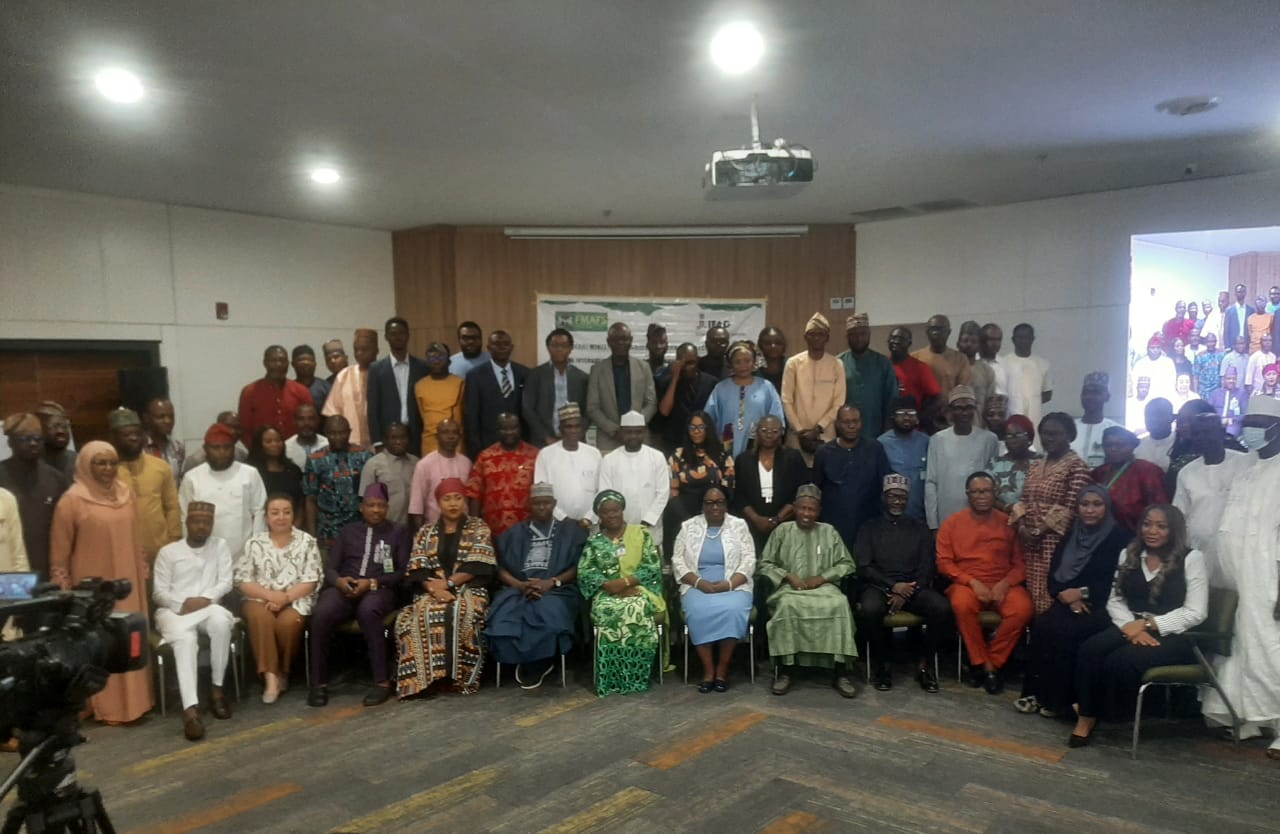
Participants at the meeting
… as COSOP 2025 Review highlights major gains, gaps
By Peter Duru, Makurdi
The Federal Government of Nigeria and the International Fund for Agricultural Development (IFAD) have opened the 2025 Second Annual Review of the Country Strategic Opportunities Programme (COSOP), with development partners, government ministries, private sector actors and farmer organisations calling for accelerated action to strengthen Nigeria’s agrifood systems.
The COSOP, a five-year cooperation framework (2024–2029), was jointly developed by IFAD, the Federal Ministry of Agriculture and Food Security, the Federal Ministry of Finance, and key development partners. Now in its second year of implementation, the review aims to assess progress and realign strategies toward meeting the 2029 targets.
In her opening remarks, IFAD Country Director, Mrs. Dede Ekoue, said the programme had recorded major achievements, particularly in processing and storage facilities, support to rural producers, and improved access to finance.
“The portfolio is demonstrating strong overall progress toward achieving the 2029 COSOP targets. We have overachieved in the development of processing and storage facilities, and we continue to strengthen rural producers’ organizations and their participation in markets,” she stated.
But Ekoue stressed that challenges still remain. “With regards to water infrastructure and land brought under climate resilience, these two are still a challenge, so we need to scale up and accelerate implementation,” she warned.
She added that the review would help stakeholders “identify ways to enhance these results in 2026,” noting that Nigeria’s digital agriculture agenda and youth inclusion strategy remain critical in driving transformation.
Speaking further on the purpose of the review, Ekoue said: “It is important to review what progress was made, what challenges we need to address, and how to accelerate impact. We cannot just say everything is fine. The challenges in the agrifood system require that we mobilize everyone to scale up the impact of our cooperation.”
She reaffirmed IFAD’s commitment to supporting Nigeria’s to reach at least 450,000 rural households by 2029.
The Assistant Director, International Economic Relations, IER, Department, Federal Ministry of Finance, Mrs. Munet Sadiku said the government remained committed to the partnership with IFAD and to improving funding predictability for IFAD-supported projects.
“Over the past year, the Ministry of Finance has worked diligently to improve the predictability and timeliness of Federal counterpart funding. We remain fully committed to ensuring that financing mechanisms support, do not hinder, the achievement of project results,” she said.
Sadiku emphasized the need for accountability and strengthened financial practices, noting that, “Effective stewardship of public resources is not only a requirement, it is a collective responsibility that underpins the credibility of our development efforts.”
She also highlighted the Ministry’s priorities for 2026, including digital financial reporting, climate-smart investments, gender-responsive budgeting, and improved coordination with States and MDAs.
Delivering the remarks of the Federal Ministry of Agriculture and Food Security, Mrs. Adebola Iruromi, Director of the Department of Development Partners Projects, praised the momentum recorded so far but called for scaling up of successful innovations across states.
“This review is more than a technical exercise. It is a strategic moment to reflect on our joint progress and strengthen the pathways that will shape Nigeria’s agrifood system transformation.”
Iruromi highlighted the achievements of models such as the Gender Action Learning System, the Commodity Alliance Forum, youth agripreneur networks, climate-resilience initiatives, and ICT4D solutions. “These models are essential to achieving national targets under the National Food Systems Transformation pathways,” she said.
“Despite the progress, challenges such as inflation, insecurity, climate shocks, and uneven state-level execution require stronger monitoring, digital tools, and deeper accountability,” she added.
Stakeholders also spotlighted the role of digital innovation. The Country Lead of Digital Green Nigeria, Mr. David Edimu, said technology was bridging the extension service gap.
He noted that “as the name implies, we digitize extension, we want to put extension in the hands of every farmer. Because even when we have extension agents, it’s about one to eight thousand farmers. This is why we must leverage digital solutions.”
Edimu noted that the AI-supported platform allows farmers to ask questions in their local languages, diagnose crop problems using images, and access timely agronomic information. “We are digitizing extension in Africa,” he added.
The Microcredit Manager for Development Exchange Centre, Emily Stephen, said efforts to digitize financial services had made it easier for farmers to access credit, though challenges remain.
“Even rural farmers are doing well in accessing their credit through digital forms, but many farmers do not have phones. So, as an institution, we have developed a phone-loan product so that they can communicate with financial institutions for seamless operations,” she said.
The National Coordinator of the National Committee for Family Farming, Mr. Raymond Enoch lauded the COSOP initiative saying it remains essential to strengthening Nigeria’s food system.
“The COSOP is intended to sustainably improve the capacities of rural farmers. Family farmers expect continued opportunities and policies that improve the food system in the country,” he stressed.
Enoch emphasized that stakeholders were expected to develop concrete action points to address implementation gaps, scale successful models, and ensure that COSOP delivers stronger impact in 2026 and beyond.
Disclaimer
Comments expressed here do not reflect the opinions of Vanguard newspapers or any employee thereof.