…raise funds through arts
By Favour Ulebor, Abuja
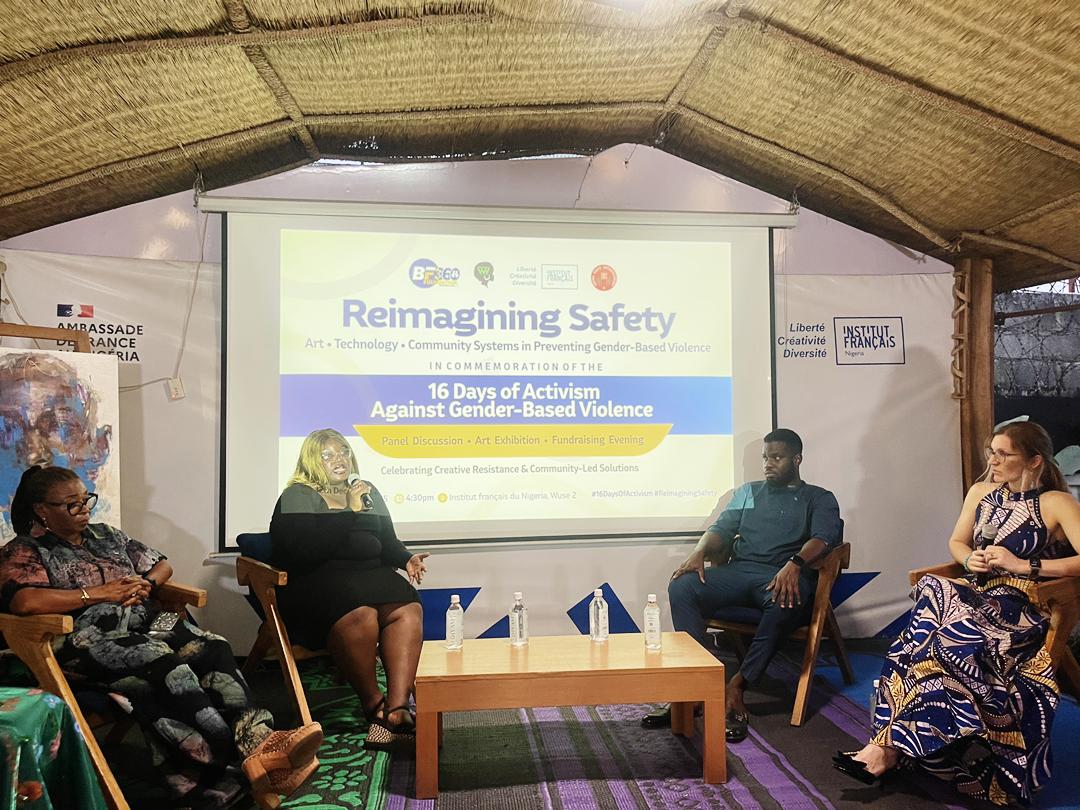
In commemoration of the 16 Days of Activism, Wonder Woman Nigeria, in partnership with Big Family 360 Foundation, raised funds through an art exhibition to support the construction of a temporary shelter for survivors of sexual and gender based violence, SGBV, in Adamawa State.
The fundraiser, hosted at the Institut Français, on weekend in Abuja, themed; Art/Innovation against GBV, brought together civil society organisations, artists, development partners, diplomats, filmmakers, and government representatives to confront one of the most pressing yet least addressed needs of survivors of violence in Nigeria: safe shelter.
Beyond advocacy and awareness, the organisers said the event was designed to mobilise concrete support for women, girls, and even men who are forced to flee abuse but have nowhere to stay.
Vice President and Trustee of Wonder Woman Nigeria, Anne Dirkling, explained that the decision to organise the fundraiser and focus on the northern part of the country was shaped by years of frontline work in Kaduna and Kano States.
According to her, both Wonder Woman Nigeria and Big Family 360 consistently receive distress calls from survivors of gender based violence who have exhausted all options except shelter.
She explained that while organisations are often able to refer survivors to hospitals, law enforcement agencies, government institutions, and psychosocial services, the absence of safe places to sleep remains a major gap.
Dirkling said Nigeria has roughly 50 shelter homes nationwide, meaning several states have none at all, leaving survivors stranded at the most critical point of escape.
She said, “We can direct them to medical care services, we can direct them to law enforcement agencies, we can direct them to also government agencies and provide social or mental support. But where to go to when it’s really a dire case of you need shelter?”.
Dirkling said the shelter project is a co project between Wonder Woman Nigeria and Big Family 360, which has a strong grassroots presence in Adamawa State.
She noted that the partnership aims not only to raise funds but also to inform government agencies, allies, and advocates about ongoing work and future plans, encouraging co funding and collaboration to bring the shelter to life in 2026.
Beyond temporary accommodation, she said the shelter would offer survivors peace, stability, and time to rebuild their lives.
According to her, having a safe space allows survivors to regain clarity, reconnect with psychological and medical care, and plan their next steps without the fear of homelessness, particularly for women with babies and young children.
On the choice of art as a fundraising and advocacy tool, Dirkling said creative expression helps translate statistics into human stories.
She noted that repeated exposure to numbers often numbs society, while art restores emotion, memory, and perspective, giving voice to survivors who are not yet healed enough to speak publicly.
In her opening address, Dirkling, traced the origins of Wonder Woman Nigeria, to Kaduna State, where it was founded by Mrs Edith Augustine with a focus on menstrual health and hygiene management.
The organisation explained that its early work revealed how period poverty exposed girls to sexual exploitation, abuse, and molestation, leading to a broader focus on gender based violence prevention and response.
Over the years, the NGO said it championed the Child Not Bride advocacy movement, conducted intimate partner violence assessments for women living with HIV, and implemented awareness programmes that helped women identify and name violence.
Through partnerships with the Kaduna State Government, community leaders, health institutions, and psychosocial support providers, the organisation expanded from education into coordinated survivor support, including medical care, counselling, legal access, and shelter referrals.
Executive Director of Big Family 360 Foundation, Dirug Samuel, described the event as a pilot phase that combines art, innovation, and fundraising to support vulnerable women in the North East.
He said the organisation’s digital solution, Smart Ara, launched in 2019, anonymously connects survivors of gender based violence to service providers in different communities.
“This application has reached over 16,000 survivors of gender-based violence,” Samuel said.
He added that over 150,000 young people across Africa have accessed GBV learning content through the platform, which is now being used in countries such as Kenya.
According to him, the number of cases reported through Smart Ara is a key measure of success, as many of the women would have remained silent without the platform.
Samuel said the funds raised at the event would support plans to build a permanent shelter for survivors in Adamawa State and help scale Big Family 360’s digital solutions across Africa.
Filmmaker, writer, and CEO of Arewa Beats Entertainment, Abubakar Marwa, spoke on the power of film and visual storytelling in driving behavioural change.
He explained that people often emulate what they repeatedly see in media and culture, noting that exposing audiences to clear messages that condemn violence can reshape social norms.
“If they see over and over again in the media, in movies, through film and the rest, that gender-based violence is the wrong thing to do, that will motivate society to do the right thing,” he said.
Marwa also linked gender based violence to education, arguing that children raised without guidance on how to relate respectfully to women are more likely to become aggressors later in life.
Co curator of the exhibition and Chief Executive Director of Africa Art Fund, Ifesinachi Iwuanyanwu, said the artworks on display were selected to spark conversation and awareness.
He explained that most of the pieces were created by female artists, with contributions from male artists, each reflecting stories of impact, resilience, and rebuilding.
He said, “A picture tells more than a thousand words,” noting that the exhibition helps people who have never encountered survivors understand the realities of gender based violence.
Representing the North Central Development Commission, Executive Director of Projects, Princess Atika Ajanah, said her organisation has taken the issue of GBV seriously through public marches, advocacy campaigns, and training programmes for young boys.
She said educating boys early is critical to preventing future violence.
Ajanah expressed willingness to support the shelter project, noting ongoing discussions with UN Habitat on building shelters for GBV survivors and out of school children, and said the initiative would be taken to the commission’s management and board in 2026.
The exhibition featured works by Uche Uguru, Millicent Osumuo, Gloria Mmaduko, Dr Ngozi Akande, Benjamin Abana, Edak Young, Faith Michael, Etuk Unyime, Prince Ozangeobuoma, Orlu Juliet, Sefa R Charles Ayede, Miracle Ome, A T Khadijah, and Nawwarah.
Organisers said the fundraiser was not only about raising money, but about reimagining safety for women and girls through collaboration across sectors, using art, technology, and community driven action to build systems that protect the most vulnerable.
Disclaimer
Comments expressed here do not reflect the opinions of Vanguard newspapers or any employee thereof.