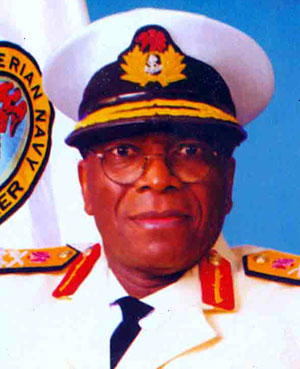
Vice Admiral O.S Ibrahim
ByKINGSLEY OMONOBI, Abuja
It is no longer news that about 90 per cent of the nations’ economic and revenue base has its roots, branches and soul in the country’s maritime environment or coastal landscape.
With the oil wells, gas, flow platforms and pipelines circumnavigating the creeks of the Niger Delta, either offshore or inshore and coastal plains, the commodity in all ramifications has sustained and kept this nation afloat.
As has been acknowledged, Nigeria with a vast coastline of about 850 kilometers of exclusive economic zone, of well over 300, 000 square kilometers, over 3, 000 kilometers of navigable inland waterways, 6 major seaports, 11 oil terminals, over 170 private jetties, 4 inland container depots and 2 inland freight stations, which the nation depends on 90 per cent for survival, is principally policed by the Nigeria Navy.

Vice Admiral O.S Ibrahim
In the 2010/2011 annual report of the Organization of Petroleum Exporting countries released in June/July 2011, Nigeria was ranked as the second biggest crude oil exporter among OPEC members by total volume export of about 6. 64million barrels per day in 2010 and earnings of over $70. 58billion during the period.
Though this rise was partly occasioned by success of the federal government Amnesty programme through which peace was restored to the Niger Delta region after years of hostilities. Aside the oil aspect, Nigeria is estimated to have about 265 trillion cubic feet of gas deposit, making her the 10th ranked highest in the world.
The fact however is that over 90 per cent of this oil and gas deposits and its related exploration, processing, exploitation, transportation and trade, be it bilateral or multilateral are carried out within the maritime environment and this can only happen if the environment is safe and conducive for transactions, a responsibility which again falls on the shoulders of the Nigeria Navy.
If we leave out the oil and gas potentials of the nations’ maritime space, the nation’s maritime environment is also rich in aquatic resources like fish, shrimps and other sea animals that have been acknowledged in the continent and abroad hence sea hunters as far as Asia and the Mediterranean, come up to the nation’s shores to look for shrimps. In 2010, available records show that the Nigerian fishing industry, less artisan fishing, was estimated at N44billion in revenue.
In spite of this large amount of aquatic deposits in the nation’s territorial waters however, it has emerged that the country has difficulty meeting the required volume of sea food demands among its citizens. This has been discovered to be due to the threats of insecurity in the territorial waters and it has resulted for instance; in the withdrawal of over 200 fishing trawlers, and 20, 000 workers back to shore.
The implication is that the nation has to fall back on imports of between 700, 000 and 900, 000 metric tons of fish annually to partially meet the shortfall of 1. 8million metric tons. Again, the Nigeria Navy is the statutory security organ of government vested with the powers to secure and checkmate the threats militating against these aquatic economic ventures.
Of great importance these days however, is the issue of terrorism, which has in a way, held the nation to standstill considering the frequency and precision with which known terrorists groups and gun men strike at national assets, security operatives; and seem to paint a picture of a nation being unsafe for foreign investments.
To make matter worse, foreign diplomatic missions in the country have regrettably signed on to the idea of sending warning letters to their mother countries warning their citizens against visiting Nigeria on the grounds that the current security challenges occasioned by bombing attacks and killings, has made the nation insecure for visits be foreigners. They even went to the ridiculous level of naming hotels as targets of bombers.
In this regard, it is pertinent to examine the terrorist’s threat at the nation’s maritime environment. Starting with bombings, it has been observed that bombings currently in Nigeria are the most common type of terrorist act in the country. This has been used to blow up oil pipelines, oil flow stations, and gas pipelines among others. For instance, IED’s have been used to blow oil wells, oil installations and a very good example is the attack and blowing off of the Atlas Cove Supply jetty in Lagos .
Another type of terrorist threat in the Niger Delta is that of kidnapping and hostage taking. This terrorism involves the use of expatriates or human shields, under duress and against their human rights, as bargaining chips, to gain publicity and favour. It is used as ransom to leverage monetary gains or release of jailed accomplices as the case may be.
There is also hijacking which is a terrorist act of seizure by force, of a sea vessel or surface vehicle, its passengers and cargo.
It also provides nobility for the terrorists to relocate the vessel or vehicle to a country that supports their cause and provides them with diplomatic immunity of cover from invasion thereby making forceful intervention difficult.
It is against this background of the enormity of security challenges in the vast maritime environment that a Maritime Law Expert, Mrs. Mfom Ekong Usoro has posited that “unlike other sectors of government expenditure where budgeting could be done by analyzing trends based on statistics, making projections and predictions, in the area of defence; government cannot predict wars and such security threats.
“Military or naval strategists will therefore have to make budgetary decisions based on uncertainties but which must be adequate for a strong and well equipped navy, because a small naval defence budget in order to service other sectors, will compromise Nigeria’s continued prosperity”.
Explaining how it is done in other climes, Usoro said, “Given the uncertainties, governments worldwide, working with economist, allocate resources to the navy using the growth model i. e. as a percentage to their gross domestic product and make substantial increase in defence spending in response to current and emerging threats in that country.
Citing examples of some problems encountered when navy platforms are inadequate for policing, she said, “Report from NNPC shows an average annual income of N11trillion was generated from Nigeria ’s maritime environment from 2005 to 2011. Also, about N1. 02trillion was lost annually due to insecurity. During the year 2006, Nigeria lost $4. 4billion in oil revenue due to unlawful activities. Another statement credited to the Petroleum minister said government is losing $7billion annually to crude oil theft in Nigeria ”.
While observing that the Navy need just a little fraction of these amounts lost to insecurity to enhance its operations which will provide safety and security for our maritime interests and ensure unhindered commerce, Usoro said, “estimated value of investment in hydrocarbon production in Nigeria is $150billion while average annual cost of crude oil theft is $3.65billion; and estimated annual loss of revenue due to illegal fishing is $1billion”.
On the other hand, she said the estimated cost of acquiring new ships for the Nigeria Navy are as follows, “General Purpose Frigate-$350million, Long Endurance Offshore Patrol Vessel-$120million, Landing Platform-$350million, Medium Endurance Offshore Patrol Vessel-$60million, Submarine-$300million and Landing Ship Tank-$90million among others. All these platforms have to be fitted with weapons, ammunitions, communication gadgets and other sensors.
Emphasizing that, “Huge savings have been made for the nation as a consequence of her (navy’s) defence and policing duties”, Usoro posited that, “The vastness of the maritime environment, inadequate funding and capacity building of the Nigeria Navy, lack of coordinated strategy to integrate maritime defence through inclusion of the Navy directly with national economic planning, giving its crucial roles in that regard, poses challenges”.
Disclaimer
Comments expressed here do not reflect the opinions of Vanguard newspapers or any employee thereof.