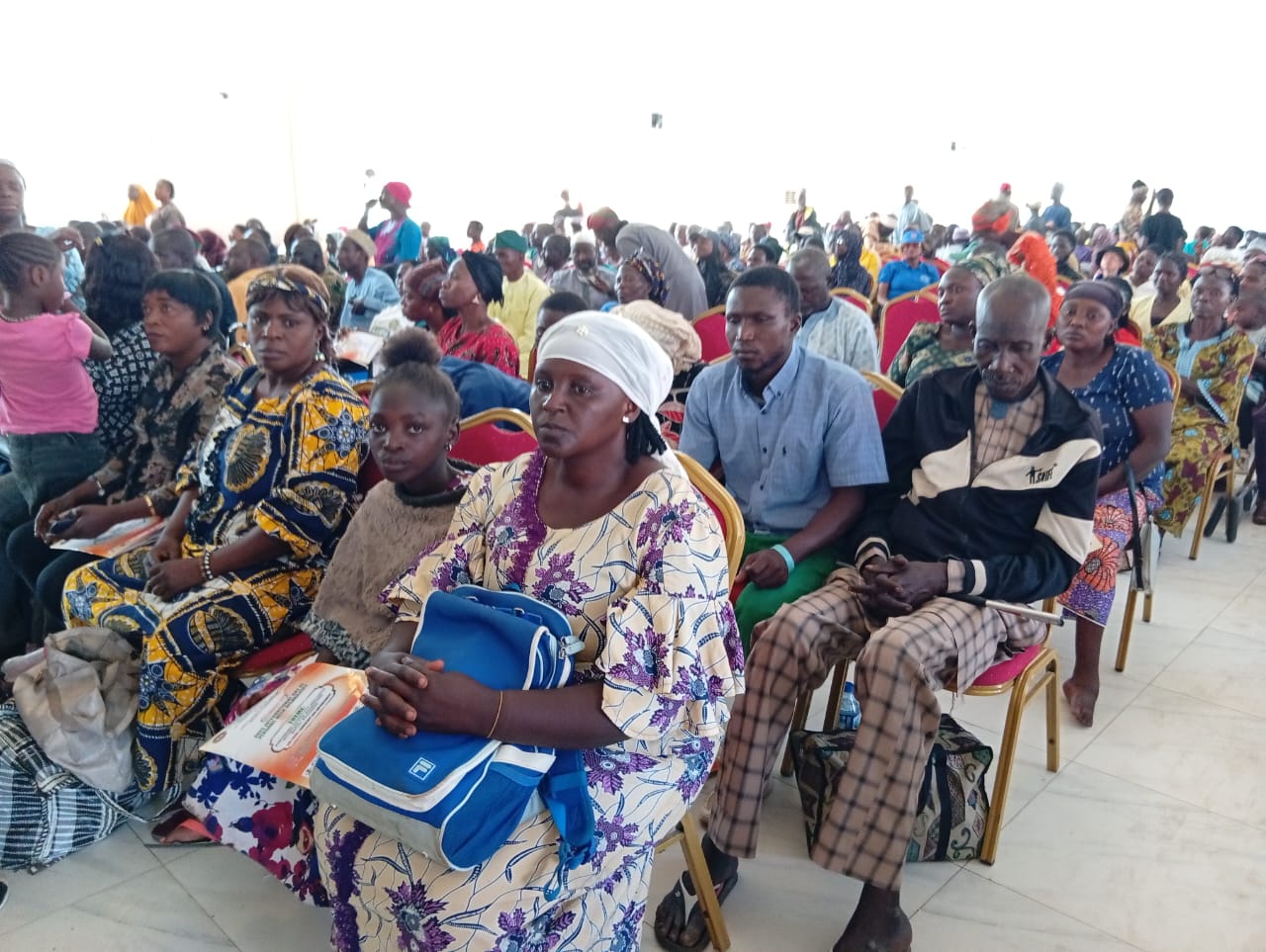
A cross-section of PWDs during the celebration of the 2025 International Day of Persons with Disabilities
…as Plateau marks 2025 International Day of Persons With Disabilities
By Marie-Therese Nanlong
Jos – The Joint National Association of Persons with Disabilities (JONAPWD), Plateau State chapter, has expressed frustration over the persistent exclusion of Persons With Disabilities (PWDs) in governance, employment, and access to public facilities.
This as the State joined the global community to commemorate the 2025 International Day of Persons with Disabilities (IDPD).
The event, held under the theme “Leadership and Empowerment,” drew partners, advocates, government officials and members of the disability community who gathered in Jos to reflect on the progress made and the widening gaps that still undermine full inclusion.
Addressing journalists, the State Chairman of JONAPWD, Shindol Aaron, said although global and national frameworks recognise PWDs as leaders and active contributors to development, political systems in Plateau State and Nigeria continue to treat them as an afterthought.
He noted that the IDPD theme reinforces the global demand for representation in decision-making, in line with commitments from the Global Disability Summit and the principle of “Nothing about us without us.”
Aaron stressed that while PWDs are demonstrating leadership across governance, entrepreneurship, education, and community development, politicians have repeatedly failed to carry them along in practical terms.
He lamented that many PWDs, despite voting and participating in political processes, are hardly remembered after elections. “Year in, year out, they register, they go out to vote, they queue for hours, but politicians don’t remember them afterwards,” he said. “And so many of our members ask, what is really the benefit?”
He added that JONAPWD has worked tirelessly to push for recognition, representation, and support, but progress has been slow.
“We push and push to get to where we are. It was not easy. We have done all we could, and we thank God we are now seeing some responses,” he said. “But real encouragement will come when government fully carries us along, not just symbolically but in ways that reflect true inclusion.”
On empowerment, Aaron noted that true transformation requires more than token distributions, and demands systems that guarantee accessible education, vocational skills, decent work, healthcare, political participation, and assistive devices, rights reinforced by the Convention on the Rights of Persons with Disabilities (CRPD) and the Global Disability Summit.
He added that despite advocacy gains, such as pushing for employment slots across MDAs, expanding vocational training, and promoting disability-responsive policies, the structural barriers remain overwhelming, as public buildings, schools, transport systems, and ICT services largely remain inaccessible.
He called for urgent action to fully implement the Plateau State disability law, improve budgetary allocation for disability programmes, and mainstream inclusion into all government initiatives.
Aaron urged government ministries, donors, NGOs, and the private sector to demonstrate genuine commitment. “Empowerment must be consistent, leadership must be inclusive, and participation must be real,” he said.
To fellow PWDs, he stressed, “You are leaders. You are nation-builders. Let us keep pushing, keep speaking, and keep taking our rightful place.”
He insisted that Plateau State and Nigeria cannot claim progress while thousands of PWDs still struggle to access basic facilities, employment opportunities, and political recognition.
Disclaimer
Comments expressed here do not reflect the opinions of Vanguard newspapers or any employee thereof.