...decries low spending of funds to reduce GBV
By Gabriel Ewepu
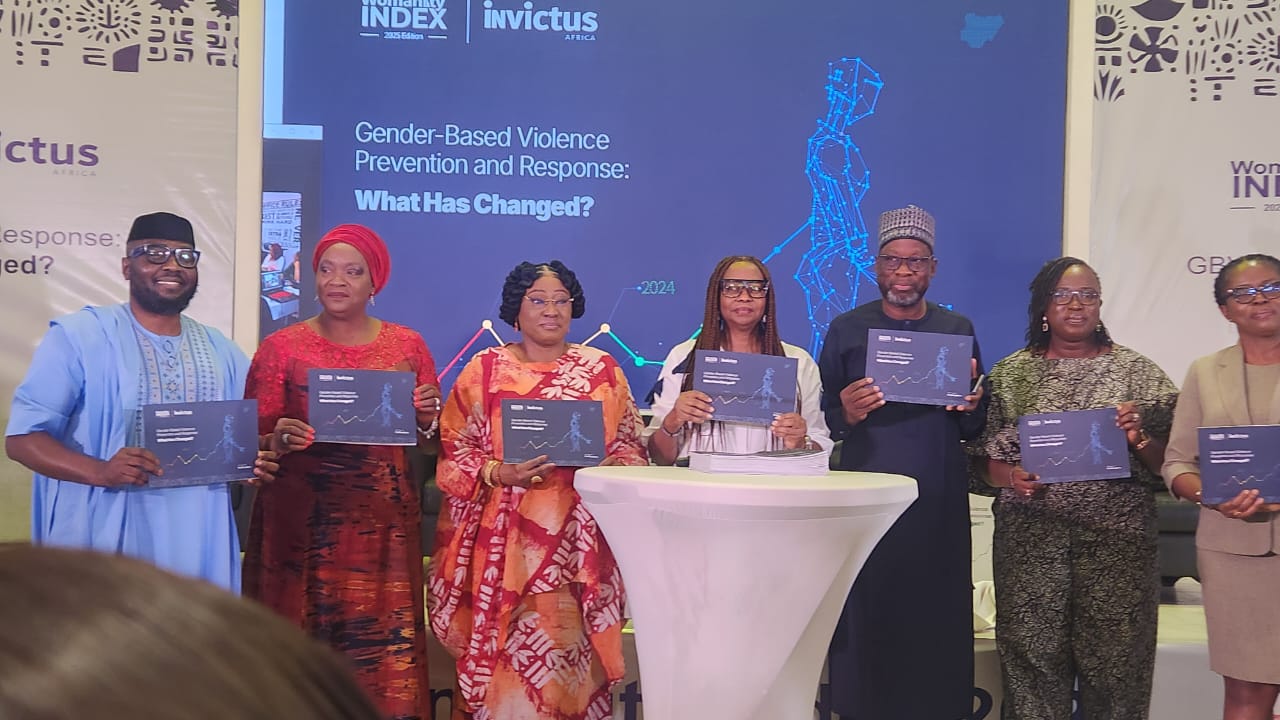
ABUJA – A nonprofit organization, Invictus Africa, yesterday disclosed in its annual data-driven report christened Womanity Index indicated that 76 per cent of Gender Based Violence, GBV, incidents occur in homes.
The report which is the third edition released by Invictus Africa with the theme ‘What Has Changed?’, during the global 16 Days of Activism, indicated that the GBV incidents in Nigeria involve intimate partner violence which ranks higher.
The report was based on an assessment of all 36 states across five indicators: Laws and Policies, Access to Legal Justice, Support Services, Information and Awareness, and Budget and Spending.
Meanwhile, the report also indicated that domestic and intimate partner violence remains the most common form of GBV, affecting 51% of survivors.
Speaking on the report, the Executive Director, Invictus Africa, Bukky Shonibare, lamented over declining awareness and shrinking state spending.
According to Shonibare, in Nigeria, the average allocation to the Ministry of Women Affairs is 0.6%. Some states allocate as low as 0.1%. Only Borno allocates 2.3%.
She said, “The problem is not allocation it is the release and spending of these funds.”
However, she emphasized strongly that if the decline in spending continues every element of the GBV response system will be weakened.
“When sufficient funds are not released, we see reduced awareness, limited witness protection, poor access to justice, and a lack of reporting pathways.
“Many states do not even have functional Sexual Assault Referral Centres. Donor-funded centres cannot replace state responsibility. Budget more, spend more, and track the spending.”
According to the report, there is a decline in public knowledge of GBV laws, dropping from 61% in 2023 to 51% in 2025. Only a few states have translated the Violence Against Persons Prohibition (VAPP) Act into indigenous languages, leaving millions unable to access or understand their rights.
The report reads in part, “Access to justice also remains uncertain, with 59% of Nigerians unaware of available legal support despite 68% preferring formal justice channels. Support services are scarce: no state has at least one functional Sexual Assault Referral Centre or shelter in all local government areas. Abia and Kogi have none at all, and most facilities are concentrated in state capitals.
“The decline in donor funding has further weakened GBV awareness efforts. Only 41% of Nigerians knew of any state-level GBV information or education initiatives in 2025, compared to 52% two years earlier.
“Budget and spending weaknesses remain the most alarming issues. Although states collectively allocated ₦120.22bn to GBV response in 2024—representing just 0.66% of total state budgets—only 37.9% of the funds were actually spent. Per capita spending averaged only ₦365.60 per woman or girl.”
Meanwhile, the Senior Special Assistant to President Bola Tinubu on International Cooperation, Dapo Oyewole, commended the Womanity Index and described it as a critical accountability tool.
“This report makes the invisible visible. Behind every statistic is a woman, a girl, a family, and a future interrupted. No Nigerian state has functional shelters or referral centres across all LGAs. This evidence tells us exactly where to act”, Oyewole stated.
He also called for stronger legislative oversight, harmonised GBV laws across Africa, and investment in survivor-centred systems.
“Progress does not happen by accident. It requires intentional investment in institutions, people, and partnerships that refuse to look away”, he added.
I’m her remarks, the former Ekiti First Lady, Bisi Adeleye-Fayemi commended leading states including Lagos, Akwa Ibom, and Ekiti but cautioned that the country still has a long way to go.
Adeleye-Fayemi said, “Every single one of us has a role to play. GBV affects us all.”
West Africa Regional Director, Ford Foundation, Dr Chichi Aniagolu, emphasized the importance of data for effective policy-making.
“The Womanity Index gives granular, state-level data that governments can use to improve.
However, Aniagolu called on states do rise up to the occasion and take responsibility for adequate funding as “Donor funding is dwindling. States must take responsibility.
“Addressing GBV does not have to break the bank many shelters already exist; they simply need maintenance and operational support.”
Disclaimer
Comments expressed here do not reflect the opinions of Vanguard newspapers or any employee thereof.