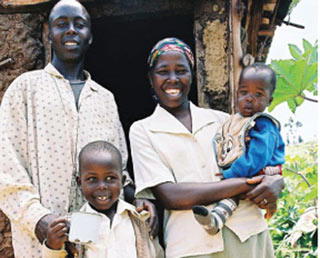
By Douglas Anele
Because of the incredible complexity of the factors necessary for the production of a human being with the right combination of qualities that make for peaceful, harmonious and responsible living, it is not possible to state with mathematical precision the ideal mix of such qualities in individuals.
However, as Aristotle points out, virtue is a matter of habit which springs spontaneously form practice. Consequently, children must be taught, preferably through practical example, moral principles such as the Golden Rule and the significance of qualities like kindness, honesty, integrity, forgiveness and love of humankind in promoting the good life which, according to Bertrand Russell, is the kind of life inspired by love and guided by knowledge.
At first sight, it would appear that the family has very little to do with international relations and global harmony, particularly considering the increasing tempo of globalisation and the dominant role of economic, political and military power in the international arena.
Thus, as far as many people are concerned, the family’s role in the quest for a rational and humane world order is relatively unimportant. But the fact that all the major actors and significant individuals in world affairs belong to one family or another implies that the family plays an indispensable in the quest for global peace and solidarity among countries.
As already indicated the choices and conduct of leaders of various countries and of international organisations reflect indelible traces of the habits and character structure formed in childhood. Thus, in order to really understand the attitude of leaders to world affairs and global peace, one would need to know the character-formation processes of their childhood. Citerisperibus, leaders that promote fairness and peaceful resolution of conflict most likely acquired that disposition when they were children; the same thing applies to those that favour crude Machiavellism and strong-arm tactics.
The unending quest for international cooperation and global harmony is supported by research findings in biological sciences which strongly suggest, inter alia, that despite differences in the racial configuration of humanity all human beings belong to one family which evolved from the hominid stock in Africa.
Additionally, dominant metaphysical theories in traditional African communities posit that hierarchies of life forces or spiritual forces which permeate reality are interconnected, meaning that there is no completely isolated entity in the cosmos. That is why pre-colonial African societies were predominantly communalistic in socio-political organisation.
In the African setting, a child learns that s/he is not only a member of an extended family which is part of a clan, village, and town; s/he also learns that the living-dead and ancestors are equally part of the family. Hence, family ties are taken very seriously because of the sense of belongingness that pervades the African life-world.
There is no doubt that international relations right now is in disarray, and that people all over the world are becoming increasingly nihilistic and sceptical about achieving positive result in the quest for global harmony due to escalating violence in many parts of the world, terrorism, economic meltdown, the widening gap between the rich and the poor (both at the level of individuals and countries), and the ever present threat of nuclear and biological warfare.
Prospects for a new world order based on fairness and human solidarity are dim, because powerful countries relentlessly use their economic and military strength to intimidate the weaker ones. To a large extent, the parlous state of international relations, despite concerted efforts by the United Nations Organisation, stems from the failure of the family to provide the fundamental personal satisfactions which in principle it is capable of.
The causes of this failure are diverse and interconnected – economic, educational, psychological, political, and social. The point still remains, however, that unless these causes are addressed leaders would continue to emerge who would sacrifice the larger concerns of humanity to the parochial interests of their various countries.
The family, as the first and oftentimes the most intimate socialising environment for a human being, is where the foundational character structures that produced Mahatma Gandhi, Martin Luther King, Mother Theresa, Bertrand Russell and other world renowned advocates of international cooperation were incubated.
Similarly, the formative years of Adolf Hitler, Benito Mussolini, Josef Stalin, and Osama bin Laden sowed the seeds that eventually matured in the inhuman conduct of these men. In my view the family should serve as the foundation for reforming international relations so that countries would see themselves as partners-in-progress not as winner-takes-all competitors, which is the case presently.
Effort towards global harmony, to be really effective and enduring, must begin from the family, because children and the youths across the globe are the leaders of tomorrow. In that connection, it is here recommended that parents and those entrusted with the care of children, instead of accepting dogmatically the antiquated doctrines of Christianity and Islam and inculcating same in the young ones should imbibe and teach children the principles of communalism advocated by African sages, and of loving-kindness and objective living prescribed by Victor E. Frankl in Man’s Search for Meaning: An Introduction to Logotherapy (1984), Sharon Salzberg in Loving Kindness: The Revolutionary Art of Happiness (1995), Bertrand Russell in The Conquest of Happiness (1996), and the Dalai Lama in Live in a Better Way: Reflections on Truth, Love and Happiness (2002).
Parents must ensure that children are trained to live according to these very principles; that the young ones are taught, right from the start, that the world is their country and their religion is “to do good.” As Wole Soyinka, the noted Nigerian playwright avers: “My allegiance is to man, locally to Nigerians; universally to humanity.”
If children who imbibed humane cosmopolitan principles become leaders of their respective countries in future they would likely promote global harmony, peace and solidarity in international relations. A paradigm-shift in habits of thought and civic education worldwide is a desideratum.
In international relations, time is ripe now for countries to recycle their swords into ploughshares by promoting the cause of peace and harmony which, in turn, would turn the earth into a paradise created, nourished and sustained by synchronisingour rational and affective faculties through knowledge and love. CONCLUDED.
Disclaimer
Comments expressed here do not reflect the opinions of Vanguard newspapers or any employee thereof.