By Evelyn Usman
The Nigerian Army’s communications backbone in theatres of operation has undergone one of its most sweeping upgrades in years, following a comprehensive overhaul of its training manuals, digital systems and operational infrastructure to align with modern telecommunications and contemporary warfare demands.
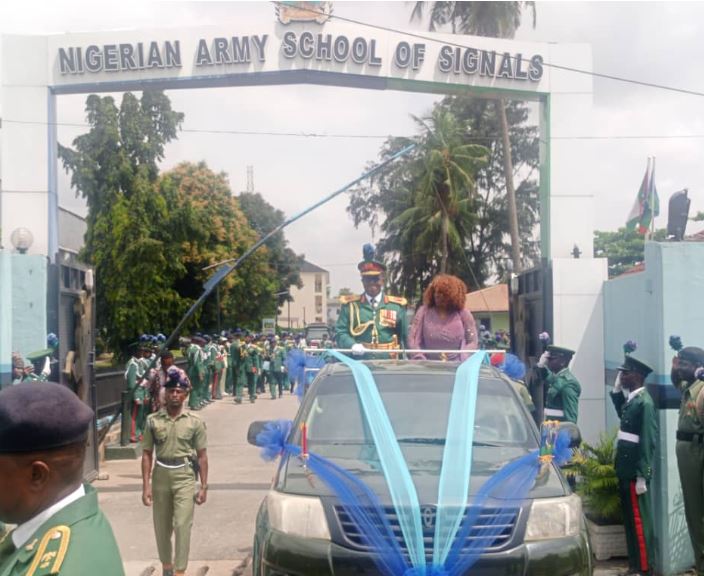
Outgoing Commander, Nigerian Army Corps of Signals, Maj.-Gen. Nosakhare Ugbo, disclosed this yesterday during his Pulling Out Parade held at the Nigerian Army School of Signals (NASS), Apapa, Lagos, marking his final exit from active service.
In his farewell speech, Ugbo explained that the transformation was driven by battlefield realities, with network engineers and technicians deploying critical installations in what he described as the most difficult combat circumstances and terrains, while programmers and analysts developed new codes and protocols that significantly strengthened system reliability across all theatres of operation.
Maj.-Gen. Ugbo, who assumed duty in February 2025 as the 39th Commander of the elite Corps responsible for training, moulding and equipping signallers in battlefield communication systems, cyber operations, encryption, ICT proficiency and digital command-and-control, said the Corps had “dramatically recalibrated” its communication architecture within nine months to meet the operational challenges of a fast-evolving battle space.
He said: “Communications support provided to all theatres of operation has significantly improved within the last nine months. We have continued to be imaginative, innovative and creative in formulating workable ideas that enabled us to achieve unimaginable feats.”
Ugbo noted that while field teams battled harsh terrains to maintain communication lifelines, maintenance units revived multiple unserviceable assets, describing their efforts as evidence that “signallers have the can-do spirit.”
A major thrust of his tenure, he said, was the complete review of technical, tactical and innovative training at NASS. He added that efforts were also made to utilise artificial intelligence and data-science tools to enhance training and operational efficiency to ensure troops remained abreast of advancements in military communications and contemporary doctrine.
He noted that training infrastructure at the School of Signals had been significantly upgraded, while office and residential accommodations at Signals Barracks, Mile 2, and other duty locations were improved as part of the wider development plan.
Anchored on the former Chief of Army Staff — now Chief of Defence Staff — Gen. Olufemi Oluyede’s soldier-first philosophy, Ugbo said his administration placed heavy emphasis on the welfare and mental well-being of personnel, noting that troops deployed across battlefronts were routinely rotated, while recreational facilities, including the Soldiers’ Club, Warrant Officers’ Mess and the ongoing rehabilitation of the Officers’ Mess, were expanded under his watch.
This, he said, was in addition to the establishment of the Nigerian Army Signals Cooperative Society and a dedicated welfare fund targeted at boosting the quality of life for personnel and their families.
Reflecting on his 37-year service, which began at the Nigerian Defence Academy in 1988, Ugbo described his career as “eventful, impactful, memorable and glorious,” recalling his journey from a young cadet to a two-star General, enriched by rigorous military training, advanced academic programmes culminating in a doctorate, and multiple command and operational deployments within and outside Nigeria.
Urging serving signallers to remain steadfast in pushing the frontiers of military communication technology, he said: “You must continue to stay focused in your drive towards creativity, innovation and application of technology in enhancing the operational capacity of the Nigerian Army. Support and cooperate with the new CCS as he takes the Corps to the next level of impossibility.”
Ugbo also expressed appreciation to Gen. Oluyede for backing the Corps’ technological reforms, and thanked his family, whom he described as “pillars of strength,” for their resilience throughout his years of service.
Disclaimer
Comments expressed here do not reflect the opinions of Vanguard newspapers or any employee thereof.