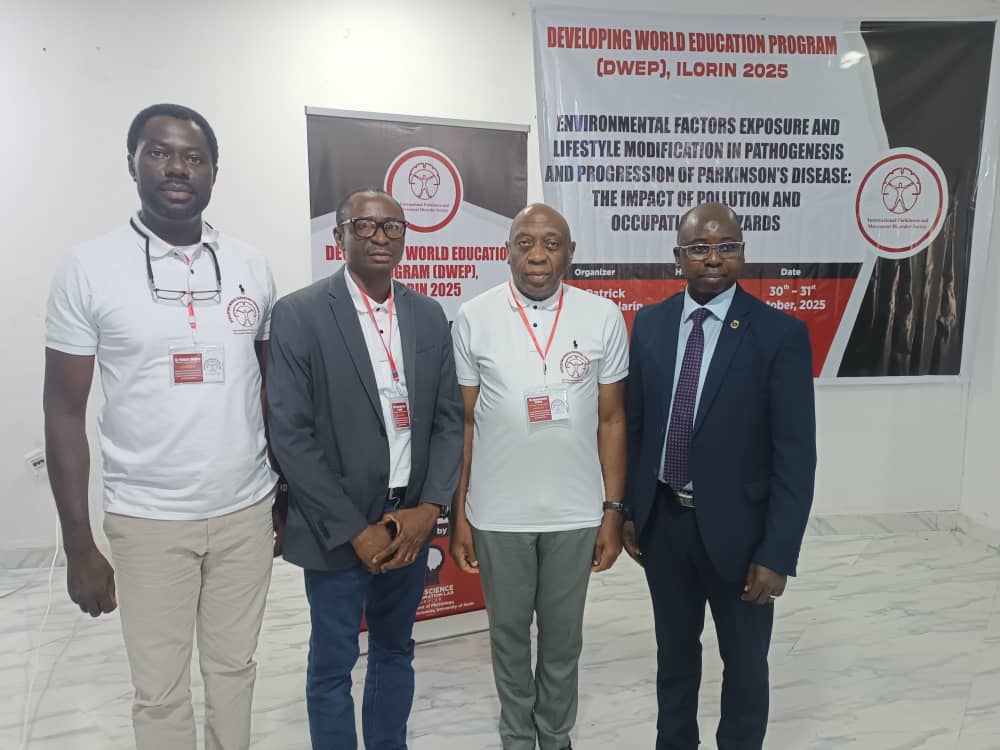
Dr Patrick Oluwole Abolarin,Convener of the Two day workshop held in ilorin and other discussants at the event.
By Demola Akinyemi, Ilorin
Worried by the rising cases of Parkinson diseases linked to environmental pollution, indiscriminate use of insecticide and habicide, medical and environmental health experts have called
for awareness, stronger environmental regulations and better workplace safety standards, especially for those working in agriculture, mining, and industrial sectors in Nigeria.
The experts who made the call during a two-day workshop held in Ilorin, themed “Environmental Factors, Exposure and Lifestyle Modification in the Pathogenesis and Progression of Parkinson’s Disease: The Impact of Pollution and Occupational Hazards.” linked the trend to rising pollution levels, unsafe occupational practices, and weak policy enforcement.
The convener of the workshop, Dr. Patrick Oluwole Abolarin, a neuroscientist and lecturer at Babcock University, Ogun State, said the event was designed to raise awareness and stimulate research into how pollutants particularly heavy metals, herbicides, and industrial chemicals contribute to the onset and progression of Parkinson’s disease.
“Research over time has shown the influence of the environment on the development of neurological disorders,” Dr. Abolarin stated.
“We are often exposed to several harmful agents such as pesticides and metals, which can damage brain cells. Unfortunately, in this part of the world, exposure to such agents is indiscriminate.”
He added that while most Nigerians focus on curative medicine, prevention remains a cheaper and more effective strategy.
“We must begin to sensitize our people about the impact of these exposures and adopt preventive measures before it becomes an epidemic,” he said.
Dr. Abolarin particularly called for stronger environmental regulations and better workplace safety standards, especially for those working in agriculture, mining, and industrial sectors.
Nigeria cannot afford to ignore the link between pollution and public health any longer,” Dr. Abolarin warned, stressing that “We need environmental policies that protect both the earth and the brain.”
A brain scientist from University of Ibadan,Professor James Olopade, in his paper
titled “Vanadium, an Environmental Toxicant and Parkinson’s Disease,” said there is growing scientific evidence linking exposure to vanadium a heavy metal found in industrial waste, crude oil, and steel welding to the development of Parkinson’s symptoms in humans.
“There is a relationship between vanadium in the environment and Parkinson’s disease in humans,” he said, adding that “Continuous exposure, especially among people living near industrial zones like the Niger Delta or those in certain occupations, increases the risk of nerve degeneration.”
Olopade further said that his two-decade research has shown that rats exposed to vanadium-contaminated environments exhibit significant brain deterioration.
“We studied rats from the Niger Delta and Ibadan and found higher vanadium concentrations in the brains and lungs of rats from the oil-producing areas,” he said.
He therefore urged the government to adopt stricter pollution controls, introduce workplace safety gear such as masks for welders, and establish a national Parkinson’s surveillance system to map out disease prevalence across Nigeria.
“Vanadium can enter the body through inhalation and move from the lungs to the brain. This has serious implications for welders, factory workers, and communities living near refineries,” Olopade warned.
Another speaker, Professor Ademola Oremosu, an anatomist from the University of Lagos, expressed concern over the unchecked use of pesticides and herbicides by Nigerian farmers.
He noted that while these chemicals help improve crop yields, their long-term neurological effects on farmers and consumers are alarming.
“Many of these substances have been linked to brain damage and the onset of Parkinson’s disease,” Oremosu said, stressing that “We must bring this to the attention of policymakers so that Nigeria can join other countries that are already restricting or banning these harmful substances.”
According to him, the drive for agricultural productivity must not come at the expense of human health. “Government agencies like the National Orientation Agency and the media must intensify awareness campaigns about the dangers of indiscriminate use of these pollutants,” he added.
For his part,Principal Investigator at the Neuroscience and Inflammatory Lab, University of Ilorin, Professor Bamidele Owoyele,highlighted the need for increased funding for local research into environmental toxins and neurological disorders.
“This training is opening the eyes of young scientists to global trends in movement disorders,” he said, stressing that “We must realize that environmental pollution through air, water, and soil contamination affects our wellbeing and can trigger neurological problems.”
He explained that while chemicals and pesticides serve useful purposes, their accumulation over time in the environment poses long-term health risks.
“They enter our food chain, water, and air, and gradually impair brain function and movement control,” he noted.
Also,a Consultant Neurologist,from University of Ilorin Teaching Hospital,Professor Kolawole Wahab in his lecture said that there’s no curative drug yet for Parkinson disease, stressing that it could only be managed.
He however noted that,”Regular physical excercise is one of the antidotes to avoid Parkinson disease,it has been found to be protective.”stressing that, “Though smoking has been found to also be a protective against Parkinson disease but it won’t be a recommendation because smoking itself is a risk factor for stroke, kidney disease and other cancers in the body.So it’s a no go area.”
The experts collectively urged Nigerian policymakers to enact and enforce stronger environmental protection laws, regulate pesticide use, and monitor industrial emissions to reduce exposure to neurotoxicants.
They also called for the inclusion of Parkinson’s disease awareness in national health programs and urged the Ministry of Environment to collaborate with the Ministry of Health on cross-sectoral monitoring of pollutants.
The experts also warned that unless urgent actions are taken, Nigeria may face an impending public health crisis driven by pollution-induced neurological diseases.
The workshop participants therefore called on the federal and state governments to integrate neurological disease surveillance into public health systems, fund research on toxic exposure, and promote cleaner technologies to safeguard citizens’ health.
Disclaimer
Comments expressed here do not reflect the opinions of Vanguard newspapers or any employee thereof.