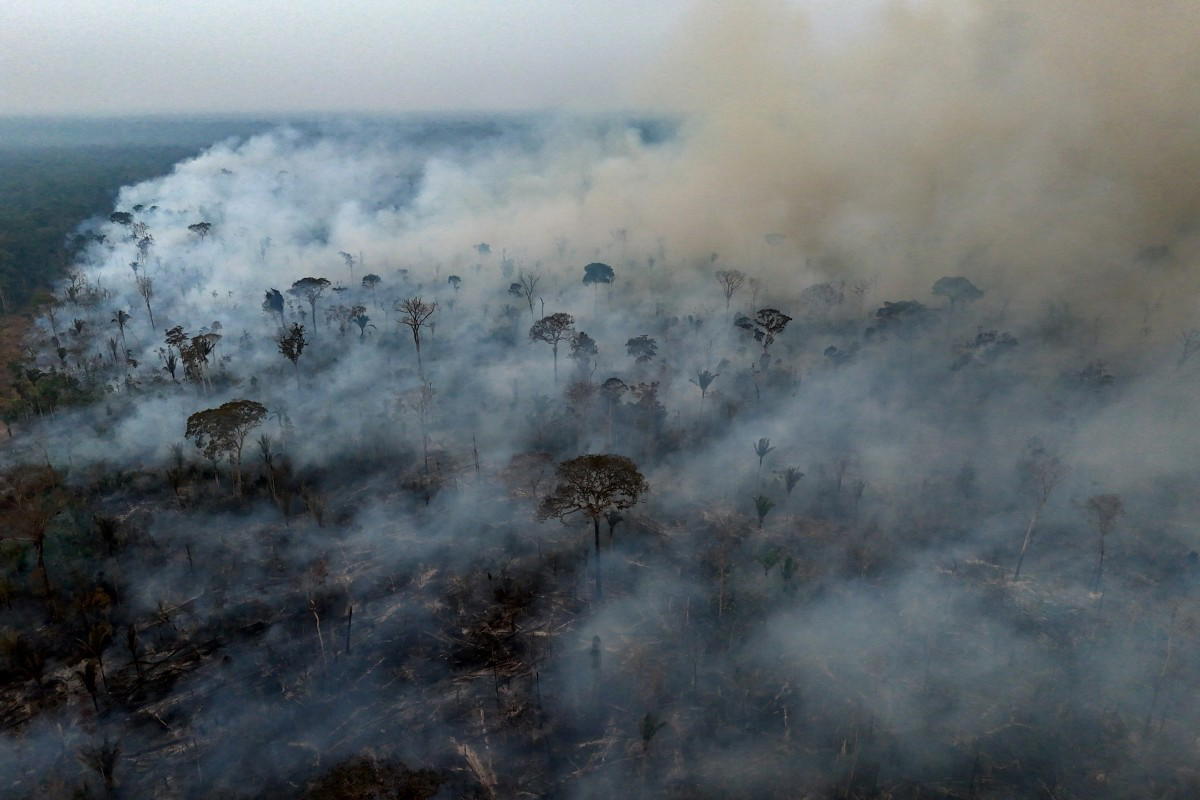
(FILES)Aerial view of an illegal fire in the Amazon rainforest on the banks of the BR-230 (Transamazon Highway), near the city of Labrea, Amazonas state, northern Brazil, taken on September 4, 2024. Temperatures passed 50 degrees Celsius (122 Fahrenheit) in northern India as an unrelenting heatwave triggered warnings of water shortages and heatstroke. 2024 is confirmed by the Copernicus Climate Change Service (C3S) to be the warmest year on record globally, and the first calendar year that the average global temperature exceeded 1.5°C above its pre-industrial level. C3S is implemented on behalf of the European Commission by the European Centre for Medium-Range Weather Forecasts (ECMWF), whose scientists have been monitoring key climate indicators, and documenting unprecedented daily, monthly, and annual temperature records over 2024. (Photo by MICHAEL DANTAS / AFP)
By Joseph Erunke, Abuja
The Federal Government has called on state governments across Nigeria to intensify efforts toward climate action and environmental sustainability, emphasizing that meaningful progress in addressing climate change must occur at the subnational level.
This call was made on Tuesday in Abuja during the launch of the Subnational Climate Governance Performance Rating and Ranking (SCGPR 2.0) report, where Lagos State once again emerged as Nigeria’s top-performing state in climate governance, followed by Katsina and Kaduna States.
Minister of Environment, Balarabe Abbas Lawal, said the initiative reflects the Tinubu administration’s commitment to ensuring that states play a central role in translating national climate policies into tangible local results.
“Climate change is a global challenge, but its solutions must be implemented locally — city by city, state by state, and region by region,” Lawal said. “This ranking is not just a scorecard; it is a catalyst for collaboration, learning, and shared ambition.”
According to the Minister, President Bola Ahmed Tinubu has placed climate change at the core of his administration’s development agenda, with a growing focus on clean energy transition, green growth, and resilient infrastructure.
He explained that the ranking aims to promote constructive competition among states while highlighting best practices and identifying areas for improvement.
“Subnational governments are closest to the people and to the realities of implementation. This report gives us a clearer picture of where progress is strong and where gaps still exist,” he added.
Lawal also commended state environmental agencies and climate officers for their dedication, describing them as “the backbone of Nigeria’s national climate resilience.”
In his remarks, Permanent Secretary of the Federal Ministry of Environment, Mahmud Adam Kambari, represented by the Director of Climate Change, Iniobong Abiola-Awe, said the exercise was designed “not to stigmatize but to illuminate,” encouraging all states to use the findings as a guide to set priorities and mobilize resources.
“Climate governance is a shared responsibility that bridges the gap between federal and subnational efforts, between policy and practice, and between aspiration and delivery,” Kambari said.
The UK Foreign, Commonwealth and Development Office (FCDO) representative, Samantha Harrison, commended Nigeria for institutionalizing the ranking, describing it as a “practical tool for accountability and evidence-based learning.”
Similarly, Director-General of the National Council on Climate Change (NCCC), Omotenioye Majekodunmi, represented by Awele Ikobi, emphasized that the report should serve as a roadmap for improvement.
“Regardless of where each state stands today, this ranking provides a clear direction for progress toward a low-carbon, climate-resilient Nigeria,” he stated.
Lagos, Katsina, and Kaduna States received top awards, while Kano and Enugu States were specially recognized for making significant strides in improving their climate governance frameworks.
The event marked a renewed push for decentralized climate action in Nigeria, underscoring that the pathway to a sustainable future will depend largely on how effectively states align with the nation’s broader green development vision.
Disclaimer
Comments expressed here do not reflect the opinions of Vanguard newspapers or any employee thereof.