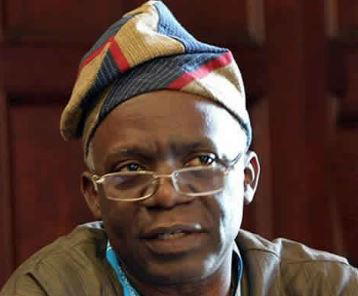
Falana
By FEMI FALANA
A fortnight ago, a group asked me to recuse myself from defending the National Union of Petroleum and Gas Workers, NUPENG. Others called me names for pointing out that the Trade Union Act has imposed a duty on employers to accord recognition to all registered trade unions and respect the right of workers to unionise. I decided to ignore the anti-democratic forces as there was no point joining issues with them and their paymasters.
However, it is pertinent to state, without any fear of contradiction, that we have, for the past four decades, embarked on legal and political struggles in defence of the fundamental rights of workers, students, teachers, lawyers and doctors to freedom of association. Some of the legal and political campaigns waged by us are set out hereunder:
Purported proscription of NANS
In 1984, the Muhammadu Buhari military junta proscribed the then vibrant National Association of Nigerian Students, NANS. We advised the leaders of NANS to ignore the proscription as it was not backed by any law. Hence, in defiance of the ban, the NANS President, at the material time, Comrade Lanre Arogundade, declared that “NANS shall continue to operate as it was not established by the Nigerian government”.
Following the anti-SAP protests organised by the NANS in 1989, the military junta sponsored cultist groups to attack leaders of student unions in all tertiary institutions. The radical ones among the student leaders were either rusticated or dismissed for frivolous reasons. The late Comrade Alao Aka-Bashorun and the late Chief Gani Fawehinmi SAN led us to challenge such authoritarian actions. It is on record that the majority of the cases were won in court. With the assistance of the Academic Staff Union of Universities, ASUU, we ensured that the few student leaders who lost their cases in court completed their university education in other local and foreign universities.
Proscription of NMA and NARD
In 1985, the Buhari military junta proscribed the Nigerian Medical Association, NMA, and the National Association of Resident Doctors, NARD, for going on strike to demand increase in the salaries of doctors and improvement in public hospitals. The harassment of the doctors exposed the utter hypocrisy of the junta, which had loudly claimed that Nigerian hospitals had become “consulting clinics” while justifying the coup d’tat that illegally toppled the Shehu Shagari administration.
Dr. Emmanuel Akpabio and Dr. Beko Ransome-Kuti, the NMA President and the 1st Vice-President, respectively, were detained in the Kirikiri Maximum Correctional Centre under the State Security (Detention of Persons) Decree No 2 of 1984. The Alao Aka-Bashorun Chambers challenged their detention in the Lagos State High Court. It was when the case was pending that both detainees were released after they had been in prison custody for six months without trial. The leaders of the NARD fled the country when the junta wanted to arrest and detain them.
Criminalisation of strikes
On October 1988, the senior staff union of the defunct National Electric Power Authority, NEPA, went on a three-day strike to protest the perennial issues of inadequate funding of the organisation, lack of safety measures and poor service conditions. Eleven of the striking workers were later arrested and accused of sabotage. They were charged with economic sabotage before a special military tribunal that sat in Jos, Plateau State.
They pleaded not guilty to the monstrous charges. But they were convicted and sentenced each to life imprisonment. The life sentence was later reduced by the military government to 10 years. As a result of local and international outrage against the criminalisation of the strike, the military president, General Ibrahim Babangida, pardoned the convicts before the end of their prison terms. They regained their freedom with their heads unbowed.
Dissolution of NLC executive council
In 1988, the leadership of the Nigeria Labour Congress was factionalised in the build-up to its Triennial Conference held in Benin, Edo State along ideological lines. The progressive camp won the election while the faction sponsored by the Ibrahim Babangida military junta lost the election as they were rejected by Nigerian workers. Completely embarrassed, the junta deployed armed troops to occupy the National Secretariat of the NLC in Surulere, Lagos.
Furthermore, the junta imposed a sole administrator on the NLC. The purpose of the capture of the NLC was to pave way for the sale of public assets (otherwise called privatisation), mass retrenchment of workers and commercialisation of social services as part of the conditionalities attached to the Structural Adjustment Programme dictated by the International Monetary Fund and the World Bank.
The Alao Aka-Bashorun Chambers dragged the junta to the Lagos High Court to justify the dissolution of the NLC. The case was struck out on the ground that the dissolution decree had ousted the jurisdiction of the court. But to the utter dismay of the junta, the NLC mobilised Nigerians to reject the imperialist agenda of underdevelopment. The proscription was, however, lifted in December 1988 when the junta had failed woefully in its dubious objective of capturing the NLC.
Imposition of caretaker committee to manage the NBA
In 1993, the junta took over the Nigerian Bar Association and handed it over to the Body of Benchers via Decree No 21 of 1993. Convinced that the illegality would be challenged by the progressive extraction of Nigerian lawyers, the Decree stipulated that “anything done or purported to be done” under it constituted an offence. The penalty for the offence was one-year imprisonment and/or payment of N10,000 fine.
The Ikeja branch of the Nigerian Bar Association resolved unanimously to challenge the obnoxious Decree. Our law firm was instructed to handle the case on behalf of all members of the branch. We dared the junta by instituting an action in the Lagos State High Court where we sought to protect the fundamental rights of Nigerian lawyers to freedom of association. The trial judge, Obadina J. (as he then was), granted our motion for interim injunction against the military dictator and his cohorts.
Dissatisfied with the ruling, the defendants rushed to the Court of Appeal, where they questioned the competence of the case and the jurisdiction of the court to entertain the case. Upon the request of Chief F.R.A. Williams SAN, who appeared for himself and other appellants, a full panel of the Court of Appeal, was constituted to hear the appeal. In a historic judgement delivered by the Court, our submissions were upheld as the Decree was declared illegal and unconstitutional. See Williams v Akintunde (1995) 3 NWLR (Pt 381) 101.
In another development, the Civil Liberties Organisation, CLO, vs Nigeria(Suit No101/93), petitioned the African Commission on Human and Peoples Rights in Banjul, The Gambia concerning the legal validity of Legal Practitioners Amendment Decree No 21 of 1993. The Federal Government could not justify its interference in the internal affairs and management of the NBA. The Commission found that: “The Body of Benchers is dominated by representatives of the government and has wide discretionary powers. This interference with the free association of the Nigerian Bar Association is inconsistent with the preamble of the African Charter in conjunction with UN Basic Principles on the Independence of the Judiciary and thereby constitutes a violation of Article 10 of the African Charter.”
For the above reasons, the African Commission held that there has been a violation of Articles 6, 7, and 10 and directed that the Decree be annulled. Shortly thereafter, the Sani Abacha military junta promulgated the Legal Practitioners Amendment Decree No 21 of 1994 and thereby withdrew from the affairs of the NBA. It was the only case that a Decree was successfully challenged during the military rule.
To be concluded
*Falana, SAN, wrote from Lagos
Disclaimer
Comments expressed here do not reflect the opinions of Vanguard newspapers or any employee thereof.