—- Only 9 percent of Ondo benefit in past years
By Dayo Johnson, Akure
The New Initiatives for Social Development (NISD) Ondo State Project Officer, Mrs Adedoyin Adebisi Patrick, has said that 75 percent of persons with disabilities have not benefitted from the social protection programme of the federal government.
Regrettably, Patrick said that only nine percent of households have benefited from social welfare programmes in the past years.
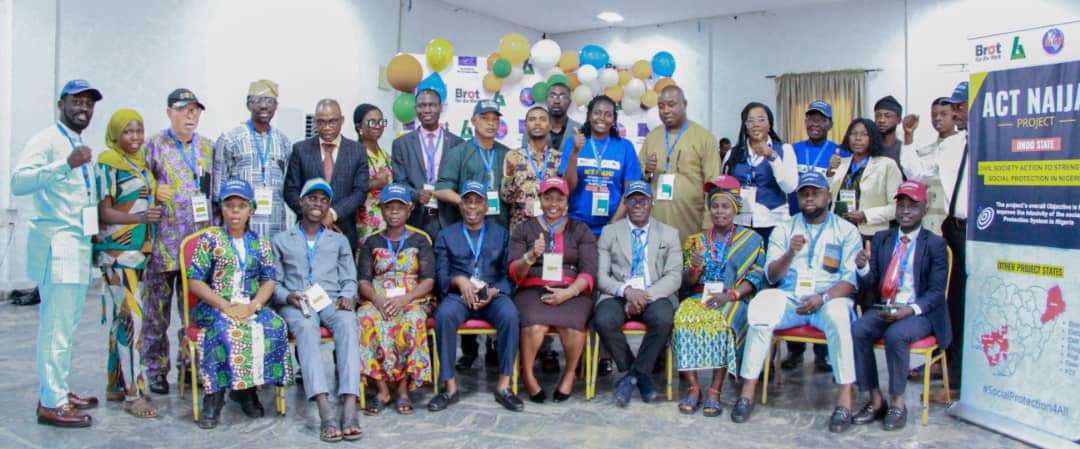
Patrick, said this during the Ondo State Dialogue on Social Protection, held in Akure under the Act Naija Project, implemented by the New Initiatives for Social Development (NISD) in partnership with the State Ministry of Economic Planning and Budget.
According to her findings has revealed that only nine percent of households in Ondo State benefited from any form of social protection programme in the past year, exposing deep gaps in awareness, coordination, and inclusion across the state’s welfare system.
Presenting the baseline assessment report, she said that the low coverage calls for urgent reforms to ensure equity, transparency, and wider inclusion, particularly for vulnerable groups such as women, youths, and persons with disabilities (PWDs).
“The report further highlighted gender and disability challenges, showing that 64 percent of persons with disabilities were unaware of any social protection programme, and 75 percent had never benefited from one.
” lt added that there was no dedicated structure to track inclusion outcomes, and gender-responsive budgeting was largely absent.
While acknowledging that Ondo State has a Social Protection Law enacted in 2016, the assessment observed that weak coordination, irregular disbursements, and poor monitoring continue to limit the effectiveness of interventions. Programmes such as the Abiye initiative and GEEP were also found to suffer from poor implementation and limited reach.
She said that the low coverage called for urgent reforms to ensure equity, transparency, and wider inclusion, particularly for vulnerable groups such as women, youths, and persons with disabilities (PWDs).
According to her, the Act Naija Project is operational in seven states and the FCT to promote evidence-based advocacy and accountability in social protection.
Mrs Patrick revealed that Ondo State baseline assessment found that only nine percent of surveyed households had benefited from programmes such as Conditional Cash Transfers, school feeding, education grants, and health insurance in the last 12 months.
She said that about 80 percent of the interventions came from government agencies, while non-governmental organisations accounted for the remaining 20 percent.
Speaking on the policy direction, the NISD Project Manager, Steve Tsado emphasized that social protection should be treated as a right, not a privilege.
Tsado said “Social protection is not a charity work, it is a fundamental human right. Implementing these interventions is not a favor to anyone — it’s their right.
“But challenges like inadequate funding and limited coverage must be addressed through stronger policy commitment.
“We looked at these challenges, and one thing we want to do is to discuss the way forward and how we can overcome them.
“Social protection is not only the responsibility of government but of all stakeholders. We all have a role to play,”
Stakeholders at the forum urged the state government to reform key welfare programmes, embed them in a legally backed framework with stable funding, and strengthen the Technical Working Committee for better coordination among ministries, agencies, and partners.
They also advocated greater collaboration between government and civil society from the planning stage to implementation, as well as regular awareness campaigns and publication of annual performance reports to enhance transparency.
In his remarks, the Representative of the Agency for Persons with Disabilities (PWDs), Mr. Idowu Oluwashola Philip, lamented persistent discrimination against persons living with disabilities despite calls for inclusion.
Philip lamented that “People often avoid associating with us because they believe disability is contagious, but that is not true.
“Inclusion must go beyond policies to reflect in people’s behaviour and institutional practices.”
Also speaking, the Ondo State Chairman of the Nigeria Union of Journalists (NUJ), Comrade Leke Adegbite, expressed concern over the poor implementation of most social protection programmes.
Adegbite said “Various social protection measures by government and organisations have not achieved the desired results.
According to him “Many initiatives have failed because of lack of sincerity and poor targeting. Those who truly need protection should be the ones benefitting.”
Participants at the dialogue recommended that the state government reform existing programmes such as Abiye and ORANGHIS, embed them in a legally backed framework with stable funding, and strengthen the Technical Working Committee to coordinate efforts among ministries, agencies, and development partners.
Disclaimer
Comments expressed here do not reflect the opinions of Vanguard newspapers or any employee thereof.