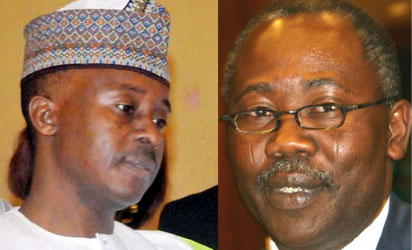
Farouk Lawan and Justice, Mohammed Bello Adoke
By Emmanuel Edukugho
Looking at the fate which befell previous investigative reports unearthing misdeeds in some critical sectors of our national economy for lack of implementation, it is not unlikely that the House of Representatives Ad Hoc Committee on Fuel subsidy management report may also go down the drain.
With what happened to the Tony Elumelu Power probe by the House of Representatives in which over $16 billion (US Dollars) stolen by contractors and some prominent eminent individuals supposed to provide power plants and fix our electricity system but nothing done to the culprits, the privatisation of government properties bought at give-away prices by top civil servants and politicians which nobody knows where the report is, the Bureau of Public Enterprise (BPE) probe report yet to be seen, not to talk of the Okigbo Panel report on the multimillion dollars windfall from the Gulf War which disrupted oil production in that region and other probes, people are now thinking nothing can emerge by this latest fuel subsidy scam involving N1.7 trillion looted by political/government office holders, state agencies and make-shift emergency businessmen. About 72 firms were fingered in the subsidy scam.

Farouk Lawan and Justice, Mohammed Bello Adoke
Chaired by Hon. Farouk Lawan, the House of Representatives Ad Hoc Committee on fuel subsidy management after several weeks of fact-finding hearings, recommended that some oil companies be made to refund nearly N42 billion to the federation account, the NNPC should refund N310,414,963,613 it received illegally as subsidy for kerosene, the NNPC, (Nigerian National Petroleum Corporation), PPPRA (Pipeline Product Pricing Regulatory Agency), and other marketers refund N1.1 trillion to government which they fraudulently appropriated to themselves.
The panel blamed the chairman of the Board of PPPRA from 2009 – 2011 and entire members during the period for opening the floodgate for what it called “the Bazaar,” and asked that they should be investigated and prosecuted by relevant anti-corruption agencies.
The report definitely has vindicated the “Occupy Nigeria” protest in January organised by Save Nigeria Group (SNG) and some civil society groups against the sudden and arbitrary increase in pump price of petrol from N65 per litre to N141 per litre. Now the Nigeria Labour Congress (NLC), SNG, Trade Union Congress (TUC) and some civil society organisations have threatened to mobilise the people for another street protest if the Federal Government fails to implement the report of the House of Representatives Ad-Hoc Committee on the fuel subsidy regime.
Similarly, the Action Congress of Nigeria (ACN) wants President Goodluck Jonathan to apologise to Nigerians for his “government’s ill-advised removal of the so-called fuel subsidy in January.”
According to ACN, the report had shown that “the removal was an egregious error of judgment that had left Nigerians feeling swindled by their government.”
The party agreed the President can be wrong in his judgement when he approved hike in fuel price without justification, but should be humble enough to apologise and then revert to the pre-January price of N65 per litre and proceed to implement the recommendations of the committee. Also indicted persons and oil firms be prosecuted, including NNPC leadership, management and the supervising ministry.
Joining in the call for the prosecution of indicted government functionaries is Nobel Laureate, Professor Wole Soyinka, urging Nigerians to prepare for another round of protest against corruption. Also agitated by the monumental corruption that characterised the fuel subsidy management, Pastor Tunde Bakare warned of an impending protest if government officials connected with the subsidy scam are not immediately brought to justice. Describing the whole thing as revealed by the committee’s report as “an organized banditry,” he declared that this is now the time to act and save the country from the grip of corruption.
But Farouk Lawan, apparently sensing the mood of the people, assured that the report might not end up in the dust bin, reportedly saying that, “the timely execution of the (probe) report will determine its next relationship with the executive arm of government.”
However, a disturbing dimension has come into probe report when the Federal Government seemed not to have made up its mind about prosecuting officials indicted.
In a press release, Minister of Justice and Attorney General of the Federation, Mr. Mohammed Bello Adoke, reacting, explained that the probe was mainly a fact-finding one, adding, that there is need to ensure thorough investigations are carried out by relevant law enforcement agencies.
He reiterated that as a democratically elected and responsible government, the administration must be guided by the dictates of the rule of law and due process.
It is also on record that President Goodluck Jonathan, in his initial reaction to the report had affirmed that any person found wanting will be prosecuted irrespective of the person’s standing in the society.
Our investigation shows that most Nigerians want the report implemented fully without unnecessary delay.
The government may not be willing to expedite action on the implementation because of the calibre of people implicated.
Many of them are top political office holders, party big wigs, friends of the presidency, seen as “sacred cows” which should not be touched no matter their culpability. In a country where corruption holds sway and has become a way of life, the fuel subsidy report may end up in the bureaucratic archives, laid to rest.
After release of the probe report, serious objections were raised by some of the indicted oil companies, including NNPC, CBN, and a leading accounting firm in their attempts to undermine the veracity and integrity of the report. Some of the oil firms said that they were not invited by the panel to testify, while others disputed the amount they received from the subsidy administration.
Initially, when government announced the removal of subsidy bringing pump price per litre to N141 from N65, it immediately introduced the Subsidy Reinvestment and Empowerment (SURE) programme with a mandate to put back proceeds from subsidy removal into infrastructure development, maternal healthcare, boost the national economy and create jobs for the teeming unemployed youths, provision of mass transit buses among other palliatives meant to cushion the effect of the removal.
Many people believed the SURE scheme was deceitful to hoodwink the citizens and cover up the frightening corruption inherently entrenched in the subsidy regime. Even President Goodluck Jonathan and his ministers were saying emphatically that Nigeria’s economy will collapse completely if fuel subsidy was not removed.
But today, the Nigerian people now know better that the subsidy was a conduit pipe used by powerful people in government, their proxies and also government agencies to massively plunder the national treasury.
How can one explain the situation in which the former Accountant-General of Nigeria admitted that cheques in the amount of N999 million were issued by his office 128 times to bypass the regulations against issuing cheques of over N1 billion or more at a time? No wonder the Save Nigeria Group, the arrow head of the devastating protest that grounded the country for over eight days in January, had insisted corruption is the problem and not the subsidy. “Kill Corruption, not Nigerians,” was the SNG slogan. But the government never wanted to hear this.
Just as the Federal Government is not anxious in seeking justice on the matter and get the stolen funds back to the treasury, so also is the Economic and Financial Crimes Commission (EFCC) foot dragging. Claiming to be waiting for an official report from the legislature even though it is conducting its own investigations on the subsidy management, EFCC affirmed that whenever the probe committee report is communicated to it, this will complement what the anti-graft body is already doing.
So the waiting game continues.
Disclaimer
Comments expressed here do not reflect the opinions of Vanguard newspapers or any employee thereof.