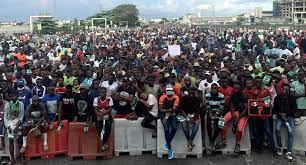
A weakening social bond that has created a new breed of Nigerians whose value system is frightening, signposts dangers ahead
By Morenike Taire, Woman Editor
Approximately 23 per cent of the world’s population of 7.7 billion, or 1.7 billion, consists of young people under 30, according to the World Bank. Of these, a staggering 86% live in developed countries. Although politically independent Nigeria is 65 years old, its population of over 230 million is skewed towards youth. With a median age of 18.1 years, around 60% of the population is under age 30.
This is both good and bad news; so far, the balance is more bad than good. This demographic, which we traditionally refer to as “leaders of tomorrow”, is, for the most part, malnourished, miseducated, neglected and unemployed.
Some even say its members are unemployable, owing to the shambolic state of education in virtually every part of the country.
Born mostly after the turn of the millennium, this demographic has never experienced military rule and struggles to grasp and deal with their socioeconomic circumstances. Moreso, it struggles to properly situate itself within the splinters of its fragmented social space, the root cause of which it mainly cannot comprehend.
Political rumblings
Just a few years after the delirious joy that attended Nigeria’s independence, the 1964 federal elections were delayed due to irregularities and subsequent violence in the Western Region, claiming thousands of lives and earning the region the moniker of “Wild, Wild West”.
Tensions continued to rise, especially after the 1965 Western Region elections, culminating in two, very bloody military coups barely a year later.
Hostilities were to eventually collapse into full scale war in the most populous country in Africa, one of the most divisive wars in the history of post-independence Africa which left ethnic animosities and distrust in its wake.
This wasn’t the first indicator that multiethnic nationhood, constructed from inherited colonial boundaries, was fragile and probably untenable; but it was certainly the strongest.
European imperial powers had neglected to lay the foundation for nation states from the various cultural and territorial entities they had forcibly amalgamated into convenient colonial holdings.
General Yakubu Gowon’s famous “No Victor No Vanquished” rhetoric, after the war, held much promise, to be followed by social reintegration. But more trouble was to come.
A carefully curated return to civilian rule was soon disrupted by further military interventions, culminating in the eventual establishment of the so-called Fourth Republic, in 1999.
The ghosts of insecurity
The ghosts of insecurity never departed, and as new states were created and numbers rose to 36 from 12, so disunity escalated, exploiting ever deepening ethnic fault lines. Grotesque fiscal federal framework created a sense of scarcity. From the ashes of Niger Delta militancy had risen Boko Haram, the Herdsmen phenomenon, the Unknown Gunmen, the Bandits and other insurgent groups. These phenomena have exacerbated ethnic tensions fostering mistrust, poverty and social disorientation.
Contrived religious trichotomy
Moreso, Nigeria is a country with many religious sects. According to a 2018 World Factbook estimate on the religious population in Nigeria, Christianity and Islam had the highest population density of 46.9% and 51.5% respectively, and 1.6% for traditional faiths. By 2025, the share of traditional membership has moved to more than 10%
Religious hypocrisy, fanaticism, intolerance and rivalry have collided with materialism, manipulations, exploitation and commercialisation to create the most toxic and morally aberrant society possible. The rash of churches, mosques and shrines dotting the country’s landscape in all six geopolitical zones and seeming religious diversity has failed to produce morally upright societies.
Educational challenges and brain drain
“School na scam”, is our youth’s pushback against the hypocrisy of their elders in continuing to pretend that getting an education and working hard at their studies remain the pass.
Disclaimer
Comments expressed here do not reflect the opinions of Vanguard newspapers or any employee thereof.