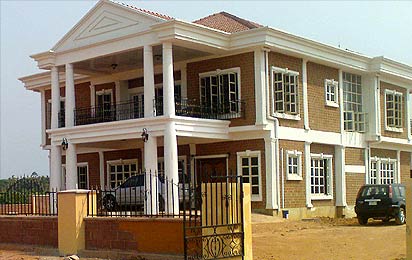
•A residential property in Lekki, Lagos
By Jude Njoku, Kingsley Adegboye & Rosemary Onuoha
That many Nigerians spend several millions of Naira to build and furnish their exotic homes is not in doubt. But the irony is that these Nigerians would not spend a Kobo to insure such properties. The reasons are not far-fetched: While many see insurance as an additional form of taxation, others say they do not have confidence in the insurance industry.
But what is property insurance?
Property insurance according to experts, provides protection against most risks to property. These risks include fire, theft and some weather damage. There are specialised forms of insurance such as fire insurance, flood insurance, earthquake insurance, home insurance or boiler insurance.
The experts stated that property is insured in two main ways – open perils and named perils. Open perils cover all the causes of loss not specifically excluded in the policy. Common exclusions on open peril policies include damage resulting from earthquakes, floods, nuclear incidents, acts of terrorism and war. Named perils require the actual cause of loss to be listed in the policy for insurance to be provided.
The more common named perils include such damage-causing events as fire, lightning, explosion and theft. A peril, as referred to in an insurance policy, is a cause of loss, such as fire or theft. Named perils policies list exactly what is covered by the policy, while open perils (or all perils) policies will list what is excluded from coverage. Named perils policies are generally more restrictive
Need for property insurance valuation
A Lagos-based estate surveyor and valuer, Pastor Stephen Jagun faulted the procedure adopted by many insurers who just assume value for properties without doing proper valuation of such properties. Stressing the need to do valuation for insurance purposes before any property is eventually insured, Jagun who is a former Secretary of the Lagos state branch of the Nigerian Institution of Estate Surveyors and Valuers NIESV, said such valuation is necessary to ensure that the owner of the property is not shortchanged.
Jagun explained further that the professional input of the estate surveyor and valuer is required to get the actual value of the property to be insured contending that the rule of thumb approach employed by some insurance companies in fixing the value of the property is not in the overall interest of the owner of the property.

•A residential property in Lekki, Lagos
Noting that the essence of property insurance is to enable the insurer put his property in its former state, Jagun said: “Assuming the value of the property is N10 million and because you do not want to offend the man, you insure the property for N5 million, if anything happens, the money that the insurance company will pay him will no longer be enough to put his property in its former state”.
Another estate surveyor and valuer, Mr. Olawande Oni insisted that estate surveyors and valuers must carry out valuation of a property before it is insured. Oni who is a past publicity secretary of the Lagos branch of NIESV, the valuation would provide pieces of advice to property owners and insurance companies about the open market value of the property and serve as a guide to getting adequate insurance cover.
Oni who decried the apathy of Nigerians to property insurance, noted “many of the property owners believe that God is their protection and always ascribe everything to God. Some of them complain of the antics of the insurance companies when the issue of claims arise”.
Asked the best policy to take, Jagun said it depends on the property owner. He is the one to decide whether the building and its contents would be insured or not.
Credibility problems hinder people from insuring properties
On why many Nigerians find it difficult to insure their properties, the former IFMA Nigeria President said it many people do not have confidence in the insurance industry. According to him, many insurance companies are not transparent in dealing with their clients.
“Insurance marketers are always desperate and sweet-tongue you into taking a policy with them but will not explain some of the hidden clauses in the policy. They should always be transparent and explain all hidden clauses from the beginning. Some of them will tell you that the policy does not take care of natural disasters but many of the problems that property owners face these days are due to natural occurrences.
“Take the example of the flooding of July last year or the rainstorm that destroyed many houses recently. Insurance covers should take care of such disasters; the holder of the policy may be required to pay higher premium to cover such. But it is only when problems occur that they will start to explain the hidden clauses. Meanwhile, the marketer who sweet-tongued you into taking the risk would not be around,” he said.
Oni supported this view. According to him, many insurance companies often hide behind hidden clauses to evade bearing loss in case of damage to properties. This, according to him, discourages many property owners from insuring their properties.
Poor public perception issue uncalled for -NIA boss
The Nigerian insurance industry has been battling to nip in the bud, the poor public perception that insurers don’t pay claims. Chairman of Nigerian Insurers Association, NIA, Mr. Olusola Ladipo-Ajayi, that the perception that insurance companies use hidden clauses to evade payment for losses does not hold water anymore because insurers now pay claims.
Ladipo-Ajayi said that the service which the insurance industry renders to the economy and Nigerians in recent times is not just about making money for insurers but also preventing losses in the economy and the country at large.
Commissioner for Insurance and Chief Executive of the National Insurance Commission, NAICOM, Mr. Fola Daniel said that more Nigerians should buy insurance because deepening the insurance culture among Nigerians will lead to financial security for them.
However, Mr. Yemi Soladoye, an insurance expert said that with the enforcement of the Market Development and Restructuring Initiative, MDRI, by NAICOM, property owners who don’t have insurance covers for such property are already guilty of the law.
Soladoye said “Property insurance has been on for some time now despite the fact that most property owners don’t consider buying insurance. However, with the enforcement of the five compulsory insurance products under the MDRI, if you are a property owner and have not complied now, you have already violated the rule.”
For Ladipo-Ajayi most Nigerians are averse to insurance because they don’t see any value in insurance adding that had some of those properties destroyed by flood last year been covered under any household policies, their owners would have received adequate compensation from the insurance industry.
He said “People think that insurance is an additional tax just as they think that putting on the safety belt is to prevent law enforcement agents from arresting them, whereas the purpose is to save their lives. People don’t have that attitude to risk matters; they just see it as an additional liability. People don’t see it as a safety precaution they just see it as a way of avoiding being apprehended.”
He however said that the MDRI is a door of opportunity that has been opened to insurers, saying “We will do our best to tap into it. So we are working on it. We also need to work harder and we are trying to do so.”
It will be recalled that in a bid to deepen insurance penetration in the country, NAICOM, launched the MDRI. The objectives of the MDRI are to build confidence in the Nigeria insurance market; promote public understanding of insurance mechanism; grow the nation’s insurance premium volume and density as well as eliminating fake insurance certificates.
Disclaimer
Comments expressed here do not reflect the opinions of Vanguard newspapers or any employee thereof.