By Ebri Kowaki
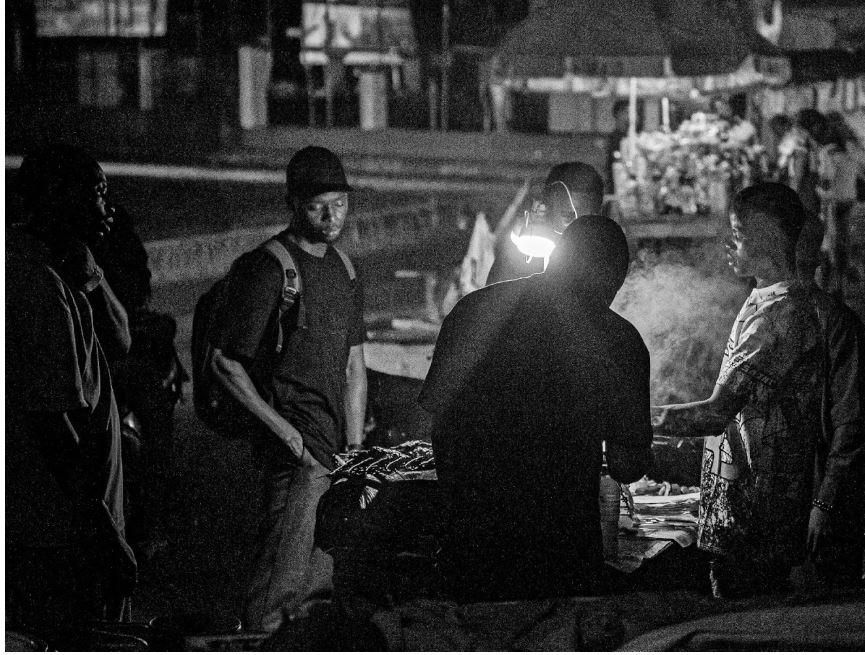
Just before Ibukun Oparinu took this shot of a Mai Tsire and his dependents, she’d been seized in her home by that feverish restlessness artists know too well. Unable to find quiet in pacing her room or placing hands to the sewing machine, she heads for fresh air. She takes her Canon case with her. It is just past 7:30pm. She had found capturing night businesses around her town mentally exciting anyway.
Like all towns of the aspiring youth around the country, night time in Bodija is a rush of heads and lights and vehicles. A little less so on inner streets, poorly lit, wiggly with 2010s Wizkid or Seyi Vibez coming off unseen speakers, challenged with potholes that seasonally become lakes. The main roads could feel like a carnival you came late to, after doing the sidestep-misstep dance with the second stranger within a hundred yards.
The air is lighthearted, face-recognizing, motor-honking, lazy-dinner buying. Motion, everyone is thinking the same thing: get home before it gets too dangerous to do so.
Ibukun is early, she refines her lens as late evening approaches full swing. From then the arm of Oshanla led on. She probably reminded a couple of bewildered tourists wandering Seychelles. Probably the main character in a made up story about a black oyibo taking pictures in the street at the pepper seller’s dinner table. She moves from the groceries line, a suya stand, to phone accessories, a closed up restaurant, ubiquitous POS handlers, another suya stand captured with a lone woman walking past. She crosses the road and walks up to the first Mai Tsire. His patronage is doubled by now, forming a loose arc around his double solar LED. and they all would have him wrap their papers already. One places a half drunk water bottle beside the vendor like a demand. The one getting served intently follows his hand from meat pile to paper, prepared to scowl if he tries to gist his way to wrapping up the dishing process by prematurely reaching for a half slice of cucumber. Ibukun smiles contentedly before raising the camera to her eyes. She would opt for a grainy monotone filter post-editing but in this colorful present, she knew this was the photograph.
Nutritionist E. Ekanem was the first to call suya a unifying factor in Nigeria. Spiced grilled meat has long been beloved in Nigerian towns and megacities from Ado-ekiti to Birnin-kebbi. Roadside suya vendors are as natural as night and remain de-facto arbiters of the ready to eat snack regardless of attempts of countless clever people to repackage and gentrify it. Tsire, the more commonplace version of the three forms of suya, is made with thin spliced beef or ram and Yaji ‘curry’. Favoured organs include liver, tripe, cow hump, kidney. The curry is used in both marinating the meat and sprinkled on the complete order of meat, onions, cabbage (etc), blended from dry hot chili and cayenne peppers, ginger, onions and crushed kuli kuli.
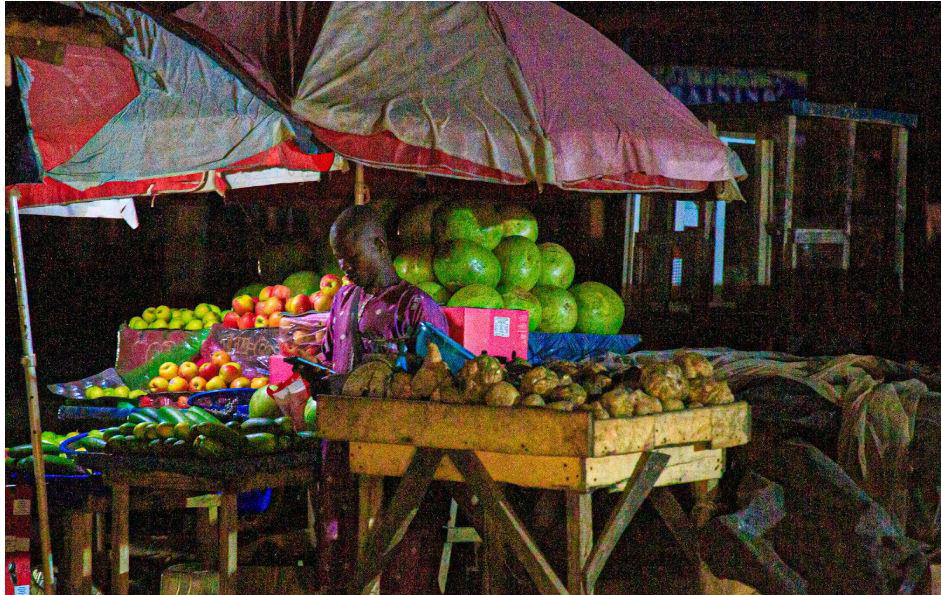
He starts serving the young man with hands pocketed, who seems to be falling asleep on the spot. Our eye moves on to brighter scenes; a little boy astride a motorcycle arms akimbo, a vision of self-assured confidence, the second hand boutique just deciding to close up, blazing generator lights, merchandise still on mannequins. They sell wholesale soft drinks as well.
Ibukun is delightfully masterful capturing motion, in Night Time in Bodija as well as on other projects. Common liminal moments is the sort of thing street photographer Godiva Omoruyi occasionally breaks the algorithm with. Wistful liminal moments, whimsical maybe; a salesman at Gods Own Ventures is about to convince his customer that these airpods would last till he is sick of using them, the Chinese manufacturers swear it, if I dey lie give you, here be my shop. The customer would bite because he dreads another night alone in his room startled by sharp sounds, and it is now almost 9pm.
Our friendly Mai Tsire would be working till near midnight, at which point he would undergo his frequent incarnation either as the fires of salvation to night owls wandering for a snack or a threatening figure with blades to the more paranoid. Fraught with sectarian violence that runs deep into its founding fabric, suya vendors may be one of the few bridges to building trust of northerners in southern Nigeria. Even when they have to deal with misrepresentation and suspicion on account of stereotypes the media has greatly helped sensationalize and promote. The paranoid may in time come to appreciate the dutiful and charitable spirit of Hausa-Fulani culture, or at least settle for a two-faced perception which is more common. Vibrant young northern men migrate in search of better lots than the state allows them at home, becoming traders and herders and farmers and labour, forming an indispensable layer of the Nigerian economy. They are spread out in close knit enclaves across the southern country.
The time honored vocation of cattle rearing or herding, inherited from ancient Somali, provides nightly beef in suya spots around Bodija as well as the rest of the 360,000 tonnes annually consumed around the country. The vocation comes with varied risks, not in the least dangers of becoming targets in local communities that fear or have suffered violence from terrorists under the guise of cattle rearing.
Ibukun depicts undeterred attitudes in her celebration of regular night in regular class Nigeria, entrepreneurs adapting to inconvenient positions foisted on by circumstance and getting on with it like the rest of the masses. Dreaming big and pursuing those realities relentlessly. Indeed, stereotypes visited on ordinary northern youth are unjustified and plain damaging. More so to relationships with outsiders and their counterparts who are unable to appraise the region as anything more than a monolith, a hotbed of extreme poverty and cannibalistic insecurity. On Shadows of Northern Heritage, another series inspired by this spirit, Ibukun paints a truer picture of disempowered youths learning to reframe life with faith and cultural groundedness, a generation of creatives, technology leaders, policy makers. These are the bodies you would run into buying fruits in Bodija or at a digital conference in Kano.
The nation has now put six decades behind its darkest moments of tribalistic sentiment. And just on time, the emerging society is more interested in proving worth on a global scale rather than one-upping the south. This is evident in the surge of cultural pride and awareness, in the rate of initiatives – from the arts to machine learning springing up by the dozens. Success in the new world is largely predicated on intimacy with technology and critical problem solving capacities. This, even more than the traditional university education, has to be emphasized for investors and policymakers in northern Nigeria as well. All Nigerian youths really need is a chance.
There is that enduring quality that earns Ibukun Oparinu’s imagery a second look; scenes that feel like chance encounters, evoking the atmosphere of British Joe Lang’s photography- to draw under light the patchwork pattern of similarities between all people.
The author, Ebri Kowaki, is an arts and culture journalist. His works have appeared in The Republic, UbuntuAfrica, Afrocritik, African Writer Magazine, and elsewhere.
Disclaimer
Comments expressed here do not reflect the opinions of Vanguard newspapers or any employee thereof.