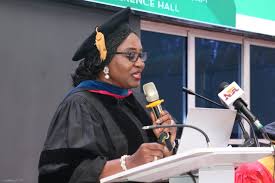
Professor of Linguistics at the National Open University of Nigeria (NOUN), Christine Ofulue.
A professor of Linguistics at the National Open University of Nigeria (NOUN), Christine Ofulue, says Nigerian Pidgin is becoming a global lingua franca due to its exceptional scale and wider reach.
Ofulue said this in Abuja while delivering the university’s 35th inaugural lecture with the theme: “Reclaiming Marginalised Voices: Intersections of Diversity and Educational Spaces.”
She stated that Nigeria is Africa’s most linguistically diverse nation, with approximately 540 distinct languages across three major language families: Afro-Asiatic, Nilo-Saharan, and Niger-Congo, spoken by over 223 million people.
“This diversity means that multilingualism is not just common, but a way of life.
“Nigerians regularly navigate fluidly among local, regional, and national languages.”
Ofulue argued that while English had been seen as the language of formal education and administration, many minority languages face endangerment, policy neglect, and declining intergenerational transmission, marking a stark divide between grassroots linguistic reality and official recognition.
The professor explained that Nigerian Pidgin was at the heart of the country’s linguistic landscape, with a vibrant result of centuries-old contact, trade, and multicultural adaptation.
According to her, Nigerian Pidgin, with its exceptional scale and reach, is among the world’s 76 pidgins and creoles.
“It is spoken by 100 million to 120 million people, making it the 14th most spoken language globally,” she said.
She said pidgin had evolved from a colonial-era trade code into a pan-Nigerian lingua franca, serving as a means of daily communication, creative expression, and social bonding, while symbolizing both urban identity and national belonging.
Ofulue added: “The journey of Nigerian pidgin is not just a story of marginalisation, but also of resilience and reclamation.
“It is a testament to everyday Nigeria’s capacity to forge unity and voice across boundaries, even as it remains excluded from many formal domains.”
She said that marginalised voices can be reclaimed through robust, strategic and locally grounded research agendas.
These include building learning analytics systems that generate actionable data, digitising indigenous knowledge systems, and undertaking comparative studies within African contexts.
The lecturer pointed out that without deliberate intervention, small languages would continue to be excluded from education, digital spaces, and economic opportunity.
Ofulue said indigenous languages can be repositioned through educational spaces, curriculum reform, inclusive pedagogy, and technology learning.
She, therefore, recommended interventions that can promote language development in marginalized languages, some of which include standardization of terminology and the development of glossaries for digital, technical, and educational fields through expert user partnerships.
“This can also be developed through the promotion of multimedia content, which includes support for audio-visual content in indigenous languages to meet learners in digital spaces,” she said.
The Vice-Chancellor of NOUN, Prof. Olufemi Peters, commended Ofulue for reminding them of the importance of pidgin to Nigeria.
Peters, who was the chairman of the inaugural lecture, spoke in pidgin while saluting the linguistics professor for a good lecture, attracting cheers and applause from the audience.
The Deputy Vice-Chancellor, Administration, Prof. Isaac Butswat, in his vote of thanks, commended Ofulue for educating the audience on the evolution of Nigerian Pidgin.
Disclaimer
Comments expressed here do not reflect the opinions of Vanguard newspapers or any employee thereof.