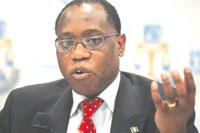
Aganga…Minister of Trade & Investment
BY FRANKLIN ALLI & MICHAEL EBOH
BUSINESS community in the country has strongly resisted the decision of the House Committee on Finance of the House of Representatives to carry out audit investigation on tax matters in 180 companies in the private sector for the period between 2006 to 2011 and the appointment of a tax and auditing firm, Olusola Adekanola & Co., to carry out the audit on its behalf.
According to them, the decision of the National Assembly to conduct an audit on the tax compliance levels of companies in the private sector in Nigeria will subject the companies to a parallel tax investigation, increase the cost burden of the companies and negatively affect the country’s ranking on the ease of doing business.
“The question remains: What does the committee want to establish, are they trying to usurp the powers of the Federal Inland Revenue Service (FIRS)? The role they seek to play is an executive function within the powers vested on FIRS as an established body with statutory duties,” said Kingsley Anaroke, Publicity Secretary, Nigerian Association of Small and Medium Enterprises (NASME).”
Continuing, he said: “NASME urges the House Committee on Finance to take another look at sections 88 and 89 of the constitution which they said gave them the powers to audit private firms, to properly interpret the clause. It is either somebody is not sufficiently lettered to decode the legislative language or that someone has chosen to hide under ignorance to aid and perpetrate illegality and corruption.
“How does this action amount to oversight function of the committee? We, therefore, urge every member of NASME to ignore the committee’s threat. The committee should channel their efforts at helping the executive arm of government to provide business environment that is conducive for investments to thrive.
“Have they done the cost benefit analysis of visiting 180 private firms dotting different parts of the country? “How much is Nigeria losing via tax evasion? How much is the committee hoping to recover and how much will they spend doing that? Have they also factored in the weight of the opportunity cost to their plenary and other committees’ sittings?”
Speaking further, David Imafidon Adonri, CEO, Lambeth Trust & Investment Co. Ltd, said: “Being delegates of the people, it is believed that the National Assembly cannot delegate its functions to third parties; otherwise, it will be acting contrary to the legal maxim that ‘Delegatus non Delegare.’
He noted that the National Assembly makes the rules under which Nigeria is governed. “It is the ruling body also with enormous powers of oversight on the entire country. However, its powers must be exercised judiciously. Members of the current National Assembly have brought unprecedented vigor and vitality to the conduct of national affairs.
“Their recent dynamic drive to restore firm order in the country through various inquiries, probes and investigations matches the wishes of the electorate for better Nigeria. The efforts are praiseworthy and should continue with undiminished intensity. The patriotic zeal now being demonstrated by the National Assembly is needed to invigorate the process of cleaning up the entire rotten system.

House in session
“However, the efforts should not degenerate to over- zealousness. Care must be taken by the National Assembly not to operate outside the ambit of their constitutional powers. It is against this background that a number of well-meaning stakeholders have observed that the appointment of a Tax Consultant by the House of Representatives Committee on Finance to investigate the books of private companies may be erroneous.
The Nigeria Employers’ Consultative Association (NECA) has rightly adduced enough reasons to dissuade the committee from embarking on this misguided exercise. Hope reasons will prevail,” he stated.
Already, NECA has dragged the House of Representatives to Federal High Court, Abuja, seeking an injunction restraining the Attorney-General of the Federation, the Speaker, House of Representatives, Clerk, National Assembly, Chairman, House Committee on Finance and Olusola Adekanola & Co. from proceeding with the audit and inspection of the books of companies in the private sector as planned.
Olusola Adekanola & Co is a consultant appointed by the House Committee on Finance to investigate Corporate Tax Returns private sector companies between 2006 and 2011.
The umbrella body for employers in the country has already directed member companies not to open their doors to the consultants, arguing that the House has no power under the law to undertake such investigation.
In an originating summons filed in the Federal High Court on Friday, 20th April, 2012, NECA asked the court for interpretation of Sections 88 and 89 of the Federal Constitution under which the House committee claims it derives its powers to carry out the action.
NECA in the suit through the Chambers of Tunji Abayomi & Co, is seeking among others, “A declaratory judgment that the investigatory powers of the House of Representatives granted by Sections 88 and 89 of the Constitution of the Federal Republic of Nigeria 1999 as amended and exercisable through the House Committee on Finance does not extend to the Plaintiff (NECA) member companies for the stated purpose to wit ‘to ensure that all revenues accruing to the federation are remitted fully and appropriately.
“A declaratory judgment that the stated purpose of the investigation of the House Committee on Finance ‘to ensure that all revenue accruing to the federation are remitted fully and appropriately’ is inconsistent with the powers of the House of Representatives having regard to Section 5 of the Constitution of Nigeria 1999 as amended, Section 3 (1) of the Companies Income Tax Act Cap 21 Laws of the Federation (2004), Section 2 (1) of Taxes and Levies (Approved List for Collection) Act, Cap 72 Laws of the Federation (2004) and all other relevant laws.

Aganga...Minister of Trade & Investment
“A declaratory judgement that the House Committee on Finance cannot as agent of the House of Representatives compel the cooperation or attendance, exact information or evidence or conduct any inquiry, howsoever or whatsoever of Plaintiff (NECA)’s member companies in exercise of the investigative powers vested on the House by Section 88 and 89 of the Constitution of the Federal republic of Nigeria, 1999 as amended.
“A declaratory judgement that the member companies of the Plaintiff (NECA) not being ‘’persons”, ‘’authority”, ‘’government ministry”, ‘’government department’,’ which executes or administers law made by the National Assembly, disburses or administers monies appropriated or to be appropriated by the National Assembly are outside the investigatory powers of the House of Representatives for the purpose stated by the House Committee on Finance under Sections 88 and 89 of the Constitution of the Federal Republic of Nigeria as amended.” The court is yet to determine the date of the hearing of the motion.
Further to this, Taiwo Oyedele, PwC /Partner, noted that tax audit and investigation is an integral part of tax compliance enforcement anywhere in the world.
“What may be different from one country to another is the approach. In Nigeria, the responsibility to carry out tax audit and investigation rests with the tax authorities based on the relevant tax laws which also establish procedures and due process for assessment, collection and dispute resolution.
“Let’s even assume that the companies allow the National Assembly to carry out the back duty investigation as proposed, how will the consultant or the National Assembly raise assessments for any underpaid taxes? After raising assessments, how will such taxes be collected – by whom and into which accounts? What if the investigation reveals that a company had overpaid taxes, how will any refund be paid? In the likely event of any dispute, what will be the process for dispute resolution?
Can the companies challenge the assessments in court? Will the National Assembly and/or the consultant be the defendant? If so, on what legal basis and if not, does it mean affected companies must accept the outcome of the tax investigation hook, line and sinker? If there will be recourse to the Federal Inland Revenue Service (FIRS) in any way, then why not mandate the FIRS to carry out the tax investigation?
“As a matter of fact, many of the companies listed in the first phase of the exercise are already undergoing audit or investigation by the Federal Inland Revenue Service. Subjecting them to a parallel tax investigation is at best an avoidable additional cost of tax compliance which is already on the high side for Nigeria compared to other countries around the globe.
According to the World Bank, Nigeria ranks very low on the ease of paying taxes worldwide and even worse in terms of the time required for tax compliance including attending to tax audits. On this benchmark, Nigeria ranks 180 out of 183 countries covered by the survey in 2011. For the avoidance of doubt, I fully support any initiative aimed at improving the tax environment to be more competitive and encourage voluntary tax compliance.
However, all stakeholders must work together to achieve these objectives in the best possible way and at the least possible cost given the already difficult operating environment.”
Disclaimer
Comments expressed here do not reflect the opinions of Vanguard newspapers or any employee thereof.