By Nwafor Sunday
An interview with Nosa Aikodon, researcher with the EU-funded TARGET project, exploring how digital twin technology could help prevent strokes and personalise healthcare globally.
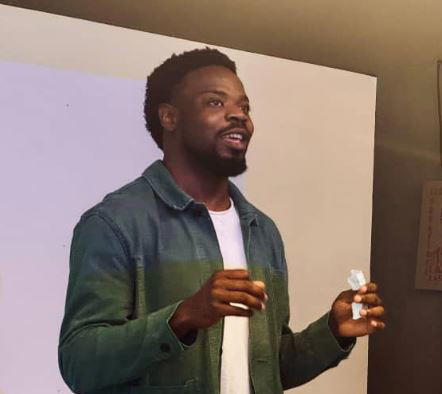
“We now have the tools to predict problems before they happen. Digital twins could help us deliver smarter, fairer care, no matter where someone lives.” —AI Researcher Nosa Aikodon delivering a keynote talk at the Research Roasters event Liverpool UK.
Imagine a future where doctors can test treatments on a virtual version of you, before giving you the actual medicine. That’s the promise of digital twins, one of the most exciting breakthroughs in modern healthcare.
We spoke with Nosa Aikodon, a researcher working on the TARGET EU project, to explain what digital twins are, how they work, and how this technology could transform healthcare in Nigeria, and across Africa as a whole.
Q: What exactly is a digital twin?
A digital twin is like a computer version of a real person. It’s built using real health information like your heart rate, lab tests, or medical history. Doctors and researchers use this virtual model to understand what’s going on inside your body, and to test different treatments without putting you at risk.
It’s not just a copy of your data, it’s a living model that helps us make better medical decisions for you.
Q: How do digital twins work?
They work by combining data and computer models. First, we collect information about a person, things like blood pressure, test results, or even how active they are. Then, we use smart algorithms to figure out what might happen in their body next. For example, will their condition improve? Is a stroke likely if nothing changes?
The digital twin helps us see into the future and try out different care options before doing anything in real life.
Q: Where are digital twins already being used?
They’re being used in factories and smart cities, but in healthcare, they’re already helping with heart conditions, cancer care, and even in the ICU. Some hospitals are using them to decide which patients need urgent attention, or how a specific drug might work for someone with multiple health issues.
Q: What technology makes this possible?
It’s a mix of AI (artificial intelligence), data from patients, and health knowledge. We feed this information into smart systems that learn patterns and make predictions. It’s like combining a really smart doctor with a supercomputer that never sleeps.
In the TARGET project, we also use these models to understand why something might happen, not just when. That helps us focus on what truly matters for each patient.
Q: Tell us about the TARGET EU project
TARGET EU is a big research project in Europe focused on preventing atrial fibrillation (AF), a heart condition that can lead to stroke. We use digital twins to figure out which patients are at higher risk, and how to prevent bad outcomes.
I work on the part where we build models that adjust for different types of people. That’s important because not all patients are the same, our models need to work for everyone, not just people in one country or group.
Q: What is the future potential of digital twins?
In the near future, your doctor might use a digital twin to guide your care. Imagine trying a new treatment on your virtual self first, to see if it’s safe or effective. That’s the future we’re working toward.
For Africa, this could be a game-changer. We could bring better care to people in rural areas, reduce guesswork in treatment, and help doctors make faster, more personalised decisions.
Q: Can Africa really use this kind of technology?
Yes, but we have to prepare for it. We need better health data systems, more training for local researchers, and stronger internet and tech infrastructure. But the potential is huge. Africa could actually leap ahead by building modern systems from the start, without copying outdated ones.
Q: Are there any risks or concerns?
Yes, and we have to be careful. People’s health data must be protected, privacy is essential when dealing with sensitive medical information. There’s also the issue of bias: if digital twin models are trained mostly on data from Europe or the U.S., they may not perform well for African patients or those from underrepresented groups. And importantly, fairness must guide how this technology is used. These tools should be accessible to everyone, not just those in wealthy regions or major cities. We need strong rules and thoughtful design to make sure this technology helps everyone.
Q: What keeps you motivated in this work?
I truly believe in healthcare that’s fair, smart, and personal. It excites me to work on something that could save lives, reduce suffering, and bring better care to people who’ve often been left out of new medical innovations. We’re not just building tools, we’re building a better future for healthcare.
Closing Note
Digital twins aren’t just about algorithms, they’re about understanding people more deeply, predicting problems before they arise, and building a healthcare system that responds to you, not just your symptoms.
“ This is where medicine is going. The challenge, and the opportunity, is to make sure it works for everyone, everywhere.”
Disclaimer
Comments expressed here do not reflect the opinions of Vanguard newspapers or any employee thereof.