By Ebri Kowaki
It was 2016, Ibadan. Oluwatobi Ogundunsin was learning a Nikon at unusual angles no different from a paintbrush.
Easel was his isolated observatory, detached inseparably from the picture: the same running splash of rust noble Bekederemo had dined to half a century earlier. Picture Tobi now; his melancholy has matured into this intimate understanding of the flawed, beneath that, seething desire to protect all things beautiful about the flawed. Where does the fountainhead lie? What has imperfection cost him personally?
Back in Ibadan, those roofs were fading from the coast, via overexposure. This early flirtation with effacement is notably absent in Tobi’s later work like Duality of Temptation, leaving the image confident enough to declare its perspectives, bashed be consequence. The artist must cultivate this confidence as a prerequisite- serious artistry cannot begin without it.
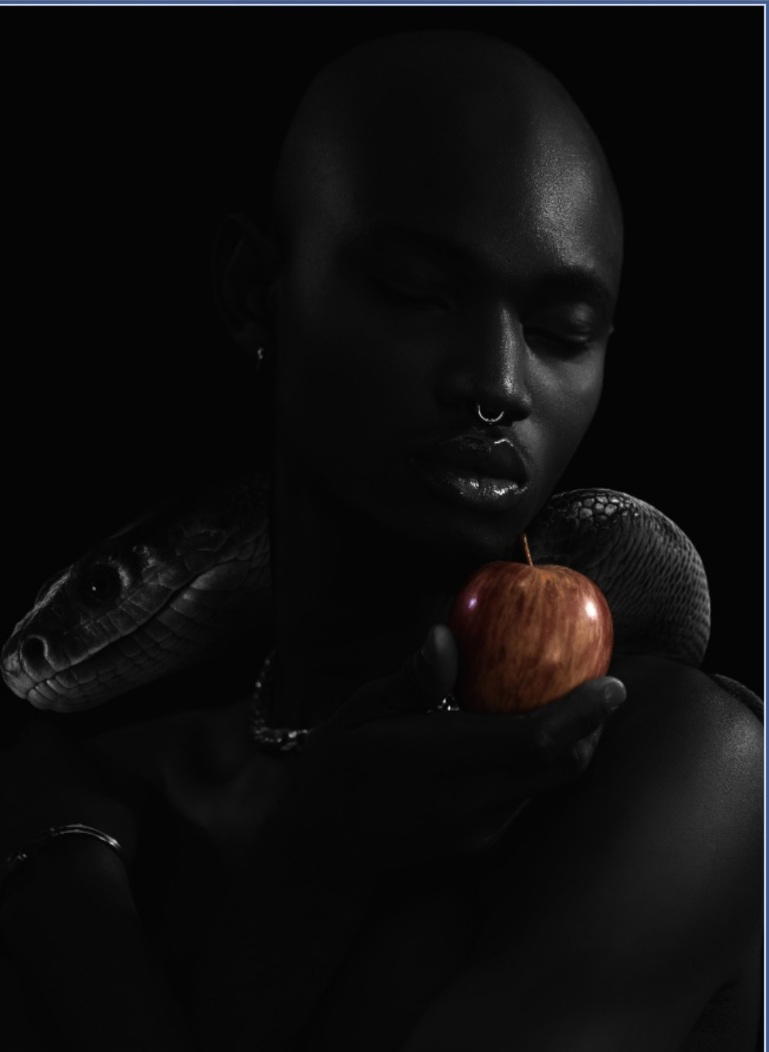
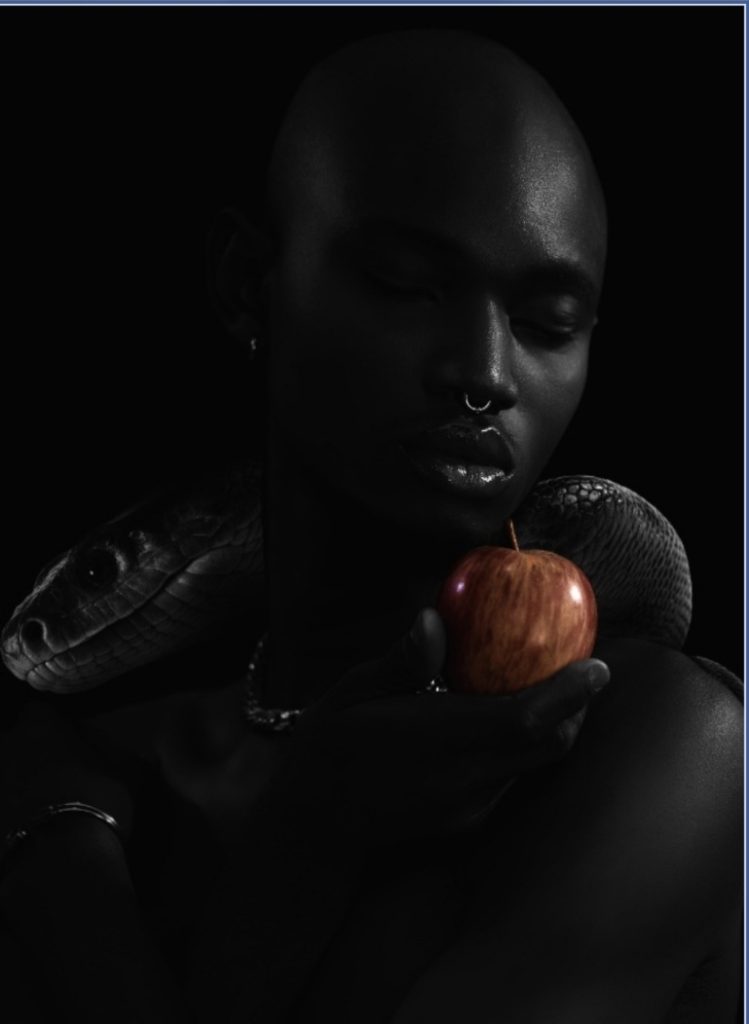
Oluwatobi’s oeuvre is what is referred to as a critic’s favorite. Most frames leave you a visual essay. Consider the earlier referred title, a glossy edgy refix of the Fall of Man plot. In Tobi’s vision, Eve is gender fluid, they are also the tree of moral knowledge.
Composition is Tobi’s heavy hitter, here tight and intimate, using a central frame structure to lock focus on the Eve’s closed face, the snake, and the apple, layered into a triangular visual balance. Their tilted head form a diagonal axis, which is echoed by the curvature of the snake and the placement of the apple. The use of hard side lighting, in typical Caravaggio-like fashion demonstrates the artist’ mastery of lighting dark skin. Caravaggio perfected the art of dispersing the fallen within the divine in a stroke. Duality asks of you; who is divine? who is fallen? Eve serene, the serpent would leap out the frame the moment he saw a pass at the border, wonder what frights he encountered atop that tree.
This becomes Eve; the one who didn’t hide, who doesn’t seethe in desire, bearing fruit and trap with the authority of the hunter. Our choices make us divine.
Our choices make us divine. the mantra like mist in late autumn. Hooded Benedictines head back to their monastery. The mantra is in active manifestation in their stride; our choices make us divine. Gordon Parks, in choosing an elevated angle, places us as distant observers, peeping into a world we are unlicensed to observe. The Rule of Saint Benedict has been meditated on for 15 centuries by Benedictine monks, who regard the patron saint the father of western monasticism. Kansas-native Gordon, whom Tobi credits as an influence, earned his place as a groundbreaking photographer of 20th century urban life. In 1942, his work received its first major recognition in the Rosenwald Fellowship. This fellowship allowed Gordon to expand his ambition, experimenting with myriad ways to photographically understand human agency and social justice. He soldered patronage with magazine photo editors after the Nazi war. Covering a Life story, he returned to his hometown in 1955, to observe the daily life and soul of the Benedictines.
Tobi and Gordon are easy parallels; both seek to perform some justice – moral or sociopolitical, both are quirks of composition, and have a knack for blowing up in your face and holding you there. Gordon channeled this into making sure his subjects haunted, as in Interracial Children Camp Buddies – black girl looks down at us flustered, face leaning to gravity against white who is preoccupied posing for a more leveled camera, undisturbed to oblivious of black’s body contact. While Tobi’s layering is chess-like, his aim is to bedazzle (excepting Duality of Temptation). Not surprisingly, this is a fashion forward motivation. Spontaneity magnifies Gordon’s impact, we can’t shy from knowing that this was a real moment with real others. The photographer steps back from orchestrating to be a vessel praised for his powers of observation. Tobi’s moments are deliciously spontaneous; a smile before it vanishes. The intended effect is somewhere buried under creative direction. And this is where Tobi Ogundunsin departs the path from Gordon Parks, this is how his most ambitious reaches cheat themselves.
A part of it is modern hubris- cultural influence of AI aesthetic, constant urge to produce Instagram-worthy content. It should now be clear that artificial intelligence development is driven neither by design or consumer satisfaction incentives. We are decades away from creating tech that creates art, meaning it creates an expression that resonantes emotionally and pushes known boundaries. AI has oversold its dream on the backs of pop sci-fi and techno-optimism. Plus, its ‘photos’ are very bad, from any critical perspective. The artist must certainly not stoop low enough to attempt to create art using AI, barely adopting its aesthetic promotes a trend that not only doesn’t advance craft or culture, but cheapens both.
Imagine this journey; from engaging imperfection, to harnessing it, then a 180 brushing in so many shines the message becomes too perfect to feel, An AI-generated face is closed wrongly. I am not saying Tobi has been passing AI-generated photos for artistic work. Like many other creatives, he appears to have become focused on making the work sit just right it ends up sitting no-where; that glossy in-between palace of a thousand pictures with zero words.
Beauty Wrapped in Colors is cause for the knell. In foreground are stalks of bamboo leaves, in what is presented as a celebration of afro-feminism. We could segway into a reflection of the cultural preference of optics over substance- IG influencers in fake jets, a thriving Youtube channel swimming in slop, a tree, any tree, because some tree is the metaphor I’m looking for. It is also unclear how indoor settings advance the concept and heavy editing advance the concept. At least, Tobi is gracious enough to not mire in cliche. For me that reveals a creative heart. Solitude is an apron, in the digital dystopia of socially engineered anxieties we have to live in. To fully unfurl creatively is to develop a distinct eye, resisting easy routes and mudslides long enough to see retina emerge from paint.
As Gordon Parks’ legacy swears, redemption is not in the camera lens. It’s out there, you may capture it, you may skillfully sharpen its voice, you would not succeed in telling it what to say and should not try.
Oluwatobi Ogundunsin holds so much promise, the artist represents the portion of Nigerian creatives whose full potential are restrained by social persuasions to aspirations alien to their intent. The few break out to perceived milder climates, Tobi now works from the United Kingdom. But that breaks you out of the economic mire at best. Mindsets and the artistic discernment for knowing when to enhance the ordinary from when to show it as is are a different matter.
Ebri Kowaki is a culture journalist. His works have appeared in The Republic, UbuntuAfrica, Afrocritik, African Writer Magazine, and elsewhere.
Disclaimer
Comments expressed here do not reflect the opinions of Vanguard newspapers or any employee thereof.