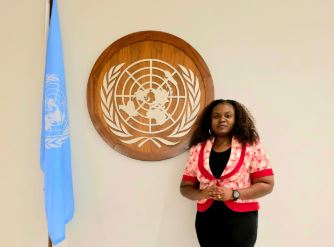
By Nnasom David
New York — A Nigerian rural development expert, Damilola Olajubutu, has called on the international development community to adopt a grassroots approach to water governance, describing it as a sustainable alternative to conventional water development strategies that have failed to solve Nigeria’s water crisis.
Olajubutu, who is the Executive Director of the Rural Nurture Initiative (RNI), made the call while speaking at the United Nations General Assembly President’s High-Level Meeting on Sustainable Development Goal 6 and related multistakeholder events held July 9–10, 2025, in New York.
Presenting on behalf of both RNI and the African Rural Development Network, Olajubutu criticized the current top-down model of water interventions in Nigeria and other African countries, which she said often ignore the real needs of local communities. She argued that many water projects collapse after implementation due to lack of local ownership, inadequate maintenance capacity, and over-reliance on high-end technologies.
“Communities know their needs best,” Olajubutu said. “When we trust their expertise and support their choices, we create sustainable solutions that endure long after external support ends.”
She said fieldwork conducted by her organization across rural communities in Nigeria showed that long-term sustainability depended less on technology and more on active community participation and management.
A key feature of RNI’s model, according to her, is the use of gender-inclusive water committees that give women — the primary water managers in most rural homes — a voice in decision-making processes. She noted that women are often excluded from water governance despite bearing the burden of water collection.
“Our gender-inclusive water committees amplified women’s voices in resource governance,” Olajubutu told delegates.
During stakeholder brainstorming sessions at the UN event, Olajubutu proposed policy reforms that include mandatory rural inclusion quotas in national water infrastructure plans. She also advocated integrating rural development methodologies into water interventions and establishing strong monitoring and feedback systems.
She said such measures would ensure that rural communities are not sidelined in planning and resource allocation.
Olajubutu further called for practical case study presentations at the upcoming 2026 UN Water Conference in Abu Dhabi. She said showcasing successful, community-led models from countries like Nigeria would demonstrate the viability of grassroots solutions and help shift global policy focus toward local empowerment.
“With over 60 million Nigerians lacking access to safe water, we must stop treating communities as passive beneficiaries and instead see them as active partners in development,” she said.
Her recommendations come at a time when Nigeria is pushing for reforms to meet its universal water access targets. Olajubutu said RNI’s integrated approach — combining WASH education, technology selection, and community training — offers a proven framework for sustainable progress in the sector.
As coordinator of the African Rural Development Network, Olajubutu also noted that the community-driven model holds potential for replication across the continent.
“Across Africa, where hundreds of millions lack safe water, communities are not just waiting for solutions. They are ready to lead the change if given the tools and recognition,” she said.
Her intervention has placed Nigeria in a strategic position to contribute to shaping global water governance discourse ahead of the 2026 conference.
Disclaimer
Comments expressed here do not reflect the opinions of Vanguard newspapers or any employee thereof.