Senate
By Zik Zulu Okafor
Tension Builds. Over the legacy fund investigation. Senate insists on the personal appearance of the Nigeria National Petroleum Company Limited, NNPCL’s Group Chief Executive Officer, GCEO, Bayo Ojulari. Their reason is staggering. It is over the unprecedented discrepancies in its Legacy Audit.
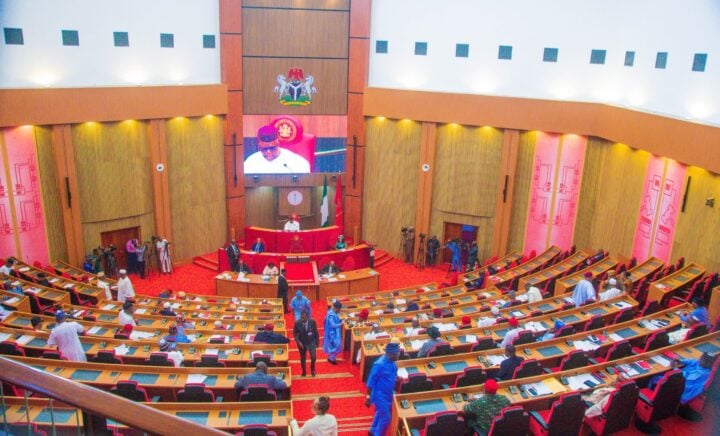
The simmering standoff escalated penultimate week, as the Senate Committee on Public Accounts again rejected the absence of the GCEO in its high-profile probe of financial discrepancies totalling a confounding ₦200 trillion.
In a packed committee session covered live by Channels Television, the lawmakers declined to engage with the delegation sent by NNPCL and instead reaffirmed their demand for the GCEO to appear in person.
“The continuous refusal of Mr. Ojulari to honour the summons of this Committee amounts to a direct affront to the authority of the National Assembly,” declared Senator Aliyu Wadada, Chairman of the SenAccounts Committee. “This Committee will not tolerate further disregard. We will be issuing a new date, and failure to comply will compel us to invoke our constitutional powers, including the possibility of sanctions.”
The stakes are high. The Senate is probing 11 critical queries in NNPCL’s audited statements . These were transactions that predate Ojulari’s appointment . Yet, today, it seems to have become a potent symbol of Nigeria’s perennial struggle for accountability in its petroleum sector.
Now, this is a clear case of a
legacy issue meeting a new era.
Ojulari, a respected industry executive, was appointed only recently. He has yet to be fully briefed on the sprawling details of the legacy transactions. Senior NNPCL officials familiar with internal deliberations revealed that the GCEO has been working intensively to piece together a comprehensive picture of the inherited financial records, if not burdens.
“Mr. Ojulari takes this investigation with the utmost seriousness,” said a senior NNPCL official who spoke on condition of anonymity because he was not authorised to comment on it publicly. “But he can not be expected to provide credible answers about transactions he neither initiated nor approved without first conducting an internal audit. Delegating senior management to meet the Senate was not evasion; it was the responsible course of action.”
Indeed, across major democracies, such approaches are well-established practices. In the United States Congress and the British Parliament, it is routine for newly appointed CEOs and agency heads to be granted time to conduct due diligence, while relevant directors or CFOs appear before committees to clarify legacy issues.
“Globally, legislatures respect the principle that accountability must be informed by knowledge,” noted Dr. Charles Amaife, a United States based governance scholar. “If you compel a new CEO to testify before he’s properly briefed, you risk turning oversight into theatre rather than substance.”
Amaife’s intelleective position sadly appears a discordant tone.
For the Senate, the matter is as much about principle as procedure. Senator Wadada was unequivocal in rejecting what he characterised as a pattern of deferral . Said he,
“This Committee has shown restraint. We issued a 10-day ultimatum and received a delegation instead. Let it be clear. Only the Chief Executive of the NNPCL is competent to address the questions before us,” he insisted.
Other lawmakers privately said they were wary of setting a precedent where new officeholders can indefinitely avoid scrutiny by citing insufficient briefings.
But it is clear to even the Senate Committee members that Ojulari is not running away. He is neither the architect of the object of the investigation nor the executor. Indeed,
behind the scenes, NNPCL officials are urging lawmakers and the public to recognise the unique circumstance of Ojulari’s tenure.
“This is not about defiance,” another official emphasised. “This is about ensuring that when the GCEO appears, he is equipped with facts, not conjecture. Nigerians deserve accurate answers, not hurried statements.”
While declining to issue an official statement on the Senate’s warnings, sources close to Ojulari confirmed he is prepared to honour the next summons personally once he has concluded his internal review.
As the Senate prepares to announce a new date, the impasse underscores a deeper tension in Nigeria’s public institutions ; the balance between rigorous oversight and operational fairness. Analysts point out that effective accountability demands both urgency and respect for due process.
“It is in the national interest that NNPCL’s leadership be given the time—within reasonable limits—to prepare for such consequential testimony,” said Gbenga Adewunmi, a lawyer and corporate finance expert.“Otherwise, the process risks losing credibility.”
For now, all eyes remain on Abuja. If the GCEO appears fully briefed at the next
hearing, it could mark not only a turning point in the astounding ₦200 trillion investigation but also an opportunity to reset expectations about transparency in the nation’s most strategic company.
Disclaimer
Comments expressed here do not reflect the opinions of Vanguard newspapers or any employee thereof.