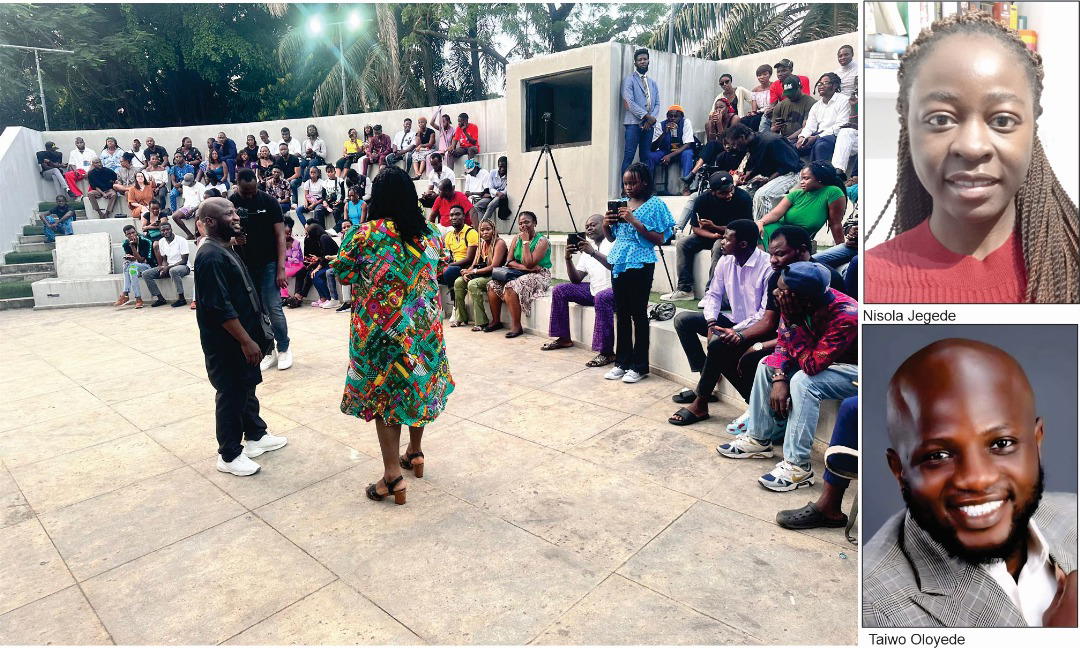
By Joju Fadairo
Lagos poet-playwright Taiwo Oloyede has never shied away from using performance to interrogate social trauma. He expands his usual spoken-word canvas into a compact, movement-driven drama that braids Yoruba oral myth with contemporary street idioms in his play, Folklore and the Gyration of the Oppressed. Premiered as the centrepiece of the 2023 Lagos International Poetry Festival, this stage play transforms traditional storytelling into a performance that is as much ritual as it is theatre.
In this drama, Taiwo Oloyede utilises characters that are living embodiments of collective memory, trauma, and hope, creating an ensemble piece where individual characters dissolve into a gallery of archetypes. Each character becomes less a fully individualised person than a vessel for communal experience. The Ancestral Griot, for example, serves as both narrator and conscience, opening and closing scenes with the cadences of Yoruba praise poetry. While this character’s omniscient voice gives the play mythic resonance, it occasionally risks flattening dramatic tension by foreshadowing conflicts too explicitly. In contrast, the Oriki Drummer blurs the line between music and speech, punctuating dialogue with bata rhythms that become a form of character exposition in their own right.

The dialogue is crafted with precision and purpose, shaping both characters and atmosphere. Drawing heavily from oral traditions, the language grounds the play culturally and also ensures each word feels original to its speaker. A significant factor in this success was the contribution of Nisola Jegede, who served as Dialogue Specialist during development. As in previous collaborations on ‘Wrinkles, Dimples, Naira and Bets’ and ‘Scent of Childhood Places’, Oloyede worked with Jegede in this specialised role. Their creative alliance birthed the polyphonic blend of staccato Pidgin, Yoruba incantation, and English free verse that defines the play’s linguistic landscape.
Jegede refined the script’s linguistic textures, ensuring each character’s speech reflected their background, motivation, and emotional journey. Her expertise is particularly evident in how she identified opportunities to heighten cultural nuance in making interactions more believable and impactful. This approach enabled the dialogue to resonate with local audiences while effectively communicating themes of resistance and resilience to broader, international audiences.

The narrative structure proves equally commendable in its creative approach. Intentionally non-linear and cyclical, it echoes the rhythms of folk songs and communal rituals. Rather than following a straightforward progression, the story unfolds in cycles, allowing for reflection and the reinforcement of key themes. This structure is inherently participatory, often breaking the fourth wall to draw the audience into the action, creating an immersive experience that mirrors the communal nature of traditional storytelling.
The culmination of these elements drove audiences to the brink of excitement during the dramatisation of Folklore and the Gyration of the Oppressed. The production demonstrates how professional theatre can achieve both artistic innovation and social relevance. By balancing cultural depth with clear, engaging language and actively involving the audience, the work stands out as both artistically ambitious and widely accessible, earning acclaim from theatre goers and reviewers alike.
Disclaimer
Comments expressed here do not reflect the opinions of Vanguard newspapers or any employee thereof.