
By Juliet Umeh
A Nigerian research team has triumphed at a leading economics conference, winning the Audience Choice Award for an algorithm that could slash municipal waste collection costs by 27%. This breakthrough offers a lifeline, turning chaotic waste streams into efficient, cost-effective systems that protect both people and the planet.
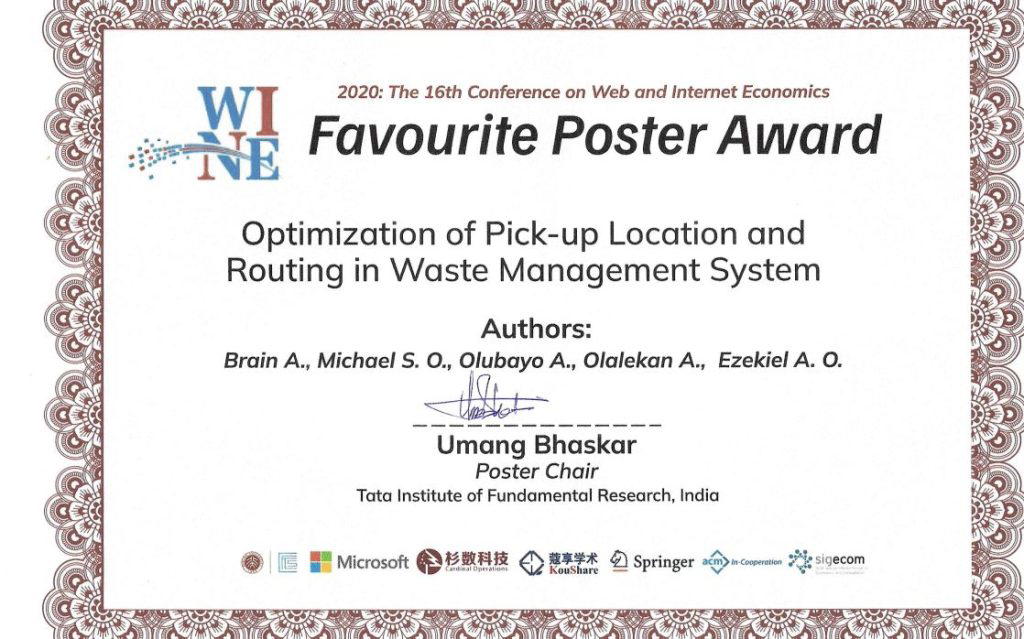
The five-member team won the Favourite Poster Award at the 16th Conference on Web and Internet Economics (WINE 2020). Their entry beat more than 60 international posters in an audience vote at the conference, held from 7th – 11th December 2020 and hosted by the Centre on Frontiers of Computing Studies at Peking University. The Conference on Web and Internet Economics focuses on algorithmic and economic aspects of the internet and related technologies. WINE 2020 attracted more than 300 participants from the field of theoretical computer science. The virtual event was live-streamed eight hours daily across three platforms—YouTube, Bilibili, and KouShare—generating over 10,000 views. Sponsors included the Centre on Frontiers of Computing Studies (Peking University), Microsoft, Cardinal Operations, KouShare, Springer, ACM SIGecom and Shanshu AI.
The all-Nigerian team was led by data scientist Aboze Brain John of Data Science Nigeria. Joining Aboze Brain John were Michael Segun Olanipekun, who presented the research; Olubayo Adekanmbi, Olalekan Akinsande and Ezekiel Adebayo Ogundepo. Their winning entry, “Optimisation of Pick-up Location and Routing in Waste Management System,” presents an algorithmic framework that reduces municipal waste collection distances by up to 27% and ensures timely service in dense urban areas. Using operations research, artificial intelligence and geographic information systems, the researchers developed a field prototype that is scheduled for pilot testing in three African cities in 2021. “Behind every neat city street is a maze of logistical decisions,” Brain said in an interview after the results were announced. “Our goal was to turn that maze into a mathematically elegant route that saves fuel, labour hours and, ultimately, the planet.”
While the conference’s main academic honours—Best Paper and Best Student Paper—went to German researchers Niclas Boehmer and Klaus Heeger, the audience choice categories highlighted projects with immediate practical applications. The algorithm addresses a critical issue in African cities, where overflowing bins and missed collections worsen environmental and public health risks. With global urban populations expected to grow by 2.5 billion people by 2025, efficient waste collection routing “is no longer a back-office concern but a frontline climate challenge,” Brain noted. “Our poster may have won the votes, but the real prize will be healthier cities, here in Nigeria and worldwide,” he said.
Results from the planned pilot testing are expected by late 2021. Successful pilots could see rapid rollout to other cities battling rising waste management costs and limited landfill capacity.
Disclaimer
Comments expressed here do not reflect the opinions of Vanguard newspapers or any employee thereof.