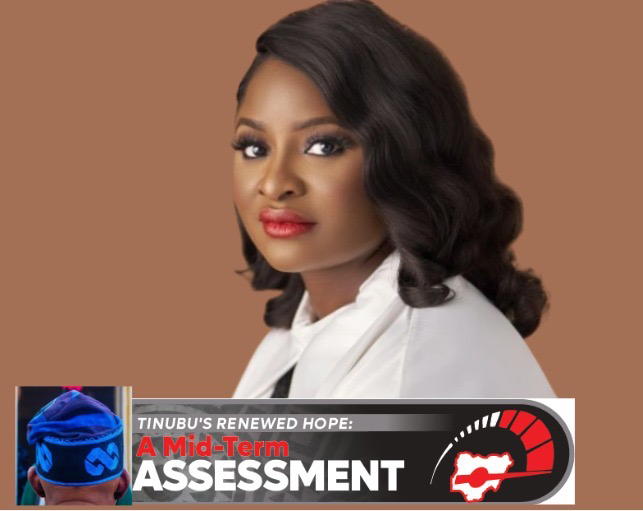
Women in leadership roles serve as powerful models for both male and female aspiring professionals. Their success inspires the next generation, breaking down gender stereotypes and encouraging young individuals to pursue their ambitions without limitations. Against this background, Vanguard takes a step further to assess and interrogate the mif-term of the President Bola Tinubu as well as set an agenda for the second half of his first term.
Omowunmi Akingbohungbe, Executive Director, Women in Business, Management and Public Service, WIMBIZ, who spoke on gender parity, hinted that the Tinubu administration has not fulfilled its promises to elevate female representation in leadership.
According to her, leadership cuts across women in business, women in public service, as well as women in corporate organizations.
Excerpts:
The current government made a declaration that it has failed to fulfill. Although the administration took the right step, it is not enough to make a declaration without implementation. There should be at least 35% female representation in government appointments.
Imagine the percentage of women in the appointment of federal ministers by this present administration. Out of 40 ministers, only eight are women.
It is 17 percent, compared to the expected 35 percent – and that is a huge gap. And 35 percent affirmative action is not the final destination. Therefore, there is a need to be deliberate in our efforts in the attainment of female representation.
Most people would want to ask what the big deal is. Why should we have female representation?
Fundamentally, the rights of women are trampled upon and this is an issue. We have, approximately, 50 percent of the population as women and yet, it is neither here nor there. There is a saying that, if you have two legs, you have to walk on both legs and you will get to the destination faster and even with the balanced movement.
When it comes to the issue of fuel subsidy removal and decision making, how many women were involved in that process? If we have the balanced perspective, there would have been more envisaging of the social impact that it would have – and which it has had. When it comes to policy making, decision making and leadership roles, women participation cannot be overemphasized.
The recent appointment of the new board for the NNPC is another major issue to highlight. There were 11 appointments that were made, only one was female, and that is no way near the 35% commitment that the government promised.
So this cuts across and given a balanced representation, it has its economic benefits and consequences if it is not well implemented.
Studies have shown that a balanced representation in leadership has sustainable benefits and not just giving to Caesar what belongs to Caesar.
Now, the only reason why we should not have a biased view is that there are many competent women out there. We have to be intentional to lead the conversation and it has to start from the government.
There is a declaration, and some directions, some appointments, but yet there is still a huge gap. My belief is that there is a huge room for improvement.
We tend to either overlook or undermine the issue of gender parity not knowing that, a lot of the issues that we are talking about from economic to security, among others, do not enjoy the benefit of balanced representation in leadership roles. When policies are being made, decisions are being taken, balanced representation gives different perspectives leading to the development of a holistic solution.
So, it is very important, not just in government, even in corporate organizations, in businesses, to have that inclusive leadership. And there have been several researches that have proven the economic, sustainability and stability sense that this stands for.
If the government makes a commitment, it is important to keep to it. There are several laws, unfortunately, commitment for implementations is a problem.
Whatever solution that has been proffered, if the solution is faulty from the base, the problem will persist.
Having balanced female representation in leadership and policy making roles is all we are asking for. This is a-360 degree view, where social, economic as well as governance impact, have the total view of both genders represented.
Let there be a balanced female representation in your organization because that is the sustainable way to go. We have capable hands that can fit into these positions, even if we do not have policies that would prepare, train and position them for such positions.
Disclaimer
Comments expressed here do not reflect the opinions of Vanguard newspapers or any employee thereof.