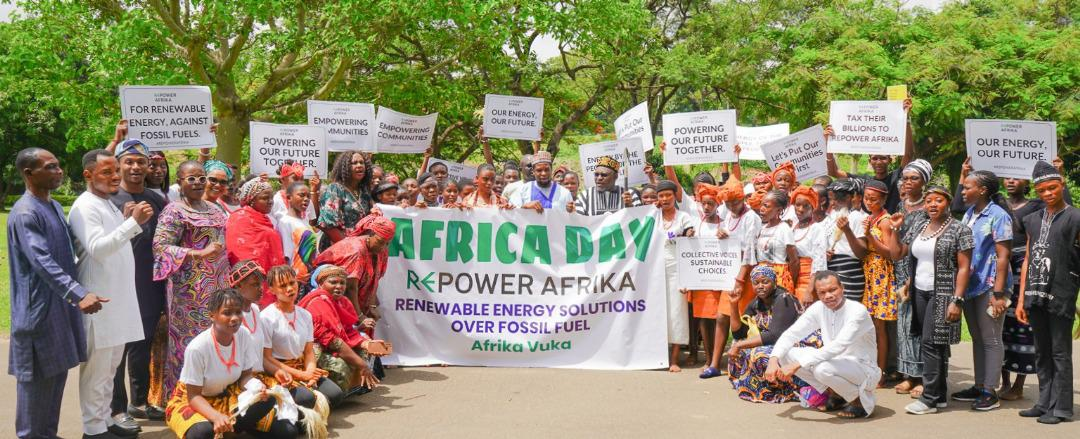
…calls for energy access for all amongst others
…celebrates Africa Day
By Favour Ulebor, Abuja
The Global Initiative for Food Security and Ecosystem Preservation (GIFSEP) Director, Michael Terungwa David, has said over 600 million people in Africa still live without electricity.
He said this during the celebration of Africa Day organised by GIFSEP on Thursday in Abuja, which brought together eight secondary schools in the Federal Capital Territory to honour African heritage and call attention to climate justice, renewable energy, and reparations for the continent.
He said the 2025 Africa Day theme, Justice for Africans and People of Africa Descent through Reparations, focuses on correcting historical injustices and building a sustainable path for future generations.
He noted that Africa is rich in sunlight, wind, and potential, but continues to suffer from energy poverty due to exploitation and foreign-controlled systems.
He said Africans are fighting against new oil, gas, and coal projects, corporate greenwashing, energy systems that deepen inequality and debt, and colonial development models that leave the continent in the dark.
He called for energy access for all, debt cancellation to fund real, public solutions, public funding for renewable energy — not more handouts to polluters, reparations for centuries of extraction and underdevelopment, and bold political will from African leaders to break from colonial energy models.
He said, “We are calling for REPOWER through Renewable Energy because energy access is a human right. Repower Africa! Not with coal or pollution, but with solar panels, wind farms, clean cookstoves, and green jobs.
“Africa is rich in sunlight, wind, and potential. Yet over 600 million people still live without electricity. Our energy systems were never built to serve the people of Africa, they were built to extract, export, and enrich the few.
“Whether it’s oil and gas for export, or expensive solar projects owned by corporations, our energy is still privatised, controlled by profit-driven companies, centralised and disconnected from communities.
“We must invest in clean energy that powers schools, homes and industries, supports our health, and builds a sustainable economy that respects both people and the planet.
“Today, we are here to display our culture. We have to celebrate the African Day by dressing in the traditional identity, eating African food and dancing.
“On this day in 1963, the leaders of independent African nations came together to form the Organisation of African Unity. Today, we gather here to celebrate with young Nigerians to teach them and remind ourselves that we are Africans not just to remember our past, but to fight for our future.
“To our African governments, we say: Prioritize the youth. Prioritize clean energy. Prioritize justice. What do we want: JUSTICE FOR AFRICANS AND PEOPLE OF AFRICA DESCENT THROUGH REPARATIONS.”
Speaking at the event, the Director of the Secondary Education Board, Dr. Muhammad Sanu Ladan, represented by Desk Officer, STAM Division, FCT SEB, Faisal Muhammad, said the event marked a solid milestone in the partnership with GIFSEP since 2019.
He said it also advanced skill acquisitions and educational opportunities, empowering young people with impactful knowledge for the future of work.
Cultural displays highlighted the day as students from GSS Gwarinpa, GSS Lugbe, GSS Mbappe, GSS Wuse Zone 3, Army Day School Maitama, School for the Gifted Gwagwalada, Government Day Secondary School Gwagwalada, GSS Zuba and GSS Tudun Wada performed traditional dances in Tiv, Igbo, Hausa, Yoruba, Fulani, and Gbagyi.
Disclaimer
Comments expressed here do not reflect the opinions of Vanguard newspapers or any employee thereof.