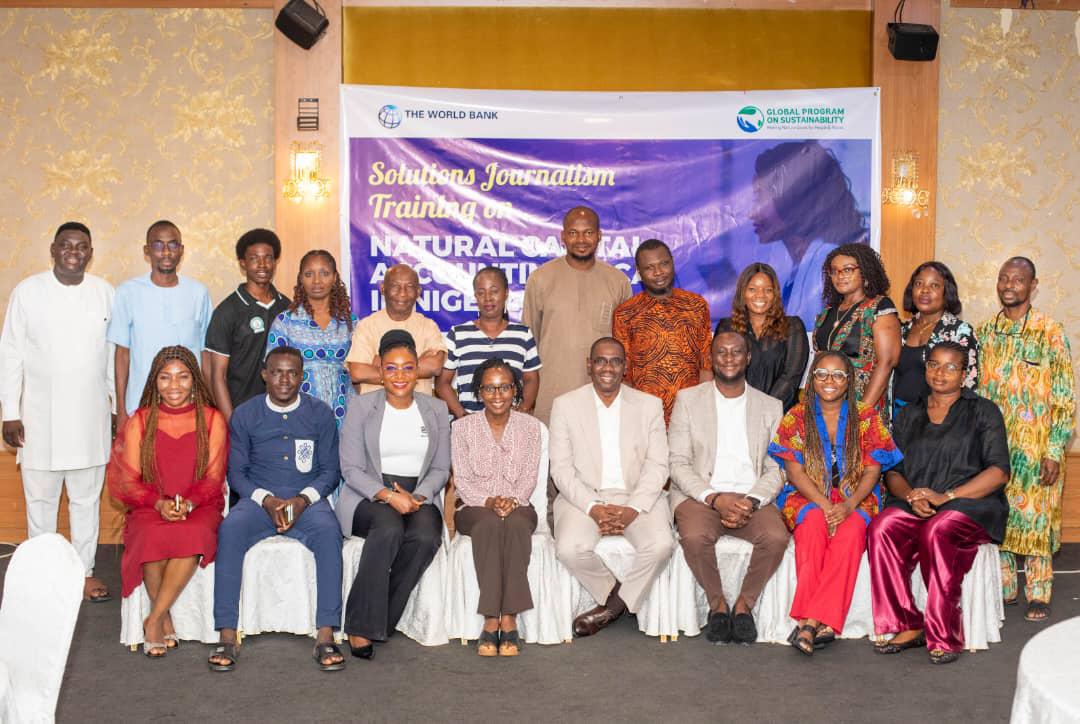
…as World Bank trains 17 journalists on Natural Capital Accounting
By Favour Ulebor, Abuja
In a bid to bridge the climate knowledge gap, an environmentalist from the World Bank, Ahmed Abudullahi, said the media is crucial to raising awareness and driving environmental accountability.
He said this during a two-day capacity training for journalists on Natural Capital Accounting (NCA) and sustainable reporting, organised by the World Bank in collaboration with Visualflow Media, on Thursday in Abuja.
The training aimed to equip participants with the knowledge and tools to report effectively on the economic and policy dimensions of natural capital in Nigeria.
Abdullahi, introduced NCA as a framework that measures and values a country’s natural resources to understand what it is worth in the environment.
He said journalists need to be trained to bridge the knowledge gap in society about natural capital, stating that capacity building and collaboration with stakeholders are necessary.
During his presentation, he said collaboration with stakeholders has helped build the capacity of government agencies for natural capital accounting.
Abdullahi noted that Nigeria’s NCA efforts have led to practical applications guiding national development.
He said the process was led by the National Bureau of Statistics in partnership with national and sub-national stakeholders.
He explained that accessing relevant data posed significant challenges that required a hybrid approach to reveal major environmental changes.
He said, “It is already being used to monitor environmental degradation and guide restoration efforts which forms the basis of our forestry intervention planning.
“Getting data that is suitable for our purpose was very difficult. It was settled that a hybrid approach is the best approach using SRCCI and Global Forest Management Dataset.
“Between 2015 and 2020, developing the land cover maps, a physical asset account, as well as the land cover check metrics, showing transitions between land types.”
He added that policy integration has begun to yield results in key sectors with stakeholder engagement cutting across government agencies and international organisations.
He said, “Already some institutions have started utilizing the output, helping in watershed management, landscape planning, and climate-smart agriculture in Kaduna and Nasarawa states.
“We have both national and sub-national members, the federal ministries, NASDA, National Council on Climate Change, state governments, World Bank, and UN Statistics Division.
“It allows us to embrace natural resources beyond traditional GDP… showcases the true picture of our economy including forests, land and water resources.”
He emphasised that a solutions journalism approach is needed to shape policy outcomes.
The Abuja Bureau Chief of The Cable,
Yekeen Akinwale, also shared insights into the role of solutions journalism in environmental reporting.
He described it as response-centered, evidence-based, and capable of providing transferable insights while acknowledging limitations.
He said, “It’s a rigorous, evidence-based approach to reporting that focuses not only on problems but also on how people are responding to those problems, telling the success stories of people in the community.
“Includes credible evidence showing how the response is making a difference, not just good intentions.”
He added that solutions journalism can shift narratives and drive systemic change in governmental and non-governmental actions and policies.
Disclaimer
Comments expressed here do not reflect the opinions of Vanguard newspapers or any employee thereof.