By Gabriel Ewepu
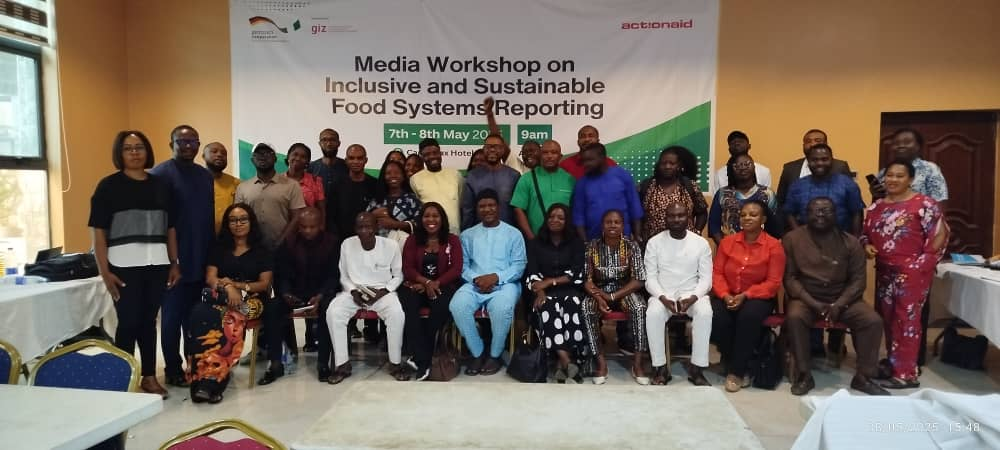
IN a bid to boost food production, ActionAid Nigeria, AAN, has built the capacity of journalists on inclusivity, investigation, analysis and issue-based reportage for the agricultural sector.
In an address of welcome by the Country Director, AAN, Andrew Mamedu, at two-day workshop with the theme ‘Media Workshop: Strengthening the Role of the Media in Promoting Investments in Inclusive and Sustainable Food Systems’, held on May 7-8, 2025, in Abuja, said the workshop funded by GIZ is to equip agricultural journalists with practical insights, including knowledge needed to report effectively on
agricultural, climate change, and inclusive decisions.
Represented by the Deputy Country Director, AAN, Suwaiba Dankabo, he pointed out that the work of journalists includes sharing of policies, mobilizing communities, and bringing visibility to critical issues, ensuring that no one is excluded from the table, and amplify thebvoices of farmers, which the workshop would focus on.
He said: “Nigeria stands at a pivotal crossroad. Our food system is under growing stress. From climate change, economic shocks, conflicts, and rising inequality. Yet, within these challenges lie powerful opportunities.
“Opportunities to build a more just, inclusive, and resilient agricultural system. But only if we act
boldly, collaboratively, and intentionally.
“This workshop, organized under the Inclusive Food Systems Project, under the funding of GIZ, and implemented by ActionAid Nigeria, is part of our broader commitment to ensure that Nigeria’s agricultural transformation is not only
sustainable, but also inclusive, especially for women, youth, and marginalized communities,
including persons living with disabilities.
“We aim to empower local farmers, enabling them to actively participate in decision-making and policy processes that impact their lives and their livelihoods.
“However, achieving this objective is impossible without strong, informed, and strategic communication. This is where you as media professionals become indispensable.
“You are not merely reporters, you are agents of accountability, storytellers who amplify the
voices of farmers, highlight their struggles and triumphs, and raise public discourse.
“Your work shares policies, mobilizes communities, and brings visibility to critical issues. Yes, agricultural and climate reporting in Nigeria remains under-resourced and under-represented in
mainstream media.
“Yet, this workshop is designed to address this gap. Over the next two days, you will be met with
the skills, tools, and practical insights, including knowledge needed to report effectively on
agricultural, climate change, and inclusive decisions.
“You will engage with experts, participate in hands-on exercises, and master storytelling techniques that go beyond the surface.
“More importantly, you will join a growing network of journalists committed to covering agriculture, not just as an economic sector, but as a justice issue, one that impacts equity, nutrition, livelihoods, and the dignity of millions, especially those who are engaged in the production of food and the effect of food.”
He further stated that, “We believe that a truly inclusive food system is one in which no other farmers, women farmers, youth, including persons with disabilities, and the most vulnerable, not only have voice, but also a stake.
“It is about who grows our food, who benefits from the system, and who gets left behind. It is about ensuring that no one is excluded from the table, whether in policy rooms or in the pages of our newspapers.
“This workshop also comes at a critical moment. Nigeria is advancing its national agricultural investment plan, aligning with continental frameworks like the Comprehensive Africa Agricultural Development Program and the role of media in tracking progress highlighting gaps and amplifying the voices of local communities is very, very critical.
“I encourage you to engage actively in these sessions, ask challenging questions, build connections, challenge existing narratives, and most importantly, reflect on how each story you tell can spark meaningful action and change, especially in the interest of women, youth, and persons with disabilities.
“Together, let us imagine a food system that works for everyone, not
just the powerful, but the poor, the rural, the women, and the youth. Let us transform not only how we eat, but how we grow, invest, and report.”
Also, GIZ’s Precious Jacdonm, in her special remarks, commended ActionAid Nigeria for the wonderful work it has been doing in the country, and particularly, organizing the workshop that brought over 30 journalists together for two days.
The resource persons extensively lectured and brought serious and in-depth issues that made participants to listen with rapt attention and gained from the contents presented to them in terms of projecting inclusivity, budgetary allocations, gender based treaties of Malabo and Maputu, (35 per cent Affirmative Action and 10 per cent budgetary allocation to agricultural sector) including issues on access to land, finance, farm inputs, and allowing women to lead in some policies and programmes in the agric space.
Food & Agriculture Programme Advisor, ActionAid Nigeria’s , Blessing Akhile, tasked participants on news, analysis and investigations that would change the narrative in the agricultural sector as she presented an overview of ‘ActionAid Nigeria Food and Agriculture Work: What We Do’.
Also, Food Systems Specialist, ActionAid Nigeria, Azubike Nwokoye, in a paper presentation on; “Understanding Inclusive Food System: What Makes Food System Inclusive? Power Dynamics in Food Production, Distribution and Consumption” as well as “Food System and Policy: National and International Food Policies (eg CAADP, UNFSS, FAO Frameworks) Tracking Budget Allocation and Policy Implementation, Holding Government Accountable, called on journalists to go the extra mile to ensure the policies in the agricultural sector are made equitable and implemented.
He recalled that the first decade of CAADP (2003-2013) presented both opportunities and challenges.
According to him, the National Agricultural Investment Plans, NAIPs, four regional plans were finalized, and 28 malnutrition, tripling intra-African trade, and building the resilience of livelihoods and agricultural BRs and recognized the critical role of infrastructure and rural development in renewed commitment to CAADP as it sets ambitious goals for 2025, including increasing livestock, forestry, and fisheries while acknowledging the importance of related sectors.
“However, the policies, programmes and projects implemented over the years have not substantially reduced the major constraints to agriculture. The sector still grapples with markets; widespread insecurity of agricultural land and investments; institutional
research; innovation and extension; low-quality inputs, limited access to finance and numerous challenges including limited awareness and adoption of productivity enhancing
technology; low agricultural productivity and value addition mainly due to inadequate
bottlenecks and weak policy implementation that lead to considerable food imports as
well as outbreaks of animal diseases”, he said.
In another presentation tagged ‘Gender & Food Systems: Women’s Roles and Barriers, Gender Sensitive Reporting’ delivered by Mrs Ebere Agozie, called urged journalists to focus more on gender, especially, women issues as it concern agricultural and climate change reportage, to showcase their tenacity, doggedness, resilience and innovations in the agricultural sector.
Also, an editor and well experienced reporter, Mojeed Alabi, opened the eyes of the participants as he presented papers on ‘Bridging Collaboration Barriers Between Agricultural Researchers and Journalists For Food Sustainability’.
Alabi pointed out that sensational news headlines should not be the major focus rather issues that touches on the policies, accountability, inclusive, and problem solving for the society.
The Communications Coordinator, ActionAid Nigeria, Okuwakemi Akinremi-Segun represented by Rolake Ogunfeitimi, presented ‘Media Framing & Language’, focusing on changing terminologies in the agricultural sector, which reporters and editors need to be conversant with in their reportage.
Disclaimer
Comments expressed here do not reflect the opinions of Vanguard newspapers or any employee thereof.