By Joseph Erunke, Abuja
A Professor of Petroleum and Gas Engineering at Nile University of Nigeria, Abdullahi Gimba, has called on African engineers and educators to take the lead in energy transition, digital reinvention, and addressing climate urgency, to drive the continent towards a net-zero future.
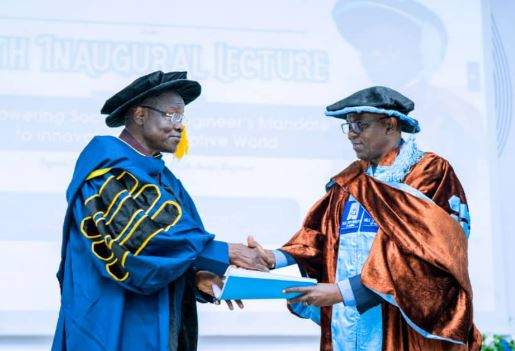
Gimba, who spoke during Nile University’s 4th Inaugural Lecture themed “Empowering Society: The Engineer’s Mandate to Innovate in a Disruptive World”, emphasized the need for Africa to transition from reactive adaptation to proactive leadership. He highlighted that the continent must produce engineers capable of transforming industries, not just fitting into them.
“We stand today at an unprecedented juncture—an era defined by accelerating energy transitions, existential climate challenges, pervasive digital transformations, and complex societal dynamics. These disruptions are not transient; they are structural and central to our collective future,” he stated.
Gimba stressed that engineering innovation is indispensable for sustainable development, inclusive prosperity, and lasting societal impact.
“Our calling as engineers, educators, and leaders is clear: to innovate courageously, responsibly, and purposefully, transforming disruption into a catalyst for growth,” he added.
He further advised educators to teach future leaders to design not just projects, but solutions worthy of the grand challenges of the era.
Drawing from his career in Petroleum Engineering, Digital Innovation, Energy Transition research, and Engineering Education, Gimba underscored the urgency for engineering to move from theory to practice—transforming it into an engine for equity, resilience, and national development.
The lecture urged participants to reimagine engineering as more than technical calculations—positioning it as a tool for compassion, creativity, and transformative societal impact.
“Today, the tide is upon us. It is the tide of Energy Transition, Digital Reinvention, and Climate Urgency. For engineers and educators alike, this is the pivotal moment—the high tide that must be seized,” he declared.
Reflecting on his journey, Gimba shared experiences ranging from compositional modeling and gas condensate optimization to mentoring students exploring hydrogen energy technologies, carbon sequestration pathways, circular economy solutions, and AI-driven diagnostics for oilfield optimization.
“As a university, as a nation, and as a continent, we must move beyond reactive adaptation to proactive leadership. We must prepare engineers who have the courage and capacity to transform industries, not just fit into them,” he said.
He also emphasized that in a world marred by misinformation and instability, engineers cannot remain neutral or amoral.
“Engineers are not merely designers of systems; they are stewards of the futures those systems shape. Our mandate must go beyond codes and calculations; it must include truth, compassion, and contextual wisdom.”
Gimba highlighted how Nile University of Nigeria is embedding sustainability, entrepreneurial thinking, and interdisciplinary collaboration into its curricula to prepare engineers for a rapidly evolving world.
“The engineer of tomorrow must embody technical proficiency, ethical clarity, and strategic vision—prepared to navigate and lead through complexities with compassion, creativity, and unwavering commitment.”
He also called for stronger partnerships between academia, industry, and policymakers to turn research insights into real-world solutions that address pressing societal challenges.
“We must cultivate ecosystems where research excellence meets industrial relevance and policy foresight, turning scholarly insights into tangible impacts.”
Gimba reaffirmed Nile University’s commitment, under the visionary leadership of Honoris United Universities, to fostering research excellence, championing interdisciplinary collaboration, and ensuring societal benefits.
“We pledge ourselves to leadership that is ethical and responsive, to innovation rooted in community realities, and to scholarly pursuits that elevate our nation and continent,” he added.
The event also featured remarks from Prof. Dilli Dogo, Vice-Chancellor of Nile University of Nigeria, who described the lecture as pivotal.
“We all agree that we live in a disruptive society. We have to be innovative, creative, and impactful, working with the government, society, and the private sector to build the country of our dreams.”
He emphasized the importance of research and innovation in driving renewable energy solutions and creating an impactful, solution-oriented society.
“Through research and innovation, we can create a society that is impactful, economy-driven, and solution-providing. That is why we are doing this.”
Prof. Dogo concluded by stressing the need for collaboration between the public and private sectors to drive an engineering-based economy that would contribute to Nigeria’s growth and global influence.
Disclaimer
Comments expressed here do not reflect the opinions of Vanguard newspapers or any employee thereof.