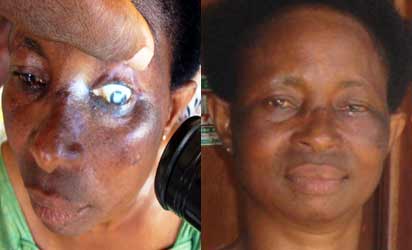
Owhotemu …Before and after the surgery
By Angela Nkwocha
The sheer number of people in need of eye surgery was staggering. For many of them, loss of sight simply crept in upon them in their waking moments while a good number had been nursing it for years.
Mrs. Obani Owhotemu, 47, and a widow who lives at 5, Akpo Road, Sapele, Delta State, had been partially blind for six years. She narrated her experience: “I didn’t notice I had eye ailment in good time. I woke up one morning to see some whitish substance coming out of my eyes. I went to the General Hospital where I was told I had cataract.
“They gave me eye drops to apply to the eyes but it didn’t work. Consequently, I sought assistance from a native doctor who also gave me medication but no relief. I returned to the hospital. This time the doctor at the General Hospital said relief on treatment depended on luck”.
After luck at the hospital failed, the widow resigned to fate. She thought she would go blind. But that was not to be. She regained her sight recently when Seplat, an oil firm, reached out to people with all sorts of eye defects in about 25 communities in Delta State under a six-week campaign tagged, Eye Can See CSR Initiative. The treatment was at no cost to the widow. The campaign targets 10,000 people suffering from sight impairment in Delta and Edo States where Seplat operates in.
The programme is an extension of SEPLAT’s community engagement initiatives which focus on bringing quality and comprehensive health care to members of her host communities.
The mammoth crowd that attended the first outing at Sapele on March 12, 2012 signposted in many ways what the company would be ‘seeing’ in the course of the campaign. Estimates from that flag off ceremony indicated that no less than 8,000 people would turn up and be attended to while those requiring eye surgery would account for about 1,000.
Putting the problem in perspective, the ophthalmological surgeon in charge of the programme, Dr. Isaiah Godwin, said: “The problem of the eye is enormous because studies shows that the prevalence of blindness is 1 per cent and if you take the Nigerian population of about 140 million people then 1 per cent of 140 million is 1.4 million which means that about 1.4 million are visually impaired and cataract takes about 50 per cent of that.”

Owhotemu ...Before and after the surgery
Francis Biokoro, 29, an unemployed graduate and another beneficiary of the Seplat initiative, had nursed partial blindness for one year. He, too, woke up one morning to discover a thing film of white covering his eye. Expatiating on this, Dr. Godwin said, “Cataract is the opacity of the natural lens, it blurs your vision but glaucoma is optic neuropathy. It’s a connection between the eye and the brain.
“It’s like when the eye sees anything, it sends information to the brain through the optic nerve. And it’s damage to that optic nerve that causes glaucoma. If your eyes are damaged by glaucoma, it is total blindness and you cannot reverse it.”
Fortunately for many, blindness caused by cataract is reversible even though the cost has always been a huge deterrent. It’s the reason many have lost their sight and many more would have been but for this intervention.
Speaking about what it costs to operate, Godwin stated; “Cataract costs between N50,000 and N100, 000 or sometimes N150,000 to N200,000 depending on the centre where you are doing it. There is no fixed price to it. Most people who are affected can’t afford the surgery and that is why we approach corporate bodies to come to their aid and take it up as part of their social responsibility; not just corporate bodies, individuals too can help sponsor these things because if you sponsor 10 cases of cataract in your local community, you have helped to reduce the cataract burden in the country.”
With over 400 free and successful eye surgeries performed at the first five centers, it was clear the impact such interventions as the SEPLAT Eye Can See Initiative can have on indigent people who go blind because they cannot afford the operation.
A total of 2,344 patients turned up in the first two days. Of that number, 929 patients went home with glasses for seeing and 29 were given reading glasses. Among those who were surgically operated upon, four were children, who suffered from congenital diseases of the eye or trauma.
Impressive as these figures appeared, it is only a tip of the iceberg, according to Godwin. “You cannot single-handedly solve the whole cataract burden, one corporate body cannot. About a month ago, we were here sponsored by the government and now we are here again and you can see the crowd. You can only do the little you can.
“So, the challenge is for everyone to get involved. You have your budget for this programme and if you exhaust your budget, you will stop, but if you are able to do 300 that means you have changed the lives of 300 people. If these numbers were all that had to be reported, so be it”.
The numbers are certainly more than 300, as SEPLAT extended its care to other patients who had no eye ailments. No less than 1,875 patients were diagnosed for hypertension; they were not just diagnosed but given drugs as well. Some 820 more were diagnosed and treated for diabetes, 468 were treated for glaucoma and four were diagnosed and given drugs for HIV. There were also 13 referrals.
The numbers will definitely cross the 10,000 man mark up by the time the SEPLAT train chugs into the last community. Word has spread fast and the hundreds that missed out in the previous communities will find their way to these places and get treated.
Disclaimer
Comments expressed here do not reflect the opinions of Vanguard newspapers or any employee thereof.