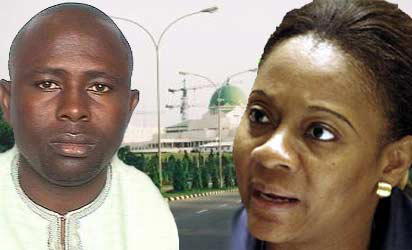
Rep. Herman Hembe & Ms. Arunma Oteh
By Douglas Anele
The kid-glove attitude to, and glamorisation of, high level corruption at the top echelons of business, politics, and other institutions of state by government implies that most public officials in Nigeria are corrupt, and that corruption is official in the country.
The ruling elite use different methods to cover up cases of graft involving top political officials and wealthy business people that have beenenjoying government’s patronage especially since 1985:these include plea bargain, granting of frivolous perpetual injunctions in favour of corrupt former governors, and shoddy investigation and prosecution of corruption cases by the police and other security agencies.
Meanwhile, the odious reputation of Nigeria as the Vatican City of corruption continues to be entrenched in the minds of both local and foreign investors. Now, Herman Hembe’s committee has been disbanded. The House of Representatives committee on Ethics and Privileges, led by Ibrahim El-Sudi, is already investigatingOteh’s allegations and will report back to the House within fourteen days.
Latest media reports claim that penultimate week, Hembe, while withdrawing from the chairmanship of the House committee on Capital Markets and other Financial Institutions, tendered three internal memos of SEC which suggest that the very idea of sponsoring the public hearing was conceived by the commission to “cement” the cordial relationship between it and the House committee on capital markets. According to these reports, when the idea was brought to her notice Oteh reportedly described it as “an excellent idea.”

Rep. Herman Hembe & Ms. Arummah Oteh
This opens a new window into the corruption allegation we are discussing, because if actually it is true that the issue of “assisting” the committee financiallyto carry out its oversight functions on SEC actually originated from the latter, then Oteh not only lied but miscalculated badly in bringing up the bribery allegation. Anyway, the same media reports assert that Hembe’s committee welcomed the move by SEC, and subsequently forwarded a budget estimate to it which amounted to N38, 418, 000.
Hembe’s quick invitation of the Economic and Financial Crimes Commission (EFCC)to probe the allegations against himself, withdrawal from chairmanship of the committee and presentation of documents purportedly indicting SEC for trying to influence his committeeat first glance seem reasonable and commendable.
Upon deeper analysis, however, it would be discovered that the issue is not that straightforward, because questions of sincerity of purpose, truthfulness and integrity rear up, both on the side of Hembe and the DG of SEC as well. First and foremost, the National Assembly, as indicated already, drips with corruption – there is no need to pretend about that.
Therefore, even if Hembe is truthful (and there is no good reason to accept as true all his statements on the issue) majority of Nigerians believe that his committee covertly demanded gratification from SEC. Secondly, if indeed the documents he tendered before the House are authentic, why did his committee welcome the commission’s overtures to “cement” their “cordial relationship”?
Why did he wait until Oteh’s damaging allegations before coming forward with the memos of SEC? And how did he get the documents in the first place, because he was not entitled to have them anyway? Hembe’s exultant invitation of the EFCC to investigate the allegations against his committee, in the light of what we know about the poor record of successful prosecution of VIPs accused of corruption, is suspect.
If we restrict our focus to members of the House of Representatives, one would want to know what the EFCC achieved in the corruption cases linked to Dimeji Bankole, Ndudi Elumelu, Nicholas Ugbane and others. Hembe knows that the EFCC is weak: the agency lacks the will, determination and competent staff to pursue corruption cases against members of the ruling cabals to their logical conclusion.
He is also aware that the Nigerian judiciary is decidedly corrupt, which implies that “judgment” can be sold to anyone willing to pay the price. Consequently, even if the EFCC succeeds in arraigning Hembe, the former committee chairman, with appropriate contacts in certain quarters, will be discharged and acquitted, just like James Ibori, Bola Tinubu and other well-known politicians were exculpated from corruption charges here in Nigeria.
In a worst case scenario, his retinue of morally bankrupt senior lawyers would delay his case ad nauseam till it is struck out for “want of evidence”and “lack of diligent prosecution.” The same considerations apply to Oteh also, perhaps to a lesser extent, because unlike Hembe she is not a politician.
As we indicated a moment ago Oteh adopted a wrong strategy if actually the idea of giving financial backing to the house committee on capital markets was that of her commission. Her allegations against Hembe might be true; equally Hembe’s allegation that it was SEC that sought to influence his committee might be true also. Only a thorough investigation by the relevant authorities will reveal the sordid truth, that is, whether Hembe or Oteh (or both) is guilty of corruption.
Meanwhile, I think that Oteh should be ashamed of herself for not asking Hembe to return the money and business class air ticket he collected from her commission immediately she discovered that the latter did notattend the conference in the Dominican Republic.
Her bringing up the issue at this time seems to me like blackmail; but more tellingly, it reveals how public officers entrusted with scarce resources waste these resources without proper accountability, as if the funds in question belong to nobody.
In a sane society, both Hembe and Oteh should have resigned from their positions. But this is Nigeria where people wear corruption as a badge of honour, where elected or selected public officials use their influence to get undeserved favours from both public and private institutions.
Some faceless “stakeholders” are already asking for ceasefire: they want the matter to be handled “with care in the interest of the capital market ant the economy as a whole.” Of course this is a veiled call for a cover-up so that the business of authority stealing would continue as usual.
Even so, no effort at concealment can clean up the stinking image of the National Assembly nor exculpate Oteh if, as a matter of fact, investigation confirms that SEC attempted to induce Hembe’s committee by offering to sponsor the public hearing. As Usman Dan Fodio remarked, conscience is an open wound, only truth can heal it. Nigerians and foreign investors too, are watching. CONCLUDED.
Disclaimer
Comments expressed here do not reflect the opinions of Vanguard newspapers or any employee thereof.