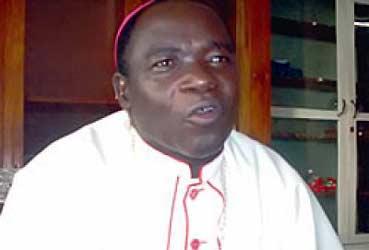
*Bishop Kukah
By Sam Eyoboka
LONG before Friday, June 10, 2011, when the Catholic Pontiff, Pope Benedict XVI appointed him bishop of Sokoto diocese to replace retiring Bishop Kevin Aje, former Vicar General of the Archdiocese of Kaduna, Bishop Matthew Hassan Kukah had endeared himself to Nigerians, not necessarily because of his priesthood but for magnanimously pitching his tent behind the oppressed; giving them hope and inspiration in both the Lord’s Vineyard and the nation.
Quite expectedly the Nigerian Media rose to salute a man who now oversees a diocese built in 1964 and a suffragan of the Archdiocese of Kaduna, covering a vast territory of 109,507 square kilometres harbouring about 44,366 Catholics who worship in 17 parishes with 32 Diocesan priests and seven religious priests, seven religious brothers and 28 religious sisters in addition to 39 major seminarians.
The activist-in-cassock priest has been at the vanguard of a crusade for a just and egaliterian society bereft of any prejudice. This is why it amazed not a few Nigerian journalists when Bishop Kukah—a creation of the Media—recently disparaged the nation’s Media for “constantly misleading people about Christians bombing churches or Muslims bombing mosques.”
While trying to justify his argument in a newspaper interview that the activities of Boko Haram in the North had no religious coloration, the Catholic bishop, who admited that “our country is in trouble”, would rather blame the Press for allowing itself to be manipulated by the same forces behind the evil against the nation. He did not, however, tell his interviewer how the Media is being manipulated and for what purpose.
From recent equivocations, the Catholic priest who is “interested in living in a secured country” appears to have some axe to grind with certain Christian leaders. “In the last few years, with the deepening crises in parts of Bauchi, Borno, Kaduna, and Plateau states, thanks to the international and national media, it has become fanciful to argue that we have crises between Christians and Muslims.
Sadly, the knee-jerk reaction of some very uninformed religious leaders has lent credence to this false belief. To complicate matters, some of these religious leaders have continued to rally their members to defend themselves in a religious war. This has fed the propaganda of the notorious Boko Haram and hides the fact that this evil has crossed religious barriers,” he said.

Bishop Kukah
Surprisingly, however, the bishop further surmised that “no one can claim a full understanding of the state we are in,” adding that the challenge is for us to have the patience to let God’s will be done. According to him, the activities of People Committed to the Propagation of the Prophet’s Teachings and Jihad, Jama’atu Ahlis Sunna Lidda’awati Wal-Jihad, better known as Boko Haram, have nothing to do with religion.
Haba! Bishop Kukah. Besides its name, the sect has been acknowledged as a jihadist terrorist organization founded by Mohammed Yusuf about 2001. The organisation is a Muslim sect opposed to man-made laws, seeking to abolish the secular system of government and establish Sharia law in the country.
True, the President of National Supreme Council of Islamic Affairs in Nigeria, NSCIA, and the Sultan of Sokoto, Sa’adu Abubakar, chairman of Northern Governors’ Forum and Niger State governor, Dr Mu’azu Babangida Aliyu, the Coalition of Muslim Clerics in Nigeria (CMCN), the Islamic Circle of North America, the Islamic Supreme Council of Canada, The Muslim Council of Britain, the Organization of Islamic Co-operation and the Council on American Islamic Relations have all openly voiced their condemnation of the group and described its activities as “anti-Islamic” and “an embarrassment to Islam.”
They have all criticised the group, saying “Islam is known to be a religion of peace and does not condone violence and crime in any form” stressing that the sect doesn’t represent Islam, but how have these sentiments changed the complexion of the group’s avowed ideology of imposing Sharia law on the entire nation beginning with the North?
According to Kukah, these are both troubled as well as promising times for Nigeria, “because amidst this confusing debris of hate, anger and frustration, we have had some very interesting dimensions. Nigeria is changing because Nigerians are taking back their country from the grip of maraud-ers….Christians are now publicly crossing the artificial lines created by falsehood and bigotry.”
Is that right? Every Nigerian is looking forward to a time when they can live and practice their trade and religion in any part of the country without fear of molestation. They want to apply and obtain a Certificate of Occupancy to build a worship centre in any part of the country as enshrined in the 1999 Constitution.
Admitted that saying Christians or Muslims are responsible for the mindless bombing of churches will not bring back the dead, but will the conspiracy of silence about who is responsible do?
How does Bishop Kukah help the Federal Government’s war on terrorism if he continues to posit that people do not commit crimes because of their faith, but rather they do so because they are criminals. Hmmmmm! In December 1996, a Christian Igbo trader, Mr. Gideon Akaluka was reportedly beheaded by Muslim youths in Kano because his wife was said to have torn a piece of the Islamic holy book to use as toilet paper.
The belief in many quarters is that there is only ONE way out of the current state of insecurity occasioned by orchestrated “falsehood and bigotry”: Truth and Justice. Which is why I agree with Bishop Kukah when he said the government has not done enough to address the issue, but men like him have not helped either.
To say that bombing of churches has nothing to do with religion, portrays him as one out of tune with realities on ground. Silence, they say, is golden if his current posture is intended, essentially, to please his new hosts.
Disclaimer
Comments expressed here do not reflect the opinions of Vanguard newspapers or any employee thereof.